AI Model Cost Optimization Platform
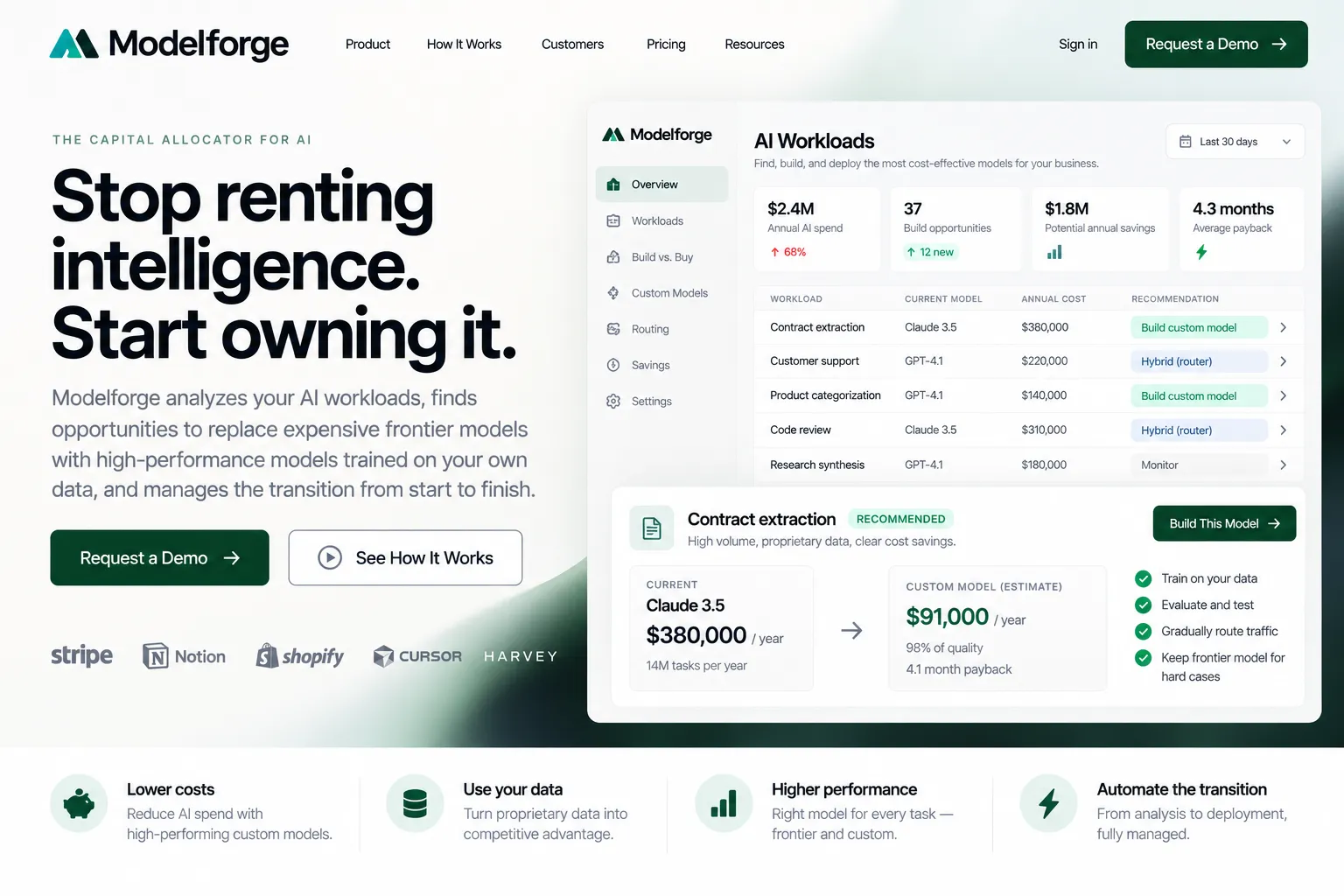
Companies are beginning to combine expensive frontier models with specialized open models trained on their own data, but deciding when to keep renting intelligence versus building it in-house is still a manual, one-off judgment. Build a capital-allocation layer that continuously watches an enterprise’s AI workloads, identifies tasks where volume, proprietary data, latency, and model spend make a specialized model economically attractive, then recommends or launches the transition and routes only the hardest cases back to frontier models. This matters now because model competition is compressing margins while post-training is making narrow models dramatically cheaper and good enough for more production work. Imagine a company spending $380,000 a year on contract extraction and the system showing that a custom model could match 98% of the quality for $91,000 a year with a four-month payback.
Description
No additional description provided.
The Pitch
The compelling part is that AI spend is becoming less like software spend and more like cloud infrastructure spend: variable, metered, and quietly wasteful at scale. Enterprises will not run everything on the most powerful model any more than they run every query on the largest database instance. The important question shifts from “which model is best?” to “which work deserves premium intelligence?” A company that answers that question continuously could become the cost governor for an era where cognitive labor is purchased by the token.
The non-obvious opportunity is that model choice is not only a technical decision; it is an economic timing decision. A workflow that is too small to justify a custom model in January may cross the threshold by June as usage grows, labels accumulate, latency requirements harden, and open models improve. Today, those inflection points are mostly invisible. The business works if it can notice when a repeated task has quietly become an asset: enough volume, enough proprietary examples, and enough predictability to stop renting general intelligence and start owning a cheaper, narrower substitute.
This also creates a new kind of enterprise memory. Most companies treat prompts, completions, corrections, escalations, and human overrides as exhaust. In reality, that exhaust is the training set for escaping dependency on expensive general models. The firm that organizes this residue can turn usage history into a map of where specialization is economically rational. That is powerful because the advantage compounds: the more work routed through the system, the clearer it becomes which tasks are stable, which need frontier reasoning, and which are ready to be carved off.
The best version of this business would not be loved because it saves money once. It would be trusted because it prevents overpaying from becoming the default operating model of AI adoption. Frontier models will keep improving, but that does not mean they should do all the work. In many enterprises, the winning architecture will look like a thin layer of expensive judgment sitting above a large base of cheap competence. Whoever manages that boundary manages one of the most important cost structures in the AI-native company.
The deeper appeal is that it gives enterprises a way to benefit from model abundance without becoming model experts. As intelligence fragments into thousands of specialized options, the scarce capability is no longer access to models, but knowing when each one is economically justified. That is a durable role: not building the smartest model, but deciding how much smartness each task deserves.