AI Medical Research Assistant for Patients
Healthcare still treats patients using generalized protocols even though every disease behaves differently across individuals. Patients spend months searching forums, reading papers, and coordinating specialists while valuable research continues to emerge every day. Imagine an AI research platform that builds a personalized medical knowledge graph for every patient, continuously monitors new studies, compares treatment pathways, identifies relevant clinical trials, and generates evidence-backed questions for physicians. Rather than replacing doctors, it becomes an always-on research partner for patients facing complex conditions. As AI becomes dramatically better at scientific reasoning and literature review, personalized medical research becomes possible for everyone instead of only elite research hospitals.
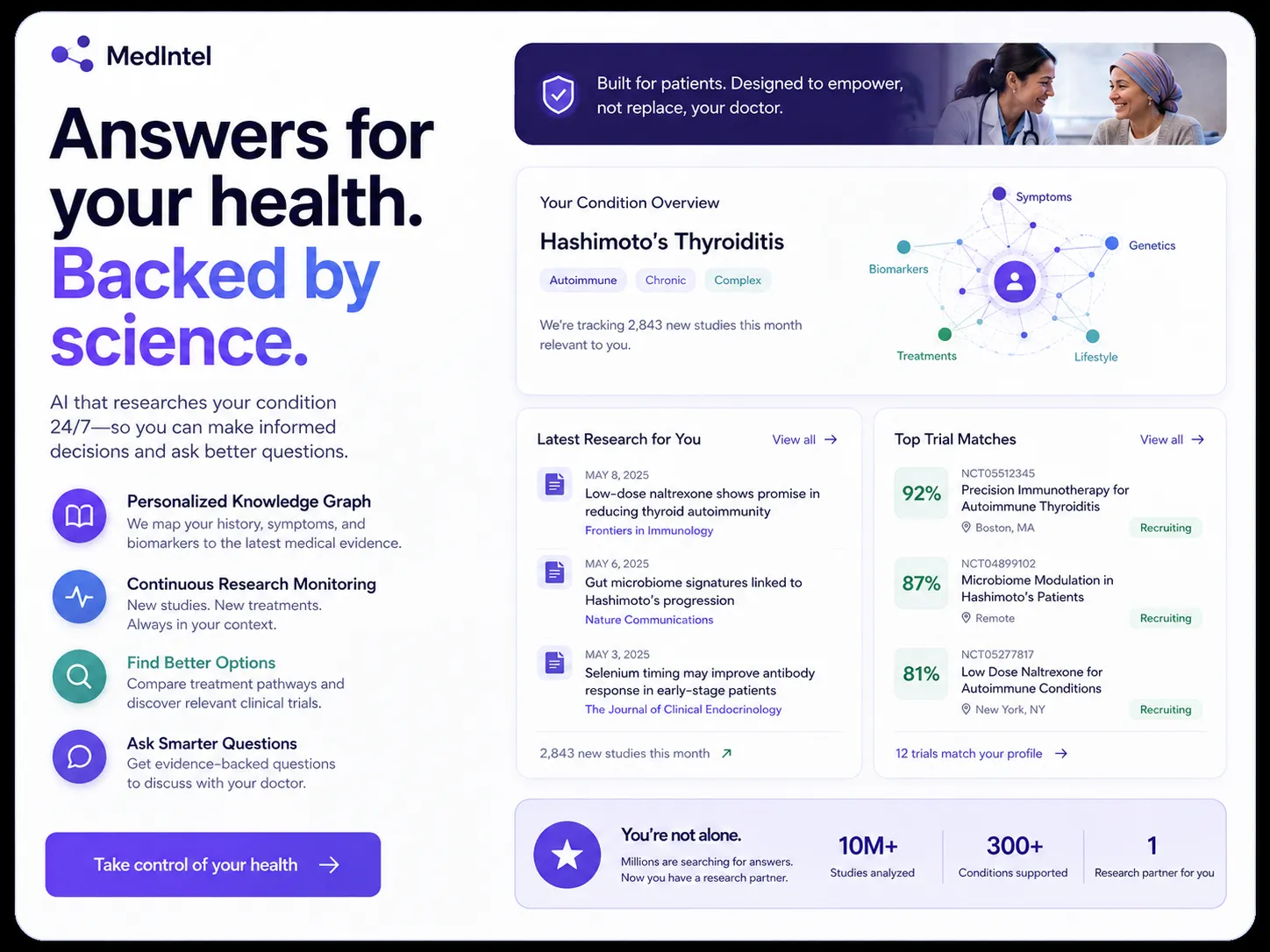
Description
No additional description provided.
The Pitch
Serious patients are already doing medical research; they are just doing it badly, alone, and under extreme emotional pressure. The alternative to a structured AI research partner is not a calm conversation with a perfectly informed doctor. It is Reddit threads, PubMed abstracts half-understood at midnight, disease-specific Facebook groups, and fragmented second opinions. A business that makes patient-led research safer, more organized, and more clinically legible is not creating a new behavior so much as professionalizing an existing one.
The deepest value would come from translating between two worlds that currently fail to meet. Patients experience illness as a continuous, personal, high-stakes narrative: symptoms, side effects, family history, failed therapies, risk tolerance, logistics, fear. Medicine often processes that reality through short visits, billing codes, standard pathways, and incomplete records. A personalized knowledge graph could become the missing memory layer: not just a file cabinet, but a living model of what has been tried, what matters, what is plausible, and what should be asked next.
This could be especially powerful because the frontier of care is increasingly defined by exceptions. Cancer subtypes, autoimmune overlap, rare disease genetics, treatment-resistant psychiatric conditions, long Covid-like syndromes, fertility complications, and drug interactions all expose the limits of average-case medicine. The more granular biomedical knowledge becomes, the harder it is for any single clinician to keep up across every edge case. A patient-specific research system becomes valuable precisely where standardization starts to blur.
The business would also benefit from a rare alignment of emotional urgency and recurring need. People facing complex diagnoses are not casually browsing for wellness tips; they are trying to make irreversible decisions with partial information. Each new lab result, scan, symptom, paper, or failed treatment changes the question. That creates a durable use case: not a one-time search, but an ongoing companion through uncertainty.
Its trust would depend on restraint. The winning version would not pretend to diagnose, prescribe, or outsmart physicians. It would make the patient more prepared and the doctor visit more productive. In healthcare, the most valuable AI may not be the one that gives the final answer; it may be the one that helps humans ask better questions before the window to act closes.