AI Market Intelligence Platform for Specific Industries
The most valuable information in fast-moving industries isn't public—it's scattered across patents, hiring trends, supply chains, earnings calls, satellite imagery, and thousands of expert conversations that no one has time to connect. Imagine an AI platform dedicated to a single industry that continuously gathers these signals, identifies what competitors are actually doing, predicts where the market is heading, and delivers institutional-quality intelligence to anyone in the field. As AI makes it possible to synthesize massive amounts of fragmented information, every major industry deserves its own Bloomberg built specifically for that market. That's a product that needs to exist.
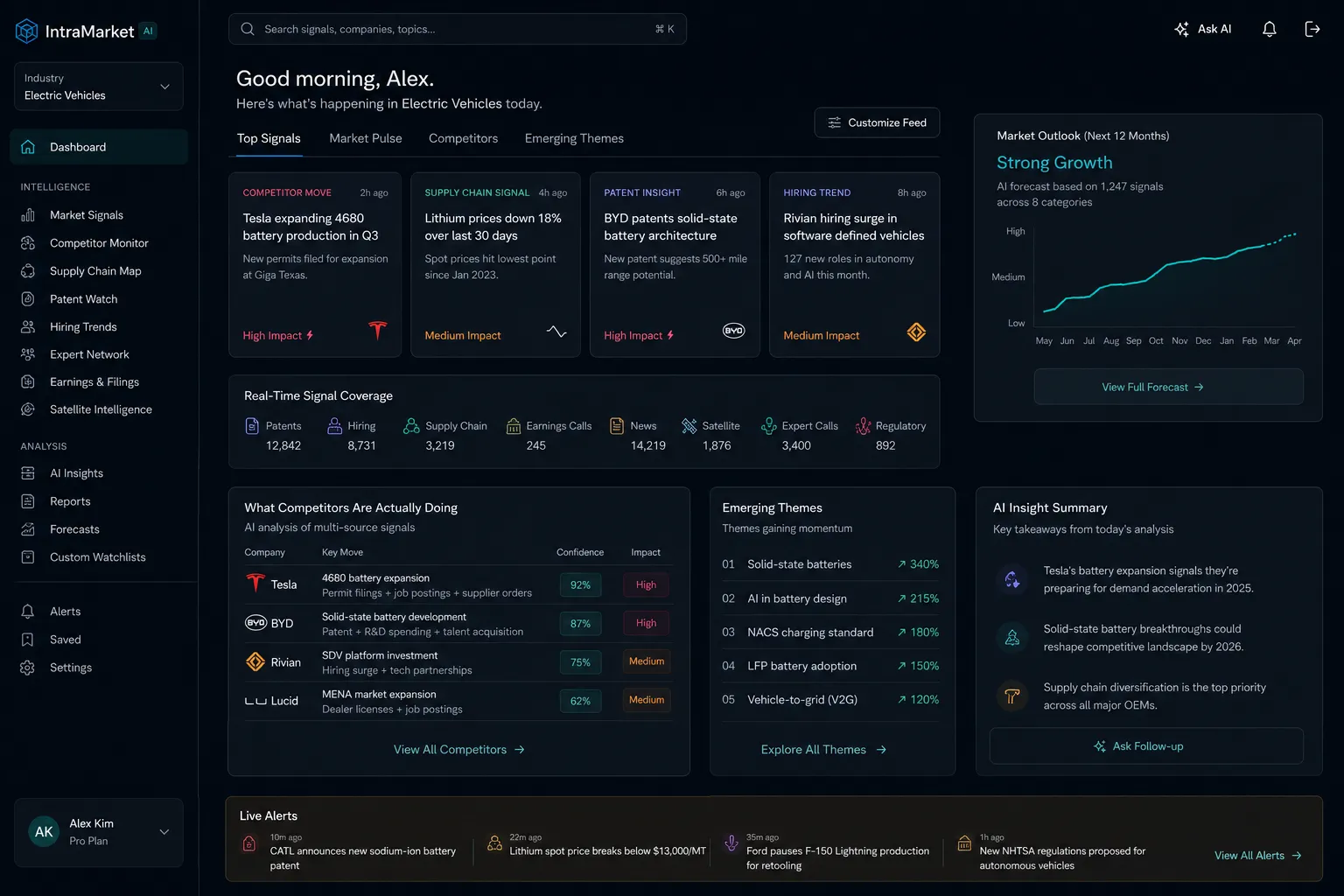
Description
No additional description provided.
The Pitch
Industry knowledge has become too abundant to be legible. The scarce asset is no longer access to information, but the ability to notice which weak signals matter before everyone else does. A company that turns scattered evidence into a living map of an industry would sit at the point where attention, timing, and money all converge. In fast-moving markets, being six months early can look like genius; being six months late can look like incompetence.
The most interesting customers would not buy this because they want more reports. They would buy it because their existing information systems are backward-looking. Most organizations still learn about market shifts through conferences, relationships, quarterly disclosures, and internal anecdotes, all of which arrive filtered and delayed. A dedicated intelligence system could become valuable precisely because it watches the unglamorous places where reality leaks out first: job descriptions, component orders, regulatory filings, patent language, supplier chatter, customer complaints, obscure technical forums. The edge comes from treating these fragments not as trivia, but as early evidence of strategic intent.
This kind of business could also compound in a way that general-purpose AI tools do not. Each industry has its own vocabulary, hidden causal relationships, recurring characters, and misleading signals. In semiconductors, one phrase in a job posting may imply a major product shift; in pharmaceuticals, a trial design detail may matter more than a press release; in energy, local permitting activity may say more than executive commentary. The more narrowly the system understands the industry, the more it can distinguish noise from consequence. Depth becomes the product.
There is also a subtle power shift in making this intelligence broadly available. Today, the best market understanding is often trapped inside large incumbents, elite funds, or informal networks of insiders. A vertical Bloomberg would let smaller operators see patterns that were previously reserved for those with armies of analysts and privileged access. That does not just make better decisions possible; it changes who gets to participate seriously in an industry.
The business works if it becomes part of how professionals form conviction. Not a place to look up facts, but a place to test whether the world is moving the way they think it is. The enduring value would come from becoming the shared nervous system of an industry: always watching, always contextualizing, and quietly redefining what it means to be informed.