AI Legal Claims Platform for Spam Calls
Spam calls continue costing consumers time despite existing call blockers because many unwanted calls still make it through, often violating telemarketing laws in the process. Lenny 3.0 transforms every spam call into a potential legal claim by using AI to continue the conversation after the user hangs up, extracting information about the company behind the call while recording, transcribing, and organizing evidence automatically. Once enough information has been gathered, the platform forwards everything to partnered law firms that pursue violations of telemarketing regulations, with users receiving a portion of any recovered settlements or statutory damages. As conversational AI, voice cloning, and automated legal workflows rapidly improve, it has become possible to create an autonomous agent that not only wastes scammers' time but also builds actionable legal cases with little user involvement. Instead of being frustrated every time your phone rings, spam calls quietly become another source of passive income while helping discourage illegal telemarketing.
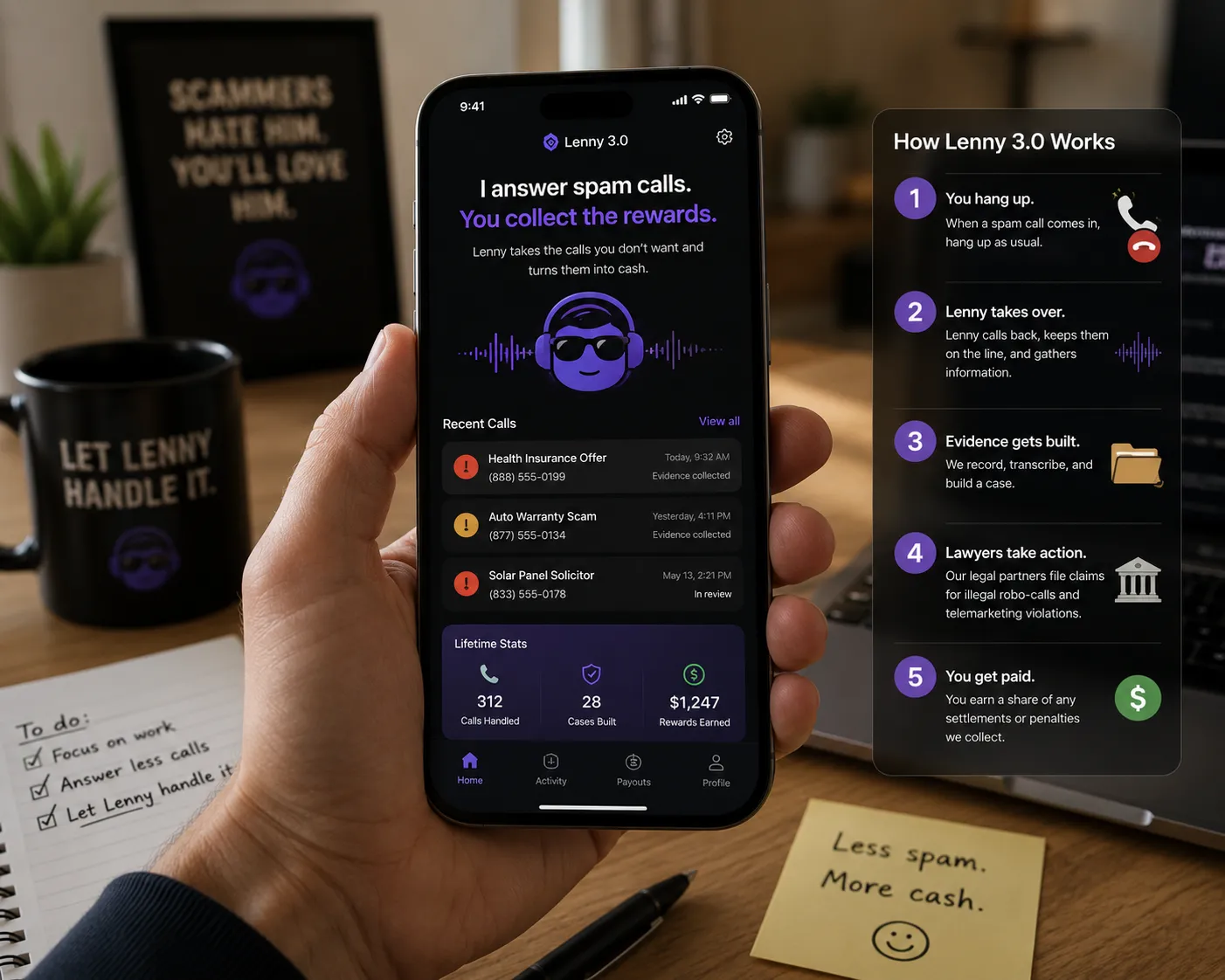
Description
No additional description provided.
The Pitch
Today, the caller pays almost nothing to create a nuisance, while the recipient absorbs the time, interruption, and irritation. This business works if it can invert that asymmetry: every illegal call becomes a small liability event for the caller, and enough small liability events can make an abusive channel more expensive to use.
The most interesting insight is that spam calls already contain the raw material of enforcement, but it evaporates in real time. A consumer may hear a company name, a callback number, a product pitch, a disclosure failure, or evidence of consent violations, but none of it is captured in a form a lawyer can easily use. The business would be valuable because it turns a chaotic, annoying conversation into structured evidence. It is less a call-blocking product than an evidence factory attached to the phone network.
There is also a behavioral trick at the center of it. People do not want to become private attorneys general; they want to hang up and go back to their lives. The product is compelling because it lets the consumer do exactly what they already want to do, while the machine does the patient, tedious work that legal enforcement requires. That matters because most consumer-protection rights are theoretically powerful but practically dormant. The bottleneck is not outrage; it is effort.
If the system became widely used, its value could compound in a way ordinary spam filters do not. One person’s call might reveal a shell company, script, lead buyer, or campaign that helps identify dozens or thousands of related violations. The calls are annoying precisely because they are industrialized; that same industrialization makes patterns discoverable. A database of conversations, entities, voices, numbers, scripts, and disclosures could become more useful with scale, not just for individual claims but for seeing the machinery behind the calls.
The deeper business thesis is that consumer attention has been treated as free inventory for bad actors. This company would put a meter on it. Not by asking consumers to fight harder, but by making the unwanted interaction legible to the legal system. If it worked, the phone would remain a weak point for intrusion, but it would no longer be a costless one.