AI Learning Planner for Career Skills
The people AI replaces won't necessarily be the least talented—they'll be the ones who stop learning. Today, professionals are left to guess which tools, skills, and technologies actually matter. Imagine an AI copilot that watches your industry in real time and builds your curriculum for you. It notices competitors adopting new workflows, tracks emerging tools, identifies the skills becoming obsolete, and delivers a personalized 30-minute learning plan every morning. Rather than another online course, it becomes your operating system for staying ahead of your profession before everyone else catches up.
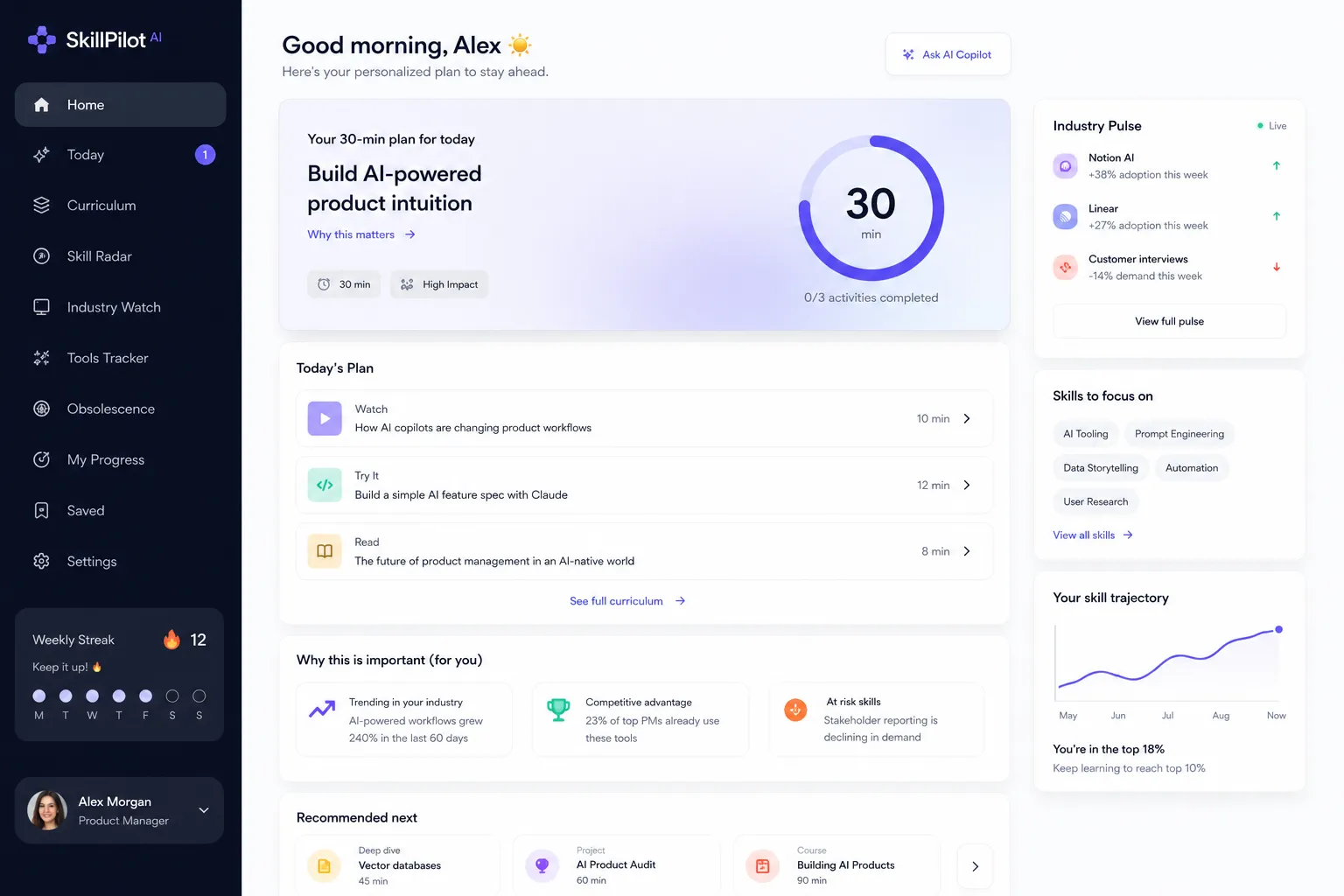
Description
No additional description provided.
The Pitch
Professional education has shifted from a periodic event to a daily survival function. The old model assumed a person could learn a body of knowledge, apply it for years, and refresh it occasionally. That assumption is breaking. In many fields, the half-life of useful knowledge is becoming shorter than the planning cycle of traditional training departments, universities, and certification bodies. A company that turns learning into a continuous sensing layer would not just sell content; it would sell orientation in a labor market that increasingly feels impossible to read.
The most valuable learning signal is no longer what an expert says you should study. It is what the market is quietly beginning to reward. A tool that can observe which workflows are spreading, which job descriptions are changing, which software is appearing in teams like yours, and which tasks are being automated has a stronger claim on relevance than any static curriculum. The insight is that the curriculum of the future may be inferred from behavior before it is formally named. By the time a skill becomes a course category, the advantage may already have moved elsewhere.
This also works because people do not fail to learn only from lack of motivation. They fail because choosing what to learn has become its own exhausting job. The internet made instruction abundant, but it did not solve prioritization. In fact, it made prioritization worse. A professional does not need another library of courses as much as they need someone to say, “Ignore these 200 things; spend today on this one.” The product’s value would come from compressing the anxiety of infinite optionality into a small, trusted daily action.
The business would become more defensible the more personal and contextual it became. Two people with the same title may need entirely different learning paths depending on their company’s tools, their competitors, their geography, their seniority, and their ambitions. Generic courses treat a profession as a category; this would treat a career as a live system. Over time, the product could know not just what is changing in the world, but which changes matter specifically to you.
The deeper opportunity is that work is becoming less defined by credentials and more by adaptability. A service that helps people notice change early, interpret it correctly, and respond before it becomes obvious would occupy a rare emotional position: not entertainment, not productivity, but professional self-preservation. In a world where AI makes many capable people feel newly fragile, that is a powerful place for a company to live.