AI Knowledge System for Nuclear Reactor Technicians
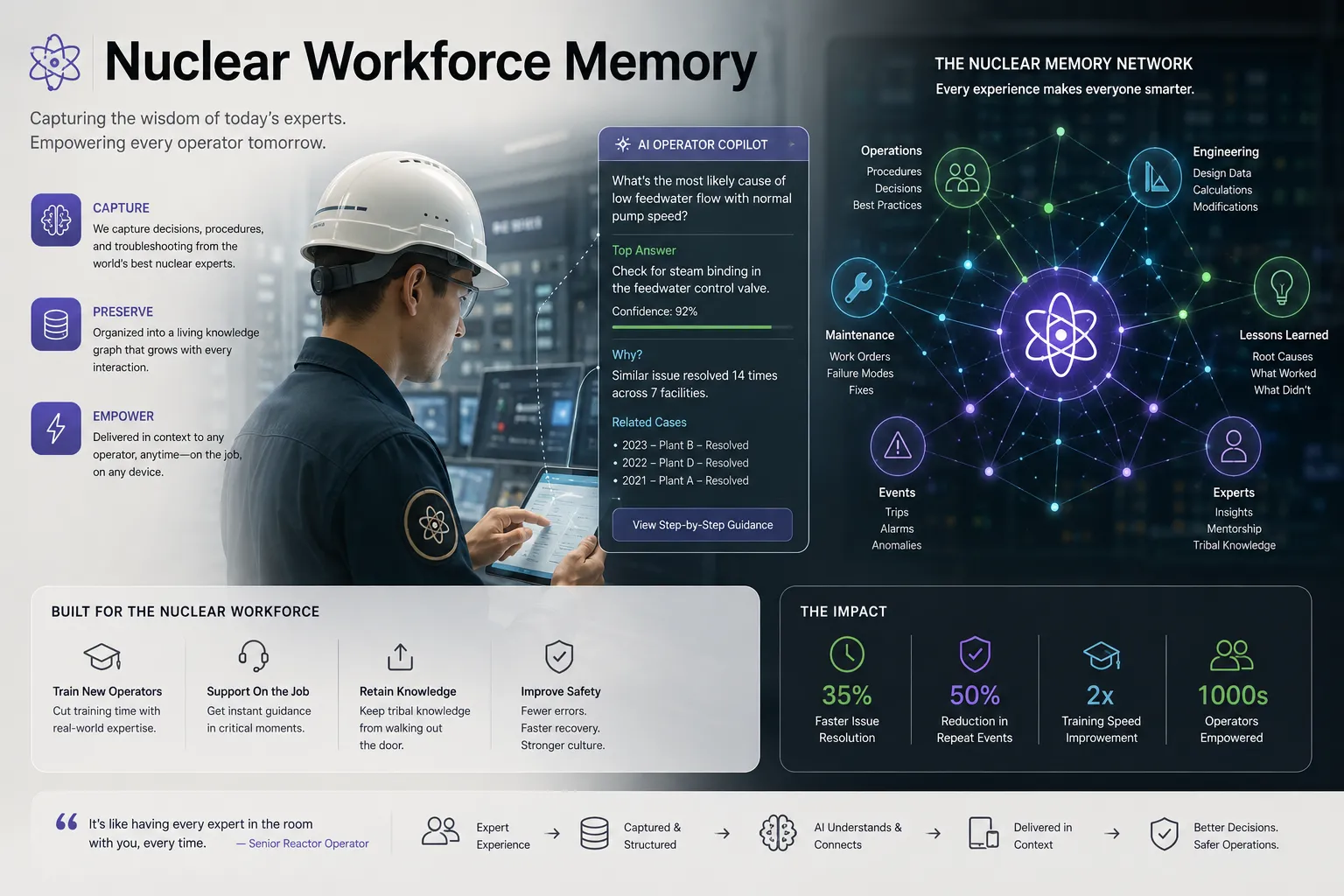
The biggest obstacle to scaling nuclear energy may not be manufacturing reactors but manufacturing expertise. Much of the knowledge required to safely operate and maintain reactors lives inside the heads of a relatively small number of experienced engineers approaching retirement. This startup creates an AI memory layer that captures how experts diagnose problems, perform maintenance, and make operational decisions so every future technician can instantly access decades of institutional knowledge. The timing is right because small modular reactors could multiply the number of operating facilities long before the workforce can scale. A technician facing an unfamiliar equipment issue could receive guidance based on nearly identical situations encountered years earlier at reactors across the world.
Description
No additional description provided.
The Pitch
nuclear expertise is not just scarce; it is unusually hard to transmit. In most industries, a retiring expert can be replaced with documentation, training, and a few years of apprenticeship. In nuclear operations, the valuable knowledge is often situational: the faint pattern of readings that suggests one failure mode rather than another, the maintenance shortcut that is safe only under specific conditions, the memory of a similar anomaly that never made it into a manual. The business works if it turns judgment, not just information, into durable infrastructure.
The deeper opportunity is that nuclear has a coordination problem disguised as a labor problem. Each plant learns from its own history, incidents, vendors, and operators, but much of that learning remains local. If a maintenance issue has appeared five times across different facilities, the sixth technician should not experience it as a novel event. A trusted memory layer becomes more valuable as more plants contribute to it, because the rare cases are exactly the ones where shared memory matters most. In a field built around preventing low-probability, high-consequence failures, access to obscure precedent can be worth more than access to generic expertise.
This is also one of the few places where AI’s most commercially useful role may be conservative rather than creative. Nuclear operators do not need a system that improvises; they need one that remembers, retrieves, compares, cites, and knows when uncertainty is too high. That makes the product more defensible than a general assistant, because its value depends on provenance, trust, regulatory usefulness, and deep integration with operational records. The intelligence is not merely in the model, but in the curated history of decisions and the social permission to rely on it.
If small reactors expand the number of nuclear sites, the industry may shift from a world of a few large, deeply staffed plants to many more distributed facilities with thinner local expertise. That changes the bottleneck from building equipment to replicating confidence. A company that lets a newer technician inherit the pattern recognition of a veteran workforce would not just reduce downtime or training cost; it would make the whole category easier to scale. The most important asset in nuclear may become a shared memory of what has already gone wrong, and what the best people did next.