AI Knowledge Graph for Creative Analogies
The best ideas often come from connecting concepts that seem completely unrelated, but discovering those connections depends on years of experience or endless research. Imagine an AI knowledge graph built specifically for creativity that maps relationships across science, history, mythology, engineering, linguistics, psychology, nature, and thousands of other domains, surfacing unexpected analogies whenever you're solving a problem. Designing a fitness app might borrow ideas from aviation, while naming a financial product could be inspired by marine biology. As AI gains the ability to reason across massive knowledge bases instead of simply retrieving facts, creativity becomes less about what you already know and more about what the system can connect for you.
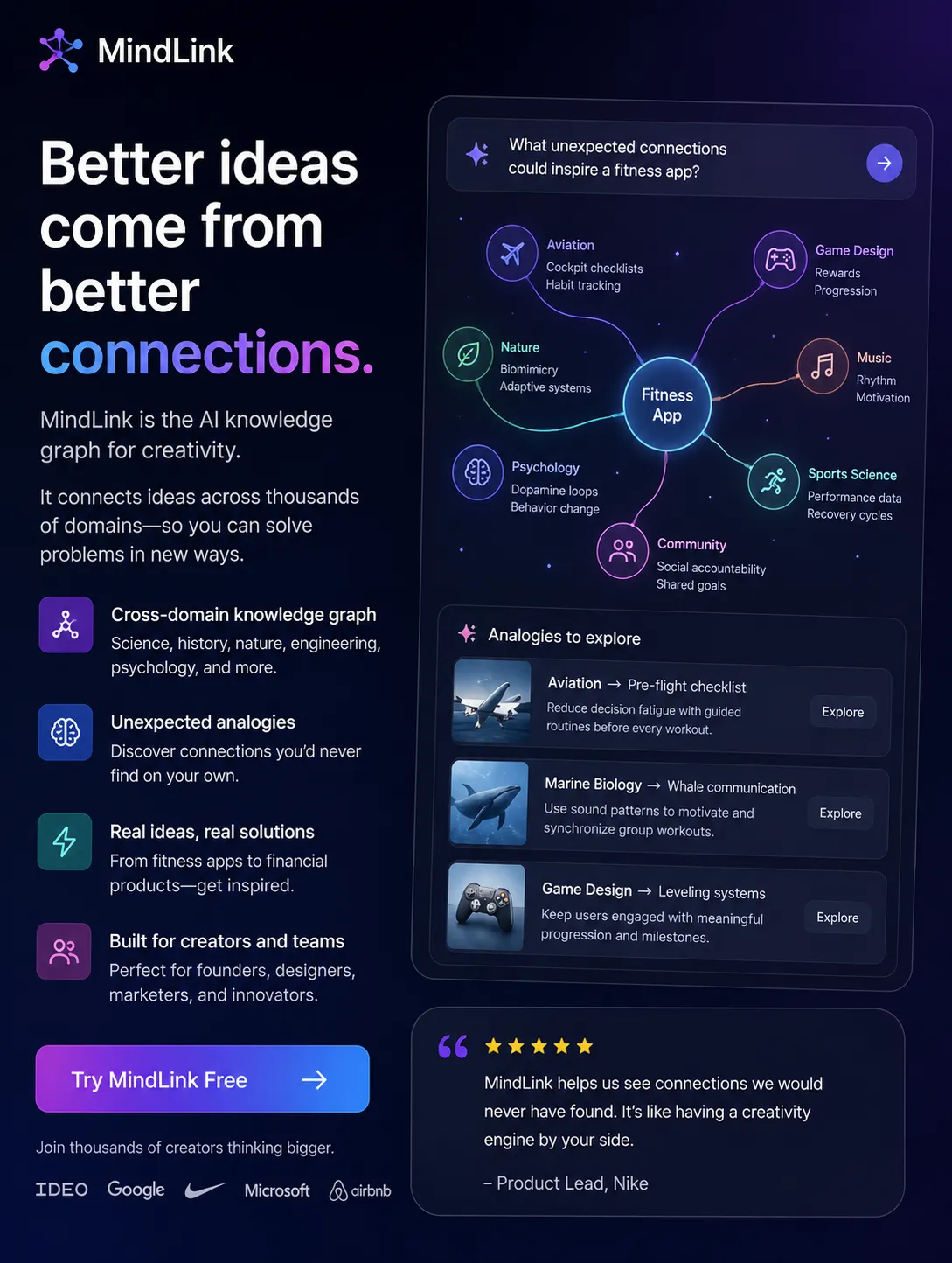
Description
No additional description provided.
The Pitch
A new kind of instrument for escaping the limits of one’s own mental neighborhood. Most professional creativity is constrained less by lack of intelligence than by the smallness of the reference pool people happen to carry around. A designer, strategist, founder, scientist, or writer usually recombines what they have seen before. The valuable product here is not information access, but controlled estrangement: a way to make the familiar feel strange enough that new solutions become visible.
The interesting business insight is that analogy is one of the few creative acts people consistently value but rarely have a systematic way to produce. Teams already pay for consultants, workshops, research reports, trend decks, naming agencies, and brainstorms largely to import patterns from outside their default frame. A system that can reliably say “this problem has the same shape as that unrelated phenomenon” would compress a surprisingly expensive and inconsistent human process into something repeatable. The buyer would not be paying for answers; they would be paying for better starting points.
This could become especially durable because the knowledge layer compounds in a way ordinary creative tools do not. A blank-page writing assistant is only as good as the immediate prompt, but a cross-domain graph can improve as it learns which analogies actually helped people move forward. Over time, it could distinguish between connections that are merely surprising and connections that are structurally useful. That distinction is the heart of the product: novelty is cheap, but relevant weirdness is rare.
The company would also occupy an unusual position in the creative workflow. It would sit before execution, before design, before copy, before strategy documents—at the moment when the shape of the idea is still fluid. Tools that influence this stage can become quietly powerful because they affect everything downstream while remaining hard to replace once teams build habits around them. If a product becomes the place people go when their thinking feels stale, it earns a role closer to a creative companion than a software utility.
The broader thesis is that as execution becomes increasingly automated, taste and reframing become more valuable. When anyone can generate a polished concept, the advantage shifts to people who can ask from a more interesting angle. A business that helps users discover those angles would be selling a scarce cognitive resource: not knowledge itself, but the ability to make knowledge collide in productive ways.