AI Insurance Loss Data Cooperative
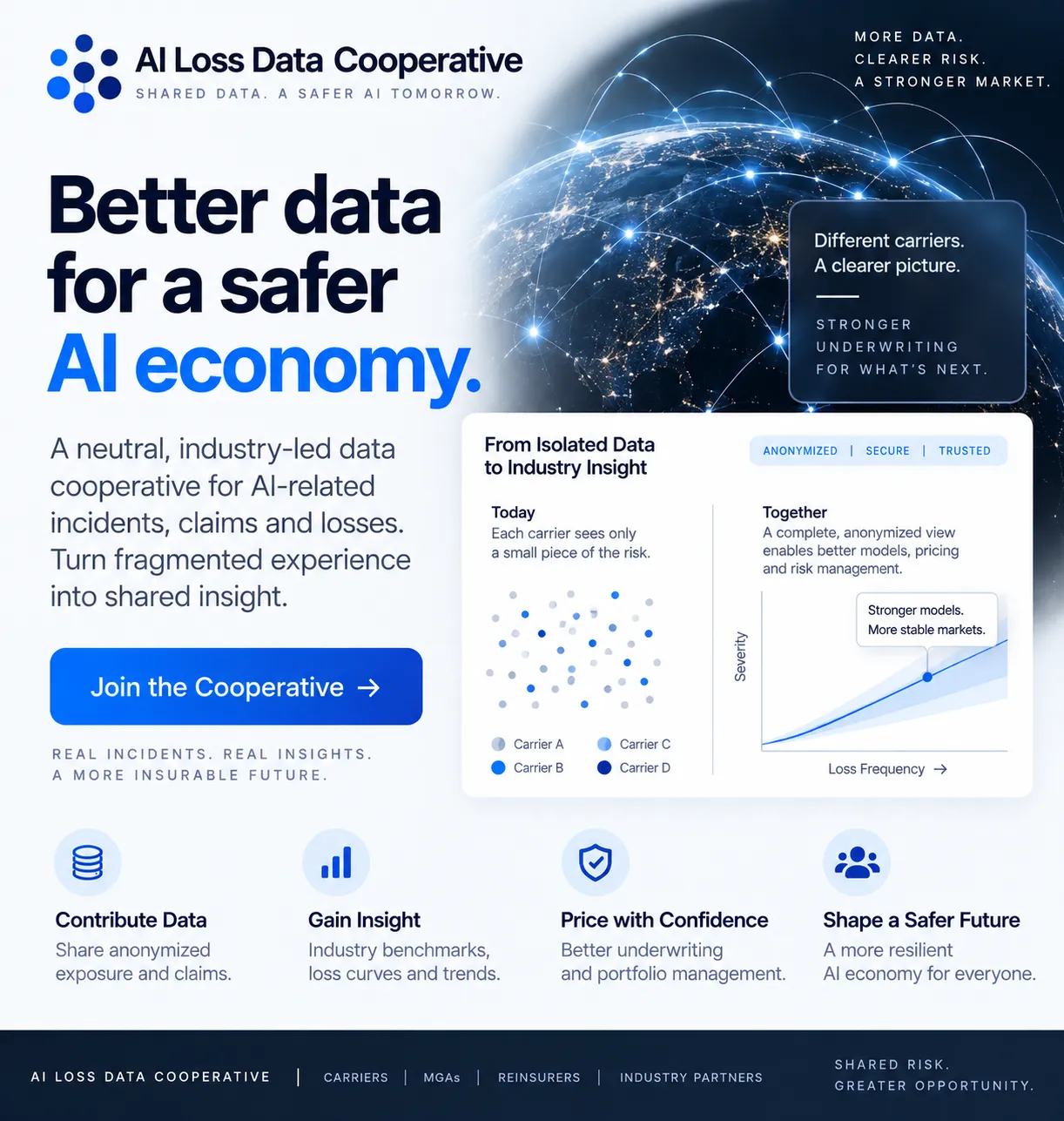
AI insurers are trying to price a risk almost nobody has enough history to understand. Every carrier sees only its own small slice of agent incidents, claims and losses, while the useful signal sits across the entire market. Build a neutral AI Loss Data Cooperative where carriers, MGAs and reinsurers contribute standardized, anonymized exposure and claims data in exchange for industry benchmarks, loss curves and underwriting insight. The product would connect what an agent was allowed to do, what controls were in place, what actually failed and how much the loss cost. Cyber insurance became much easier to price once the market accumulated real loss history. Autonomous software will need the same thing, but the first valuable dataset may have to be built collectively.
Description
No additional description provided.
The Pitch
AI risk has the wrong shape for traditional insurance learning. A carrier can wait years to build its own claims history and still end up with a distorted picture, because the most important failures may be rare, clustered, or hidden inside someone else’s book. The market is being asked to insure systems that can act across finance, healthcare, law, customer operations, and software infrastructure, but each insurer is effectively looking through a keyhole. A shared loss memory turns underwriting from isolated guesswork into a compounding information asset.
The unusual power of this business is that its value increases precisely where competition alone cannot solve the problem. Insurers compete on risk selection, pricing, distribution, and capacity, but they have a common interest in not mispricing an entire emerging category into either paralysis or catastrophe. A neutral cooperative could sit in that narrow zone where sharing does not destroy differentiation; it improves the baseline facts everyone needs before they can compete intelligently. The business works if it becomes trusted plumbing for an industry that cannot afford to learn only from its own accidents.
The most interesting data will not be the headline-grabbing incidents. It will be the connective tissue between permission, control, failure mode, and loss. Two AI agents may both “make an unauthorized transaction,” but the underwriting meaning changes completely depending on whether the failure came from prompt injection, weak approval thresholds, excessive tool access, poor logging, model drift, or human override failure. If the cooperative can translate messy incidents into a shared taxonomy of causal patterns, it becomes less like a database and more like the actuarial grammar for autonomous systems.
There is also a timing advantage hidden in the immaturity of the category. Once every carrier has invented its own definitions, exclusions, and incident labels, standardization becomes political and expensive. Early on, before habits harden, the entity that defines the reporting language can shape how the whole market sees the risk. In insurance, categories are not merely described; they are manufactured through forms, codes, benchmarks, and loss tables. Whoever helps make AI losses legible may become part of the market’s operating system.
The deeper thesis is that autonomy will create insurable risk faster than individual institutions can privately understand it. A business that converts scattered failures into shared actuarial knowledge would not just sell data; it would make an insurance market possible. That is a rare position: valuable not because it owns the risk, but because it teaches everyone else how to see it.