AI Infrastructure Credit Exposure Mapping Platform
AI infrastructure is increasingly financed through layers of GPU loans, data-center leases, power contracts, guarantees, and special-purpose vehicles, which makes portfolios look diversified even when the underlying repayment risk depends on the same handful of AI companies and hardware suppliers. Build a look-through credit graph that maps every financing agreement back to the customers, guarantors, chip vendors, power providers, and contracts ultimately supporting it, then shows lenders and investors their true correlated exposure. This matters now because tens of billions of dollars are flowing into AI infrastructure through increasingly complex structures that traditional issuer-by-issuer credit analysis can miss. Imagine a portfolio that appears spread across 17 borrowers and 23 facilities, but the system reveals that 61% of repayment ultimately depends on three hyperscalers and the resale value of one generation of GPUs.
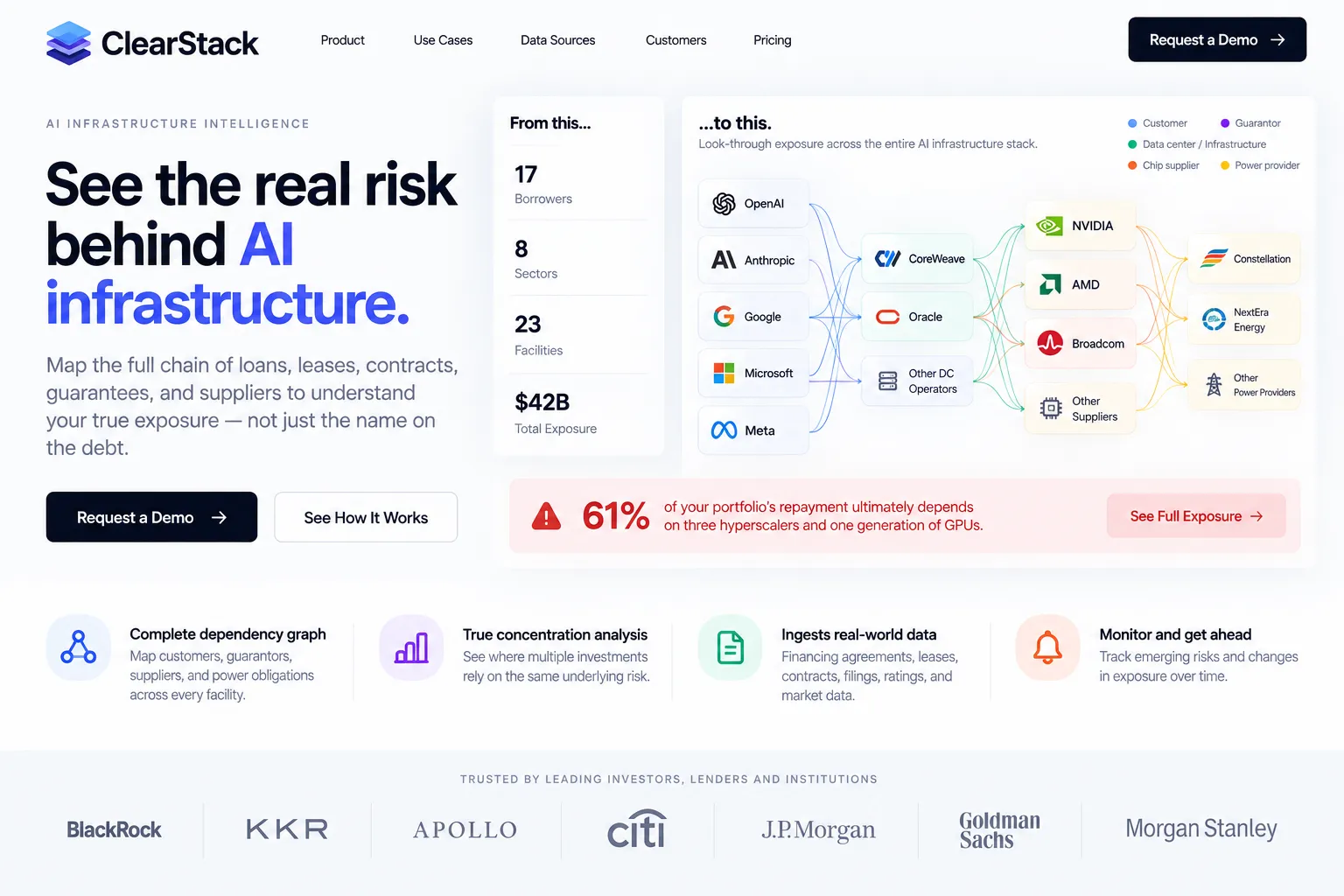
Description
No additional description provided.
The Pitch
This would sell a new unit of perception. Credit markets are very good at naming the borrower in front of them, but much worse at seeing the economic machine behind the borrower. In AI infrastructure, the legal entity taking the loan may be almost incidental; the real collateral is a chain of assumptions about GPU demand, utilization rates, hyperscaler contracts, supplier warranties, power availability, and secondary-market hardware values. A company that can turn those hidden dependencies into something legible would not just provide better data. It would change what lenders believe they own.
The timing is powerful because AI infrastructure finance has the shape of a classic maturity mismatch before it has the public markers of one. Long-lived facilities and multi-year debt are being underwritten against assets whose economic lives may be shortened by model efficiency, chip cycles, export rules, customer concentration, or a single architectural shift. The danger is not simply that some borrowers default. It is that many ostensibly separate credits could reprice at once because they are all exposed to the same technological depreciation curve. A look-through credit graph would make that shared clock visible.
The best version of this business would become valuable precisely because nobody in the chain has the whole picture. Banks see their facilities, private credit funds see their deals, data-center operators see their leases, hyperscalers see their commitments, and insurers see their guarantees. Each participant may be rational locally while the system becomes crowded globally. A neutral map of interdependence would become more useful as the market grows more private, more bespoke, and more fragmented.
There is also a subtle behavioral reason this could matter: complexity flatters everyone’s risk model. A portfolio with many entities, covenants, and contracts feels diversified because the spreadsheet has many rows. But if the repayment logic collapses to the same few customers, the same chip supply chain, and the same residual value assumption, diversification is mostly typography. The business works if it can expose the difference between legal diversification and economic diversification.
If it existed, the company would sit in the gap between credit analysis and supply-chain intelligence. That is an unusually rich position because the most important risk in AI infrastructure is neither purely financial nor purely operational; it is the conversion rate between technological relevance and debt service. Anyone who can measure that conversion better than the market would become hard to ignore.