AI Inference Cost Reduction Platform
Most inference requests inside companies repeat similar patterns. Instead of running a model every time, this platform learns the behavior of those requests and replaces them with lightweight approximations whenever confidence is high enough. Expensive foundation models are only called for edge cases. A customer service platform might answer 85% of incoming requests instantly without ever invoking a frontier model, reducing cost by an order of magnitude.
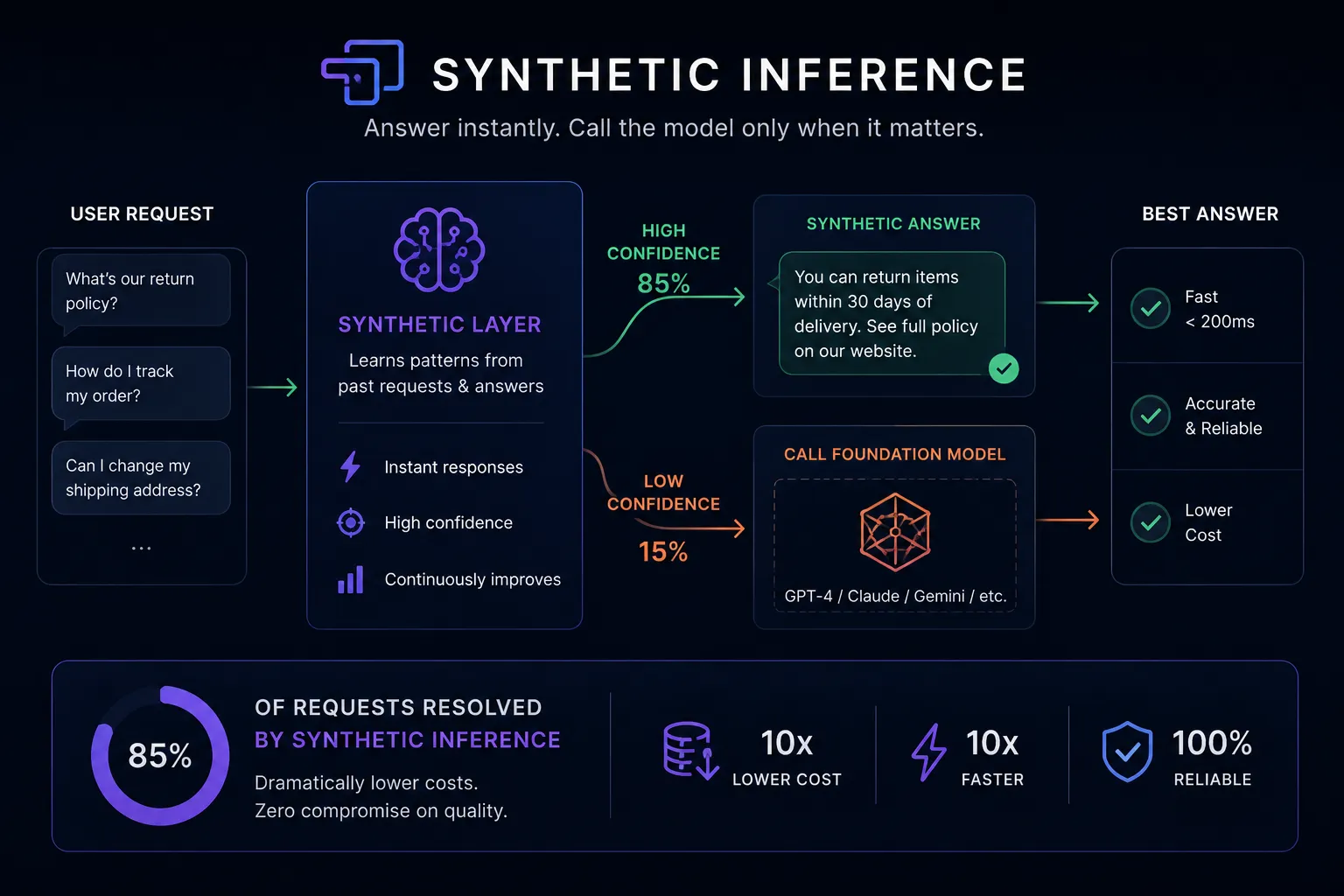
Description
No additional description provided.
The Pitch
The interesting part of this business is that it treats model intelligence less like magic and more like an overused utility. Inside companies, many AI calls are not fresh acts of reasoning; they are expensive replays of familiar work. A support system does not need a frontier model to rediscover the same refund policy a thousand times a day, and an internal analyst bot does not need deep reasoning to answer the same handful of metrics questions in slightly different language. The business works if it can identify the boundary between “this needs intelligence” and “this only needs recognition.”
That boundary is valuable because enterprise AI spending has an unusual shape: the marginal cost is attached to usage, but the marginal value often is not. The first correct answer to a recurring question is valuable; the 10,000th version of the same answer is mostly a tax. This creates room for a company that captures the repetitive structure of AI demand and converts it into something closer to infrastructure: faster, cheaper, and more predictable than repeatedly renting intelligence from the most expensive models in the world.
The deeper insight is that companies will not optimize AI costs by asking employees to use AI less. Once AI is embedded into workflows, usage tends to expand invisibly: more tickets, more drafts, more classifications, more background agents making more calls. The winning cost-control layer is therefore not a dashboard that scolds teams about consumption, but a silent intermediary that preserves the experience while removing unnecessary model calls underneath. It becomes valuable precisely because users do not have to change behavior.
There is also a trust advantage in being conservative. A system that only substitutes an approximation when confidence is high does not need to beat frontier models at general reasoning; it only needs to know when the problem is boring. That is a narrower and more commercially useful form of intelligence. In many enterprise settings, the hardest requirement is not brilliance but consistency, and repeated requests create enough evidence to make consistency measurable.
If this company existed, it would sit in a powerful position between application developers and model providers. Model providers benefit from more usage; customers benefit from less waste. A neutral layer that learns which calls are truly necessary could become the accountant of enterprise AI: not deciding what people should build, but quietly separating essential intelligence from expensive repetition. Its value would grow with AI adoption, because the more companies rely on models, the more duplicated cognition they generate.