AI Implementation Platform for Small Businesses
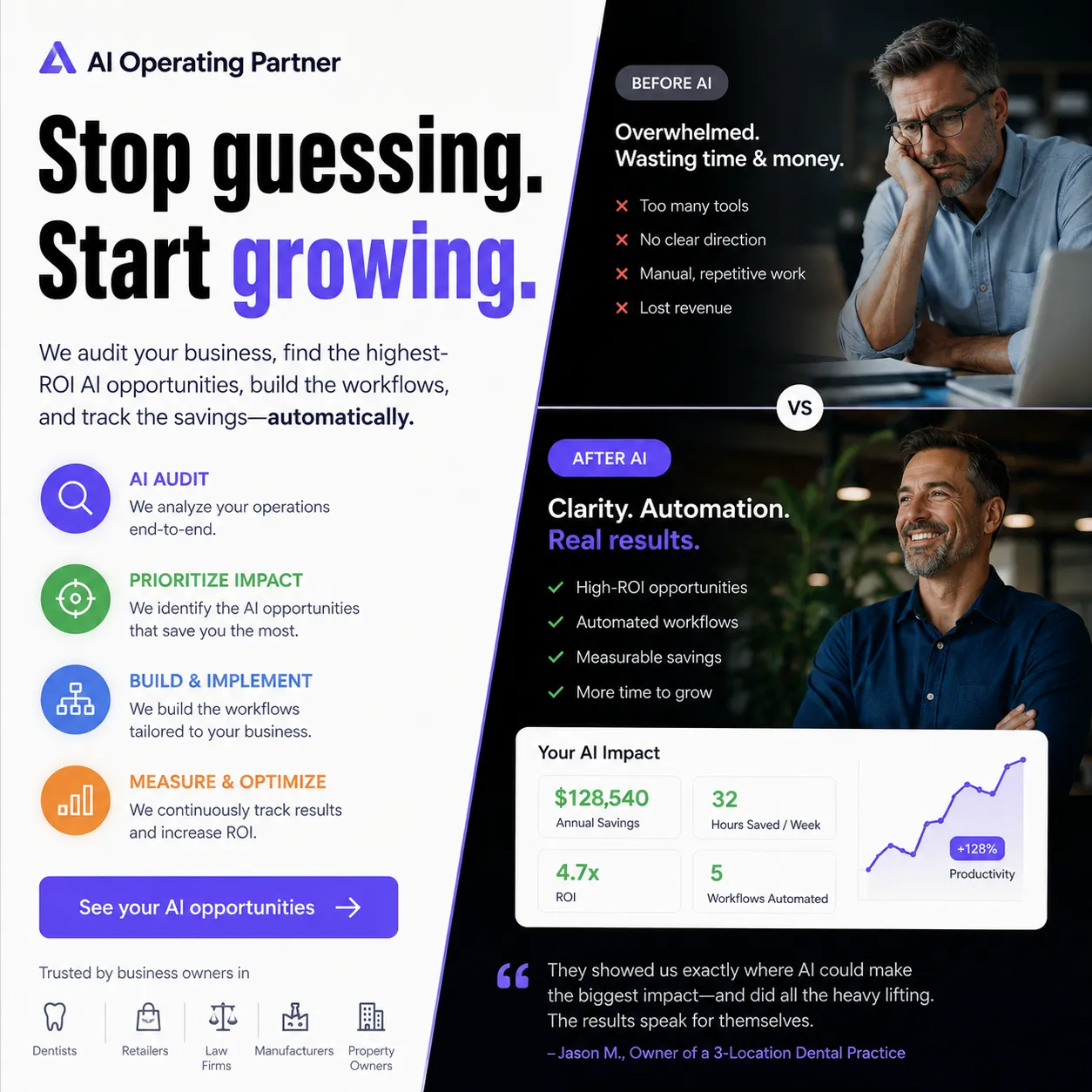
Every business owner knows AI matters, but most have no idea where to start. They're overwhelmed by thousands of tools and generic advice instead of practical workflows tailored to their industry. Imagine an AI platform that understands a specific business—dentists, retailers, law firms, manufacturers, property owners—and automatically audits operations, identifies the highest-ROI AI opportunities, builds the workflows, and continuously measures the savings. Rather than selling software, it becomes an AI operating partner for every industry. As foundation models become capable of automating increasingly complex work, businesses don't need more AI tools—they need someone to tell them exactly what to implement.
Description
No additional description provided.
The Pitch
AI adoption is not intelligence; it is translation. Most small and mid-sized businesses do not lack access to powerful models, they lack the operational judgment to know where those models safely fit into the messy routines of their work. The winning company would not be the one with the cleverest chatbot, but the one that turns “AI” from an abstract capability into a ranked set of business interventions: shorten intake, reduce missed billing, automate follow-ups, reconcile documents, catch errors before they become expensive.
The deeper opportunity is that industries have repeatable pain hiding under local variation. One dental office may feel unique, but its scheduling, insurance verification, recall campaigns, treatment plan follow-up, and supply ordering resemble thousands of others. The same is true for law firms, clinics, agencies, property managers, and manufacturers. A company that learns the workflow anatomy of an industry can reuse that knowledge across customers while still appearing highly tailored. That creates a rare combination: service-level relevance with software-level scalability.
The most interesting business insight is that measurement may matter more than automation. Business owners are wary of vague promises, but they respond to visible leakage: hours lost, leads ignored, claims denied, quotes delayed, inventory misordered. If the system can find waste, implement the fix, and keep a running ledger of recovered time or money, it becomes hard to categorize as another software expense. It starts to look like an operating discipline, closer to bookkeeping or payroll than a discretionary tool.
There is also a timing advantage hidden in the confusion. AI tools are multiplying faster than businesses can evaluate them, which makes neutrality valuable. The customer does not want to become an expert in model selection, prompt design, integrations, or workflow redesign. They want an informed intermediary that absorbs that complexity and is accountable for outcomes. In fragmented markets, trust often goes to whoever can reduce the number of decisions the owner has to make.
If this company worked, it could become the default layer between frontier AI capability and the real economy. Models will keep getting cheaper and more capable, but that may actually increase the need for an operator that knows what to do with them. The durable asset would not be a single model or tool; it would be accumulated knowledge of how work actually gets done, where money leaks out, and which automations survive contact with real businesses.