AI Home Inventory Search App
People constantly forget what they own, where they put it, or end up buying duplicates because there is no simple way to search the contents of their own home. Existing inventory apps require manually scanning and updating every item, making them too much work to maintain. A Home Pokédex solves this by using AI and computer vision to automatically create a searchable inventory of everything in your house. Users simply walk through their home with their phone—or eventually let stationary cameras keep it updated—and can instantly ask questions like "Where is my drill?" or "Do I already own a soldering iron?" Beyond finding items, it can generate insurance inventories, remind users about forgotten purchases, suggest products to sell, and automatically build shopping lists based on what's running low. With modern vision models now capable of recognizing thousands of everyday objects accurately and local AI making continuous processing practical, the technology has finally reached the point where this experience can happen with almost no manual effort. Imagine heading to Home Depot and asking whether you already own wood glue, only to learn there are two unopened bottles in your garage, or getting a notification that the espresso machine you bought a year ago has never been used and can be listed on Facebook Marketplace with one tap.
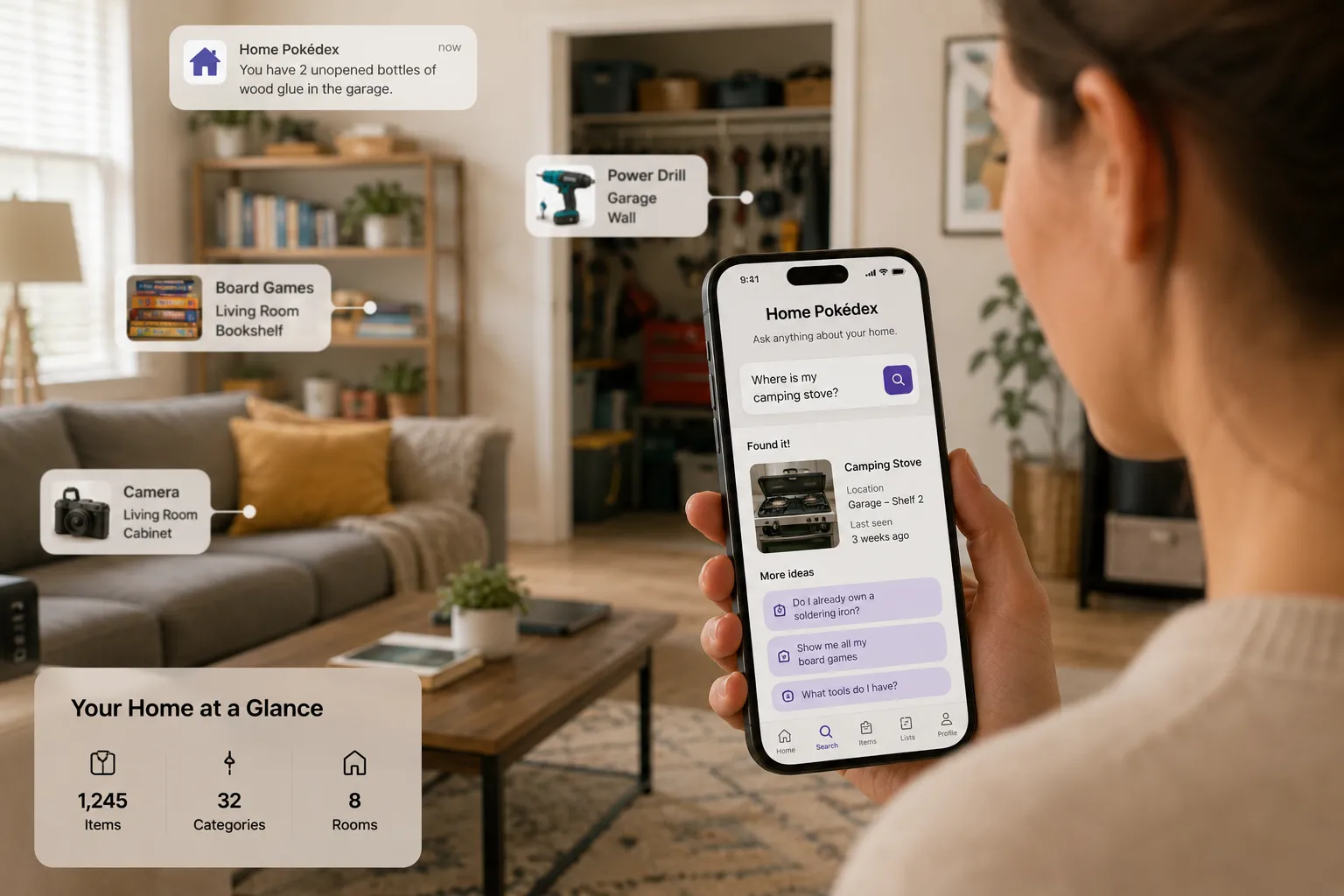
Description
No additional description provided.
The Pitch
Turn the home from an opaque storage space into a searchable personal database. That sounds mundane until you notice how much household spending is caused by uncertainty rather than desire: people buy the same cable, spice, tool, cleaner, medicine, or school supply because the cost of checking is higher than the cost of repurchasing. The hidden market is not “organization,” which most people vaguely aspire to and rarely maintain. It is the tax people pay for not knowing what they already have.
The key insight is that the home is full of low-value objects that become high-value only at the moment of need. A hammer in the garage is worth almost nothing in a spreadsheet, but it is worth a trip avoided when a shelf breaks. A forgotten warranty, spare part, receipt, or appliance manual is useless until the exact second it matters. A business that can surface possessions at the moment of intent is not just cataloging objects; it is changing the timing of usefulness.
This also creates an unusual kind of data asset: a private map of real consumption, not inferred from browsing or purchases, but observed from what actually remains in the household. Most commerce companies know what someone bought. Very few know what they still have, what they never used, what is nearly depleted, what broke, what was stored together, or what substitutes already exist nearby. That distinction matters because the home is where purchase intent is either created or canceled.
The business becomes more interesting as it shifts from memory to judgment. Once a household inventory exists, the system can answer questions people are bad at answering themselves: what should be replaced, donated, insured, repaired, sold, replenished, or ignored. The value is not in producing a perfect database; it is in reducing tiny frictions that accumulate into wasted money, clutter, and errands.
The strongest version would feel less like productivity software and more like a new household sense. Search made the internet feel navigable; this would make the physical home feel navigable. If it worked with little effort, people would quickly stop thinking of it as an app and start treating it as a normal expectation: of course your home should know what is inside it.