AI Healthcare Claims Dispute Adjudication Platform
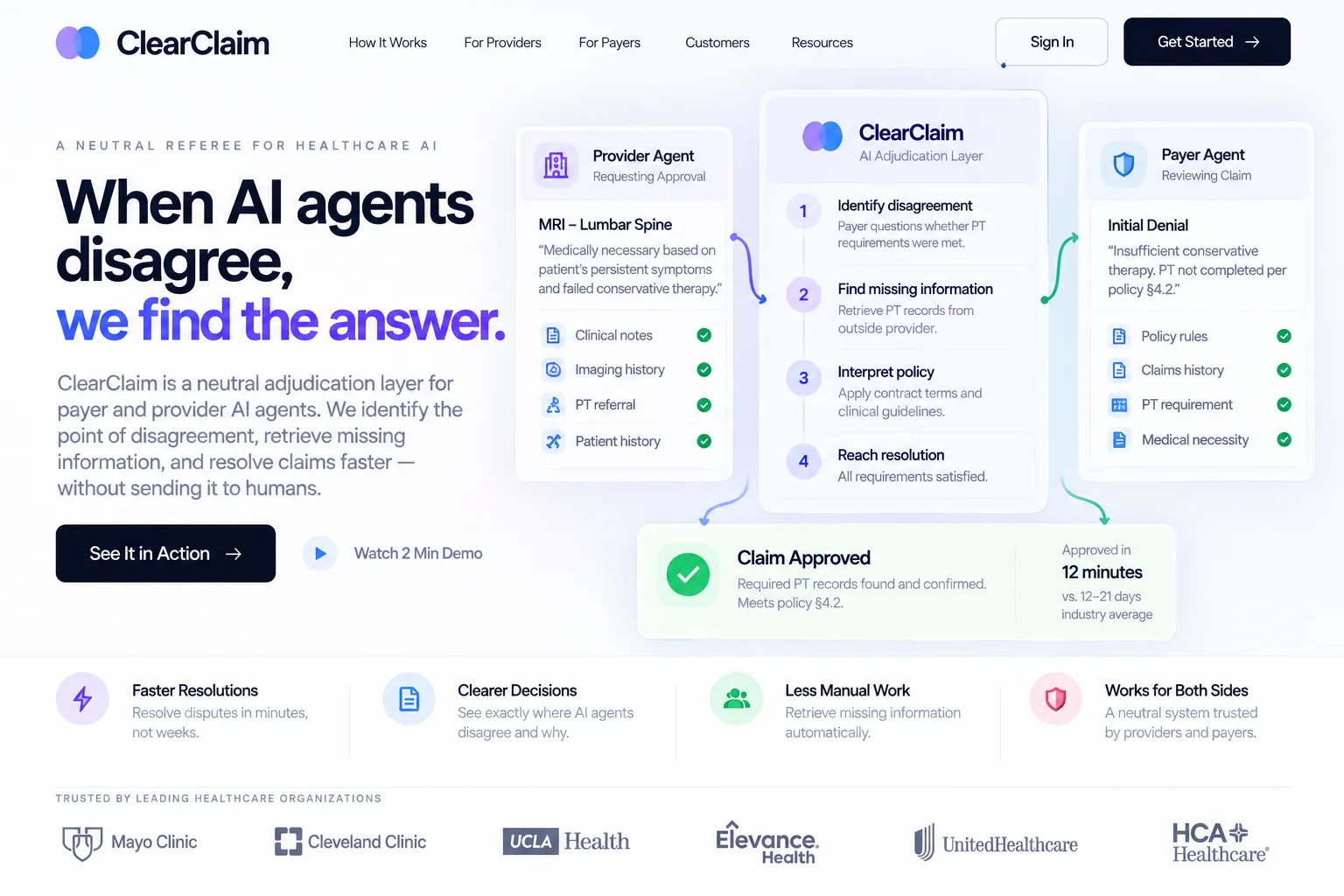
Hospitals and insurers are both automating prior authorization, claims review, denials, and appeals, which means healthcare is heading toward a world where one AI argues that a treatment should be paid for while another argues that it should not. Build a neutral adjudication layer where payer and provider agents submit their evidence, policy interpretation, clinical rationale, and contract terms, and the system identifies the exact point of disagreement, retrieves any missing information, and resolves administrative disputes before they escalate to humans. This matters now because AI is making both sides faster without making the underlying rules any clearer. Imagine a provider agent requesting an MRI, a payer agent denying it for insufficient physical therapy, and the system discovering that the only disagreement is an outside PT record that can be retrieved automatically and used to approve the claim.
Description
No additional description provided.
The Pitch
Healthcare payment disputes are not usually philosophical disagreements; they are often failures of shared context. A denial may look adversarial, but underneath it is frequently a missing document, a mismatched definition, an outdated policy citation, or two parties applying different versions of a contract clause. A business that can locate the precise seam where interpretation breaks would turn a costly argument into a structured reconciliation problem.
The deeper opportunity is that automation will increase the volume and speed of conflict before it reduces it. If every provider has a machine generating appeals and every payer has a machine generating denials, the bottleneck moves from labor to legitimacy. The scarce asset will not be another AI advocate; it will be a trusted venue where both sides accept that the dispute has been represented fairly. In markets where each party suspects the other’s automation is self-serving, neutrality becomes infrastructure.
This company would sit in an unusual position because it could learn the grammar of administrative disagreement across many institutions without needing to own the underlying clinical relationship or insurance product. Over time, it would know which disputes are truly about medical necessity, which are about contract interpretation, which are about documentation hygiene, and which are predictable artifacts of broken workflows. That map of friction would be valuable because healthcare organizations often know their denial rates, but not the recurring micro-reasons that produce them.
The business also works because the economic waste is unusually concentrated and measurable. A resolved dispute has a visible counterfactual: staff time avoided, days in accounts receivable reduced, appeals prevented, care delayed less often, and fewer claims escalated into expensive human review. Unlike many healthcare tools that promise distant improvements, this kind of system could prove its worth one transaction at a time, in the language both sides already understand: fewer unresolved cases and faster final answers.
The most interesting version would not “side with patients” or “side with payers,” because that would make it just another weapon in the administrative arms race. Its value would come from being boring in the right way: a shared interpreter for rules that were never designed for machine-speed combat. As healthcare becomes more automated, the rarest layer may be the one that makes automation accountable to the same facts.