AI Guest List Builder for Industry Dinners
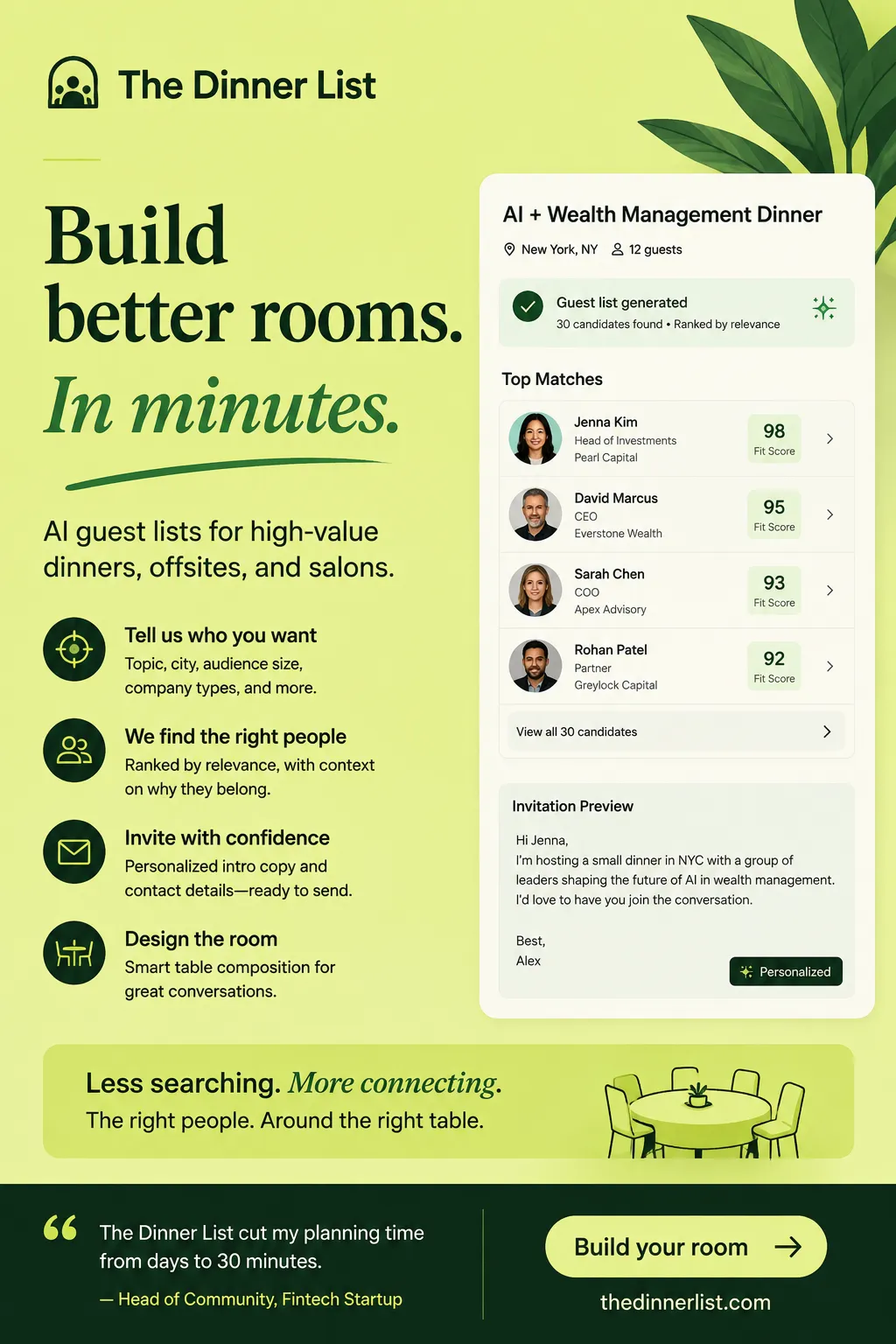
The hardest part of hosting a great industry dinner isn’t finding a restaurant — it’s figuring out who should be in the room. The Dinner List would let someone enter a topic, city, and audience — “AI + wealth management, NYC, 12 senior operators” — and instantly generate a researched guest list ranked by fit, including why each person belongs, contact information, personalized invitation copy, and who should sit next to whom. As AI makes digital outbound cheaper and noisier, companies, investors, and communities are increasingly using intimate dinners to reach people they actually care about, yet building the guest list still means hours of LinkedIn searches and spreadsheets. A VC could enter the thesis for an upcoming dinner Friday afternoon and have 30 perfectly matched candidates ready to invite before leaving the office. Don’t plan the event. Build the room.
Description
No additional description provided.
The Pitch
A dinner is one of the few business formats where scarcity is native. A webinar can be ignored, a conference can be wandered through, and a cold email can be deleted unread, but a seat at a twelve-person table forces a decision: is this room worth an evening? That makes the guest list the product. The restaurant, menu, and calendar invite matter far less than the precise social geometry of who is present, who is adjacent, and who quietly validates everyone else’s decision to attend.
The interesting business is not event software; it is taste at the top of the funnel. Most professional networking tools are built around search, which assumes the user already knows what they are looking for. But the highest-value rooms are usually assembled from people the host would not have thought to search for: the operator adjacent to the topic but not yet famous for it, the buyer with a quiet mandate, the founder whose company reveals an emerging need, the former executive who knows where the bodies are buried. A system that can surface those people becomes more valuable than a database because it expands the host’s imagination.
There is also a subtle shift in status here. As digital channels become more automated, in-person invitations become a stronger signal precisely because they are expensive in time, attention, and social risk. The person invited is not just being marketed to; they are being selected. That turns good curation into a form of social currency. If the company reliably helps hosts create rooms people later describe as “surprisingly good,” it earns trust in a way ordinary contact tools never do.
The defensibility would come from learning what makes a room work, not merely who matches a keyword. The best guest is not always the most senior or most visible person; sometimes it is the person who makes three other people more likely to come, or the one whose presence prevents the conversation from becoming predictable. Over time, the product could understand patterns of complementarity: who brings authority, who brings candor, who bridges two clusters, who should not be seated together because they duplicate the same role.
This is compelling because the unit of value is unusually compressed. One excellent room can create a hire, a customer, an investment, a partnership, or simply a relationship that would have taken years to manufacture online. In a world drowning in reach, the scarce asset is not attention in the abstract; it is the right twelve people paying attention to each other at the same time.