AI-Generated Disposable App Testing Platform
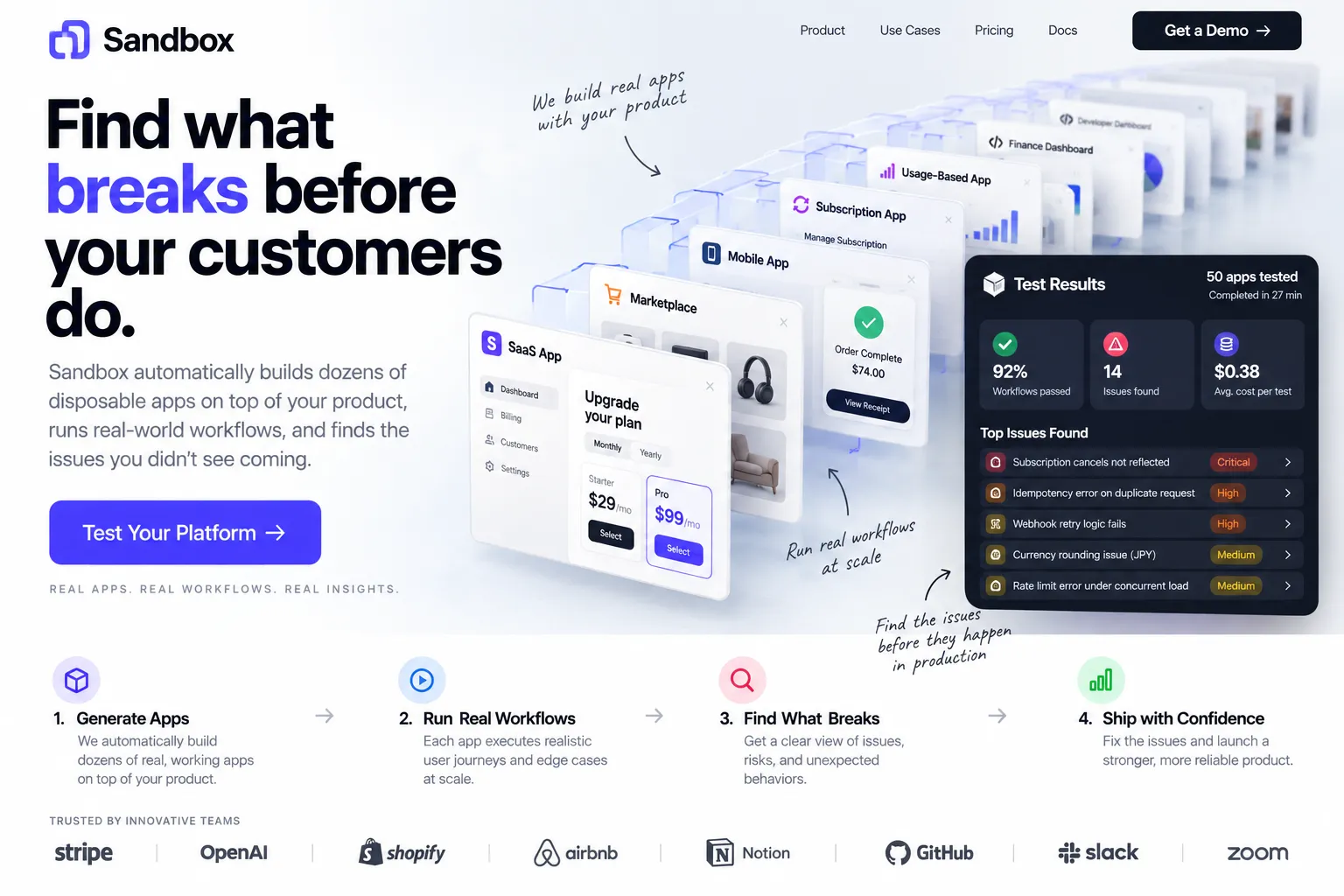
Platforms and APIs are usually tested against predefined scenarios, but the hardest problems often appear only when real developers combine them in unexpected ways. Build a testing platform that automatically generates dozens or hundreds of disposable apps on top of a product, runs realistic workflows through them, and deletes the apps when the test is finished. This becomes possible now because AI can build credible software cheaply enough that entire temporary products can become test cases instead of expensive engineering projects. Imagine a payments company launching a new API and having the system spin up a subscription app, marketplace, mobile checkout, usage-based billing product, and 50 stranger variations overnight to find the combinations that break before customers do.
Description
No additional description provided.
The Pitch
Software products no longer need to be tested only as isolated interfaces. They can be tested as ingredients inside other software. That matters because modern APIs do not fail only when an endpoint returns the wrong response; they fail when a customer tries to compose billing, permissions, onboarding, webhooks, edge-case data, and third-party integrations into a living system. The real surface area of a platform is not its documentation. It is the universe of things people try to build with it.
The interesting business would sit at the boundary between QA and customer reality. Most testing tools ask, “Does the product behave as specified?” This one asks, “What kind of product will a customer accidentally build, and where will that reveal a hidden assumption?” That is a more valuable question for any company whose product is used by developers, because developer trust is fragile. A broken dashboard is annoying; a broken API can become someone else’s broken business.
Temporary apps are powerful because they make misuse observable. Customers rarely implement platforms in the clean, linear way internal teams imagine. They retry requests too aggressively, store stale objects, chain workflows in odd orders, localize fields, mix old and new versions, or build business logic around behavior that was never intended as a guarantee. A disposable app can embody those weird patterns and produce failures that conventional tests would never think to assert. In effect, the test case stops being a script and becomes a small, opinionated customer.
This also creates a useful asymmetry. It is expensive for a company to discover integration failures through support tickets, customer escalations, and churn, but increasingly cheap to manufacture synthetic customers before launch. The more complex the platform, the greater the gap between internal confidence and external behavior. A testing system that narrows that gap becomes most valuable exactly where ordinary QA becomes least sufficient: payments, identity, data infrastructure, commerce, communications, and developer tools with many possible implementation paths.
The deeper thesis is that AI-generated software may turn testing from verification into exploration. Instead of merely confirming that known paths still work, companies can continuously search the space of plausible products built on top of them. For platform businesses, that search space is the product. A company that maps it well would not just find bugs; it would reveal how developers actually experience the platform before those developers arrive.