AI Facilitator for Team Creative Brainstorming
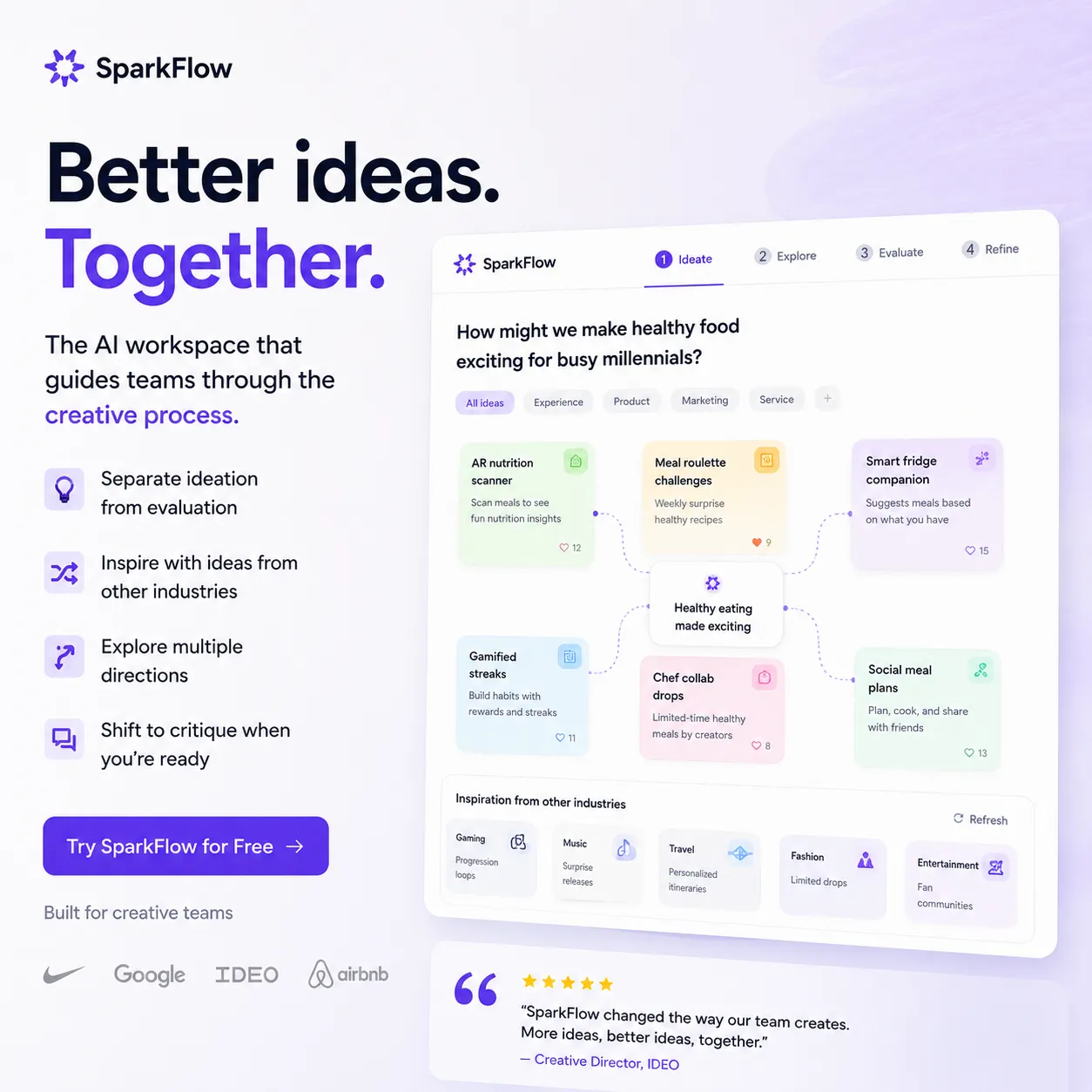
Creative work usually fails because teams judge ideas long before they've had a chance to evolve. Brainstorming sessions reward safe suggestions, the loudest voices dominate, and promising ideas are discarded before they're explored. Imagine an AI workspace that guides teams through the creative process, separating idea generation from evaluation, introducing unexpected inspiration from unrelated industries, encouraging multiple directions, and only shifting into critique once enough possibilities have been explored. Rather than acting like another chatbot, it becomes a facilitator that helps teams think more creatively together. As AI becomes a better collaborator instead of just a generator, creativity can become a repeatable process rather than a lucky breakthrough.
Description
No additional description provided.
The Pitch
A business like this would matter because most organizations do not actually lack ideas; they lack conditions in which fragile ideas can survive long enough to become useful. Early-stage creative thinking is unusually vulnerable to hierarchy, taste, speed, and social risk. The person who says “that might be stupid, but…” is often holding the most valuable raw material in the room. A product that protects those unfinished thoughts from premature judgment would not just make teams more creative; it would recover value that companies already paid for but routinely suppress.
The deeper opportunity is that creative process is one of the few parts of work where better structure can feel like more freedom, not less. Many collaboration tools make teams faster at converging: comments, votes, approvals, status updates. But creative work needs a deliberate period of divergence, where quantity, weirdness, and contradiction are productive. A workspace designed around that rhythm would be useful because it understands that “efficiency” too early is often the enemy of originality. The most valuable output may be the idea no one would have written down if the room had been optimizing for agreement.
It is also compelling because the best creative facilitators are rare, expensive, and inconsistently available inside companies. A skilled facilitator knows when to widen the aperture, when to reframe a prompt, when to import a pattern from another domain, and when to postpone criticism. If software can embody even part of that judgment, it turns an uncommon human skill into an everyday operating layer for teams. That is different from generating ten taglines or fifty product names; it changes the quality of the conversation before the answer exists.
The non-obvious business insight is that the system’s value may increase with the messiness of the organization. In companies with many disciplines, seniority levels, geographies, and political constraints, creativity often becomes performative: people contribute what is safe to say in public. A neutral facilitator can create a parallel space where ideas are developed before they are exposed to status dynamics. That makes the product not merely a creativity tool, but a way to reduce the hidden tax that organizational politics imposes on imagination.
If this worked, it would become important because creative advantage is increasingly less about access to raw generation and more about taste, framing, and selection. When everyone can produce plausible options instantly, the scarce skill becomes knowing how to explore the possibility space before narrowing it. A company that helps teams do that consistently would sit at the point where AI stops being a novelty and becomes a discipline.