AI Exposure Due Diligence for Acquisitions
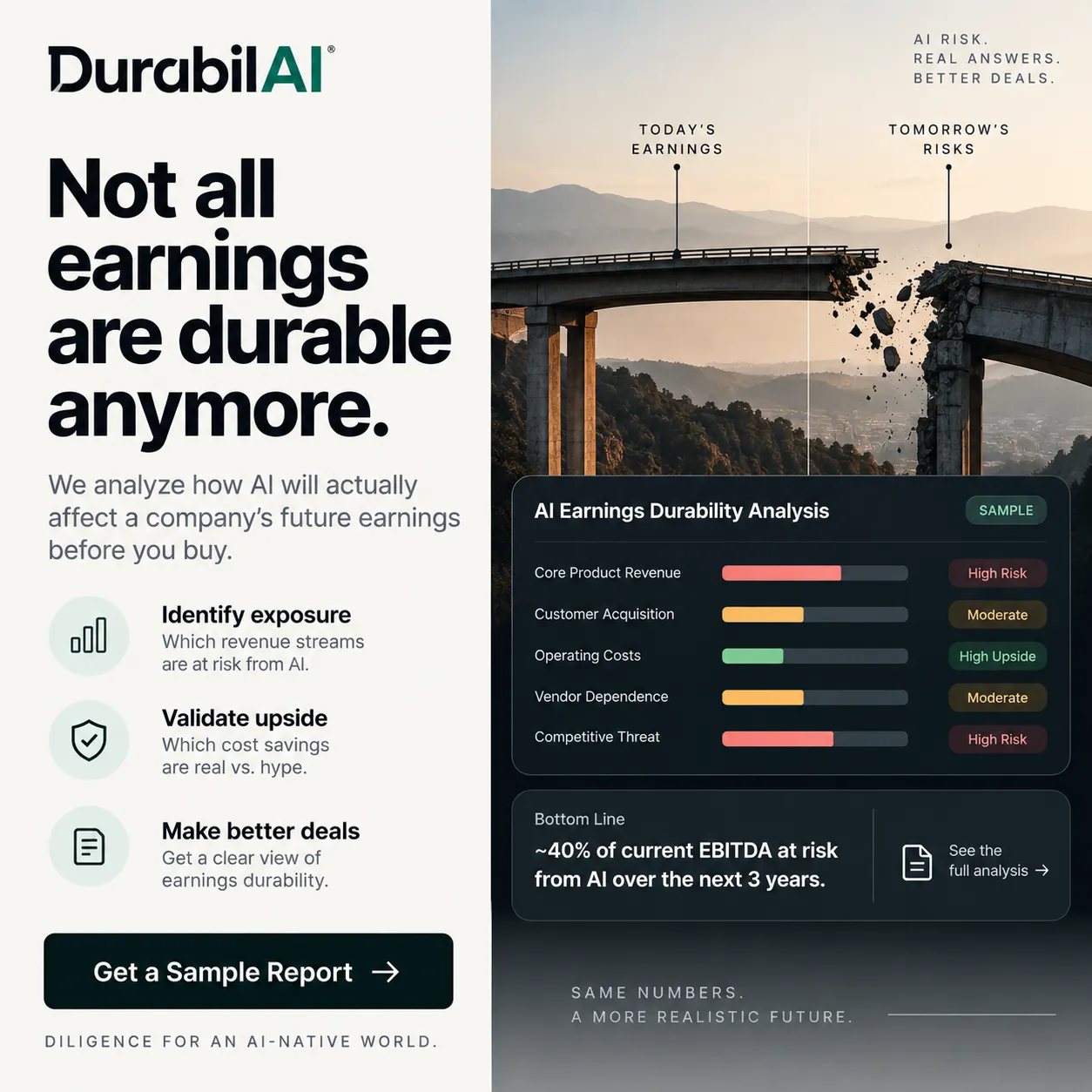
AI is making it harder to know what a company’s future earnings are actually worth. A software business may look highly profitable today even though AI is about to commoditize part of its product. Another company may promise huge labor savings that have not yet happened. Build something like Quality of Earnings for AI exposure. Before an acquisition, analyze which revenue streams are vulnerable, which costs can realistically disappear, where model or vendor dependence creates risk, and how much of management’s AI story is already reflected in the valuation. Traditional diligence asks whether historical earnings are real. This asks whether those earnings are durable in an AI-native world.
Description
No additional description provided.
The Pitch
AI changes the meaning of “quality” in Quality of Earnings. Historically, diligence tried to separate recurring earnings from accounting noise, one-time expenses, and management optimism. But AI creates a different kind of distortion: earnings can be perfectly real and still be structurally mispriced. A company can have clean financials, loyal customers, and high margins, while quietly sitting on revenue that is about to become a feature inside a larger platform or an internal workflow automated by the customer.
The most interesting wedge is that AI risk does not show up evenly across a P&L. It hides inside product boundaries, customer behavior, support intensity, implementation work, data access, and vendor dependencies. Two companies with the same EBITDA can have completely different futures if one earns money from judgment, trust, and embedded workflow, while the other earns money from information assembly that models are rapidly learning to reproduce. Traditional diligence often treats revenue by contract type or customer cohort; AI diligence would treat revenue by its replaceability.
This would be valuable because buyers do not need a philosophical view on AI; they need a defensible adjustment to price. Most acquisition debates around AI will otherwise be vague and performative, with sellers claiming productivity upside and buyers fearing invisible obsolescence. A specialized diligence product could turn that argument into something more concrete: which earnings deserve a premium because AI strengthens the moat, which deserve a discount because AI erodes it, and which cost savings are plausible versus PowerPoint theater.
There is also a timing advantage. The market is still early enough that many businesses are being valued with old mental models, but late enough that AI exposure is no longer hypothetical. That gap creates room for expertise to become a standard diligence category. Once buyers lose money on companies whose “recurring software revenue” turns out to be automatable middleware, they will not want a generic technology assessment; they will want someone to pressure-test the earnings themselves.
The deeper business is not simply selling reports about AI risk. It is creating a new language for how durable cash flow should be judged when capabilities are changing faster than financial statements. If historical earnings used to answer “did this business really make money?”, the new question is “what part of that money still belongs to this business?” That question will become unavoidable.