AI Executive Function Coach for ADHD
Millions of people struggle with executive dysfunction, ADHD, and attention-related challenges that make it difficult to remember everyday tasks, stay organized, and follow through on routines. Traditional reminders quickly become background noise because they're easy to dismiss and ignore. An AI-powered Executive Assistant acts as a persistent life coach that continuously learns a user's habits and proactively intervenes throughout the day using voice, wearable devices, earbuds, or ambient notifications. Rather than simply reminding someone to drink water or leave for an appointment, it adapts its coaching style, escalates reminders when necessary, and delivers prompts at the exact moments they're most likely to be noticed. With AI becoming increasingly personalized through wearables, smart homes, and contextual assistants, technology is finally capable of providing ongoing behavioral support instead of static notifications. Imagine wearing a lightweight earpiece that quietly reminds you to leave for your meeting, notices you've forgotten to drink water all afternoon, and adjusts its coaching style over time based on which interventions actually change your behavior.
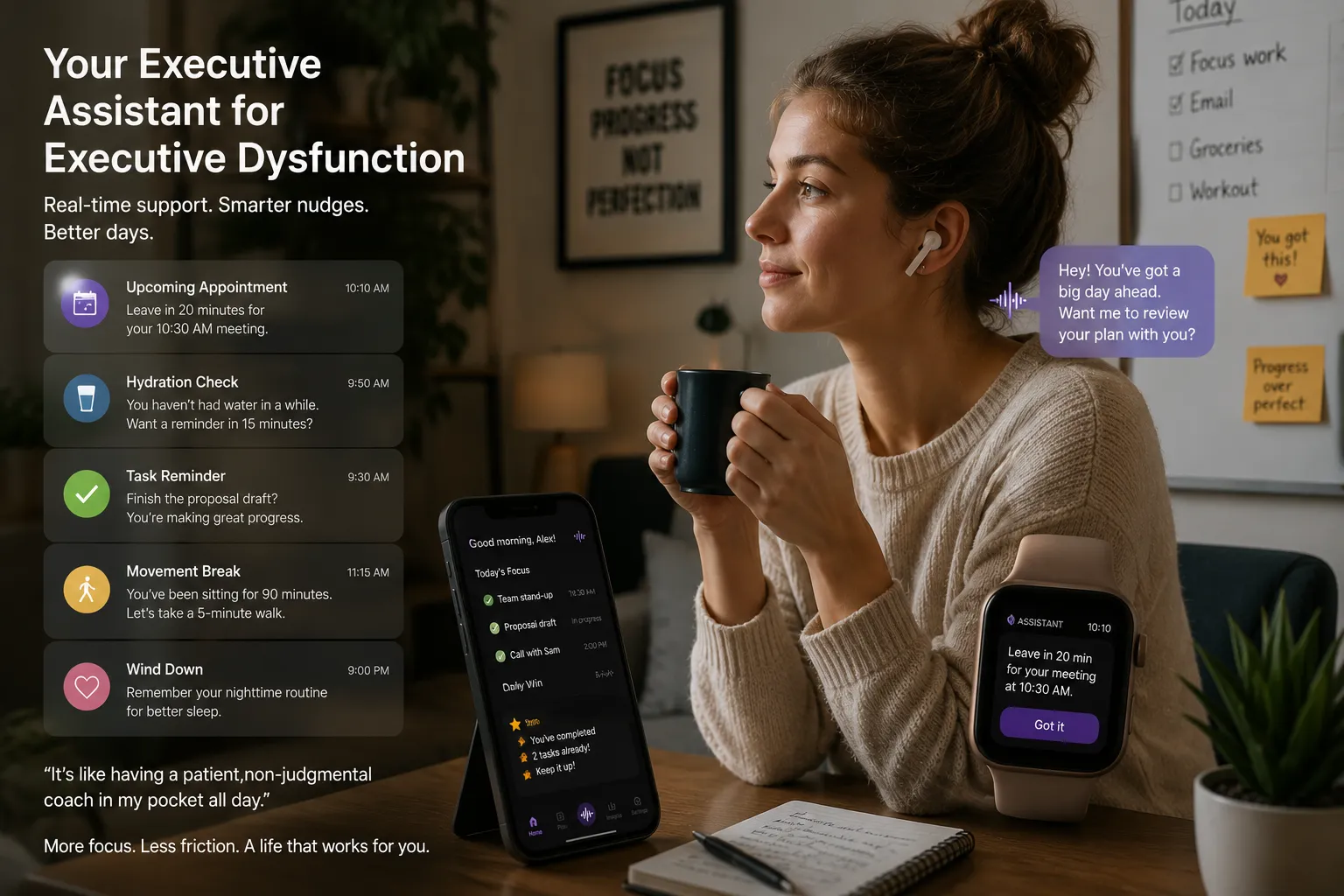
Description
No additional description provided.
The Pitch
People usually know what they intended to do, but the intention fails to survive contact with distraction, fatigue, time blindness, or emotional friction. A business that can intervene at the moment intention decays would occupy a much more valuable position than a calendar, task manager, or habit tracker. It would not store plans. It would help convert plans into behavior.
The reason this could matter commercially is that the existing category is built around voluntary engagement, while the people who need the most support are often least able to open the app, check the list, or maintain the system. Most productivity tools quietly punish the exact users they claim to serve: they require consistency before they can create consistency. A useful assistant in this space would invert that relationship. Its value would come from showing up when the user does not.
The business would also benefit from an unusually strong learning loop. A generic reminder is easy to ignore because it has no memory of failure. But behavioral assistance gets better when it learns which prompt works at 8 a.m. versus 8 p.m., which tasks require gentleness versus urgency, and when silence is more helpful than another nudge. Over time, the product’s real asset would not be a list of user preferences, but a private map of what actually moves a specific person from inertia to action.
There is also a deep willingness to pay hiding in plain sight: people already spend heavily to compensate for executive dysfunction through late fees, missed appointments, unused subscriptions, lost objects, delivery orders, coaching, therapy, and sheer household chaos. The cost is not just inconvenience; it is the accumulating tax of not being able to reliably act on one’s own intentions. A product that reduces even a fraction of that tax could feel less like software and more like infrastructure for daily life.
The most interesting version of this company would not be another productivity brand promising optimization. Its emotional center would be relief. For a large group of people, the dream is not to become superhuman; it is to stop being ambushed by ordinary life. A technology that can provide timely, adaptive, nonjudgmental support would create a category closer to cognitive accessibility than productivity, and that distinction is what makes it durable.