AI Entrepreneurship Curriculum for Student Businesses
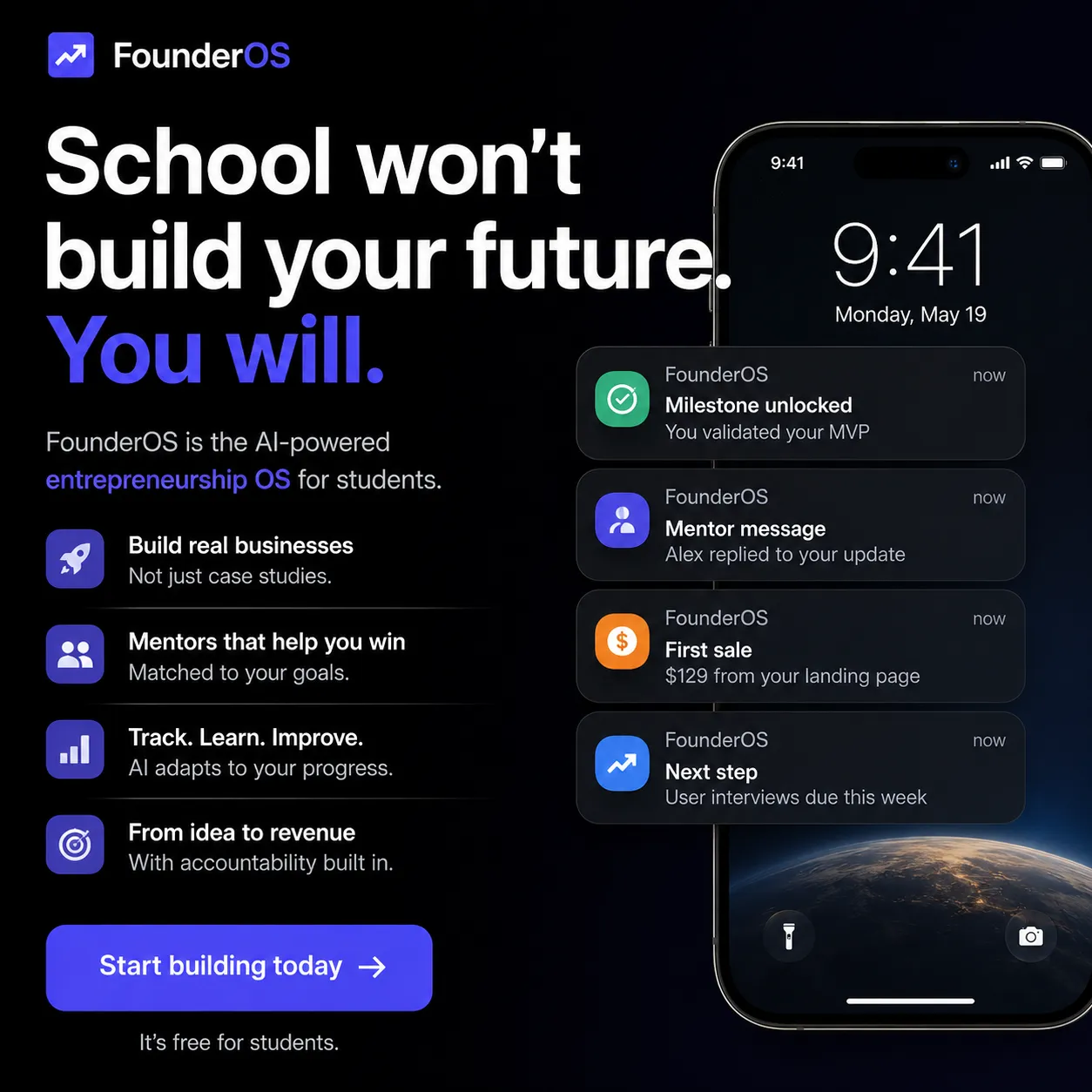
Schools teach students how to pass exams but rarely how to build products, acquire customers, or generate revenue. Young entrepreneurs are increasingly learning from YouTube, Twitter, and Discord instead of traditional classrooms. Imagine an AI-powered entrepreneurship operating system that gives students real businesses to build, assigns mentors, tracks milestones, manages accountability, and adapts lessons based on each company's progress rather than standardized tests. As AI can now personalize education at scale, entrepreneurship can become an individualized curriculum instead of an extracurricular activity.
Description
No additional description provided.
The Pitch
Entrepreneurship education has always suffered from a mismatch between how it is taught and how it is learned. You cannot really understand customers, pricing, distribution, or persistence through lectures alone; the knowledge becomes real only when a student is trying to get a stranger to care about something they made. The unusual opportunity is to treat the business itself as the textbook: every failed landing page, awkward sales call, abandoned prototype, and first dollar of revenue becomes curriculum.
The deeper shift is that entrepreneurship is one of the few subjects where the student’s progress can be measured by contact with reality. Most education relies on proxies: essays, grades, attendance, participation. A young founder creates better signals. Did anyone respond? Did anyone pay? Did the team ship? Did they change course after evidence? An AI system built around these signals could make education less performative, because it would be hard to fake traction, iteration, or persistence in the same way one can fake comprehension for a test.
There is also a powerful identity layer here. Many students do not want another course; they want permission to become the kind of person who builds things. Schools often make entrepreneurship feel like a club for the already confident, the already connected, or the already technical. A guided operating system could turn the first messy steps into something legible and less lonely. That matters because the biggest barrier for young entrepreneurs is often not intelligence or ambition, but not knowing what to do on Tuesday afternoon when nobody has replied.
The business becomes especially interesting if it sits between education and the outside market rather than inside either one. Traditional schools have authority but move slowly; online creator ecosystems have energy but little structure or accountability. A company that combines institutional trust with the immediacy of real-world building could occupy a rare middle ground. It would not just teach entrepreneurship; it would create a repeatable environment where more young people can discover whether they are entrepreneurial before life makes experimentation expensive.
If it worked, the product would produce something more valuable than completed lessons: a living record of initiative. A student who has tested ideas, talked to users, made decisions under uncertainty, and earned even modest revenue has a different kind of credential. In a world where AI makes answers cheap, evidence of agency may become one of the few signals that still feels scarce.