AI-Enabled Company Operating System Licensing
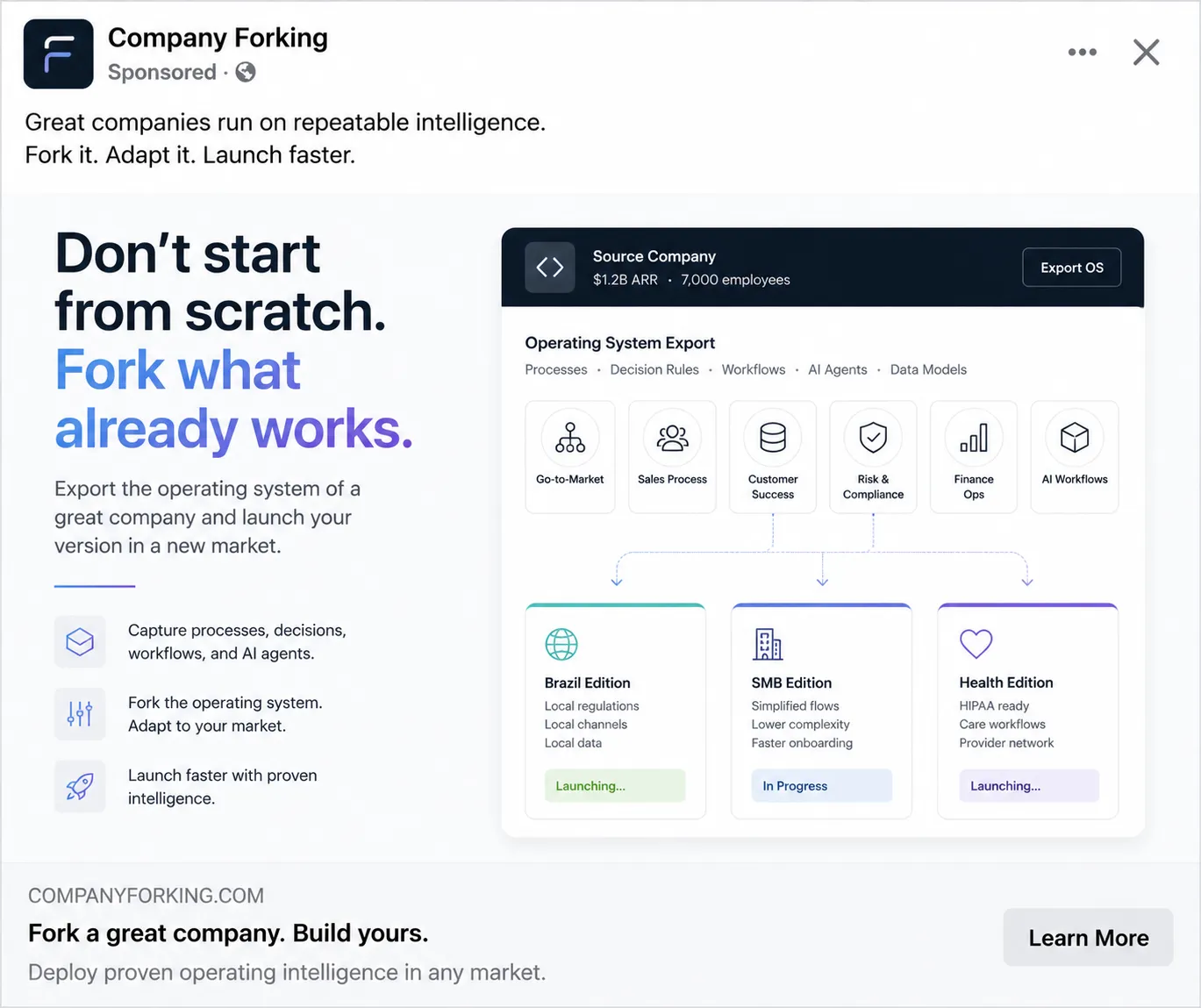
Software can be forked. Soon companies might be too. As more organizational knowledge moves into AI agents, prompts, workflows, decision rules and machine-readable operating systems, Company Forking packages that architecture into something another entrepreneur can instantiate. Take the operating system of a successful US insurance brokerage, fork it for Brazil, replace its regulatory and distribution modules, and launch. Pieces of this are emerging as AI operating layers gain organizational memory, lineage, handoffs and workflow forking. The next franchise might not license a brand or storefront. It could license the executable intelligence of a company.
Description
No additional description provided.
The Pitch
Business rests on the idea that many companies are less unique than they appear. Their durable advantage is often not one brilliant secret, but thousands of small operational decisions accumulated over years: when to escalate, what to verify, which exceptions matter, how to qualify demand, how to sequence work, what language converts trust into action. Today that knowledge is trapped in people, documents, meetings, and habits. If it becomes executable, it stops being merely “know-how” and starts behaving like a portable asset.
The interesting shift is that replication becomes cheaper than imitation. Historically, copying a business required hiring veterans, studying processes, buying software, and rediscovering all the invisible judgment through mistakes. A forkable company changes the unit of transfer. Instead of teaching a new team how an organization works, it gives them a working organism with assumptions exposed and modules that can be swapped. That matters because many markets are geographically, legally, or culturally fragmented, but operationally similar enough that a proven pattern can travel if its local dependencies are cleanly separated.
This could also change the economics of expertise. The most valuable operators in a company usually cannot scale themselves; their judgment is consumed internally and disappears when they leave. Encoding that judgment into agents and workflows creates a second life for operating excellence. A great niche business in one country, industry, or channel could become the template for dozens of related businesses without becoming a monolithic multinational. The knowledge owner captures value from adaptation, while local entrepreneurs keep the parts that require context, relationships, and risk-taking.
The non-obvious attraction is that the best “companies to fork” may not be famous brands. They may be boring, precise, regulation-heavy, workflow-dense firms whose advantage comes from avoiding errors and handling edge cases. These are exactly the businesses that are painful to clone by hand but increasingly legible to machines. A small insurance brokerage, freight forwarder, collections operation, specialty clinic administrator, or compliance-heavy service firm may contain a more valuable operating genome than a glamorous consumer company.
If this exists, it becomes a market for organizational DNA. Some companies will be built not to expand directly, but to be forked well: clean decision logs, modular policies, traceable workflows, documented exceptions, portable agent roles. The prize is not just faster company creation. It is a new way for business knowledge to compound, where the hard-won lessons of one operating environment can become the starting point for another rather than a story told after the fact.