AI-Driven Search Engine for Internal Company Memory
Companies generate mountains of unstructured data—Slack threads, Notion docs, meeting transcripts, emails—but no one knows where to find anything. Traditional search is brittle and keyword-based, and enterprise knowledge gets lost or duplicated. This startup would build an AI-native search engine designed specifically for internal company memory. Unlike previous attempts, this one doesn’t just index documents—it creates a semantic, time-aware, agent-readable graph of all internal knowledge. Employees could ask: “What was the latest thinking on our Q3 pricing experiment?” or “Has anyone answered this vendor question before?” and get clear, sourced answers, not links. What makes this novel is the shift from search as lookup to search as reasoning—an LLM-powered system that remembers, understands, and summarizes institutional knowledge across formats and time. This wasn’t feasible until now because LLMs couldn’t persist context or perform on-the-fly reasoning across sprawling corpuses. With retrieval-augmented generation, embedding memory, and AI agents, that’s finally possible.
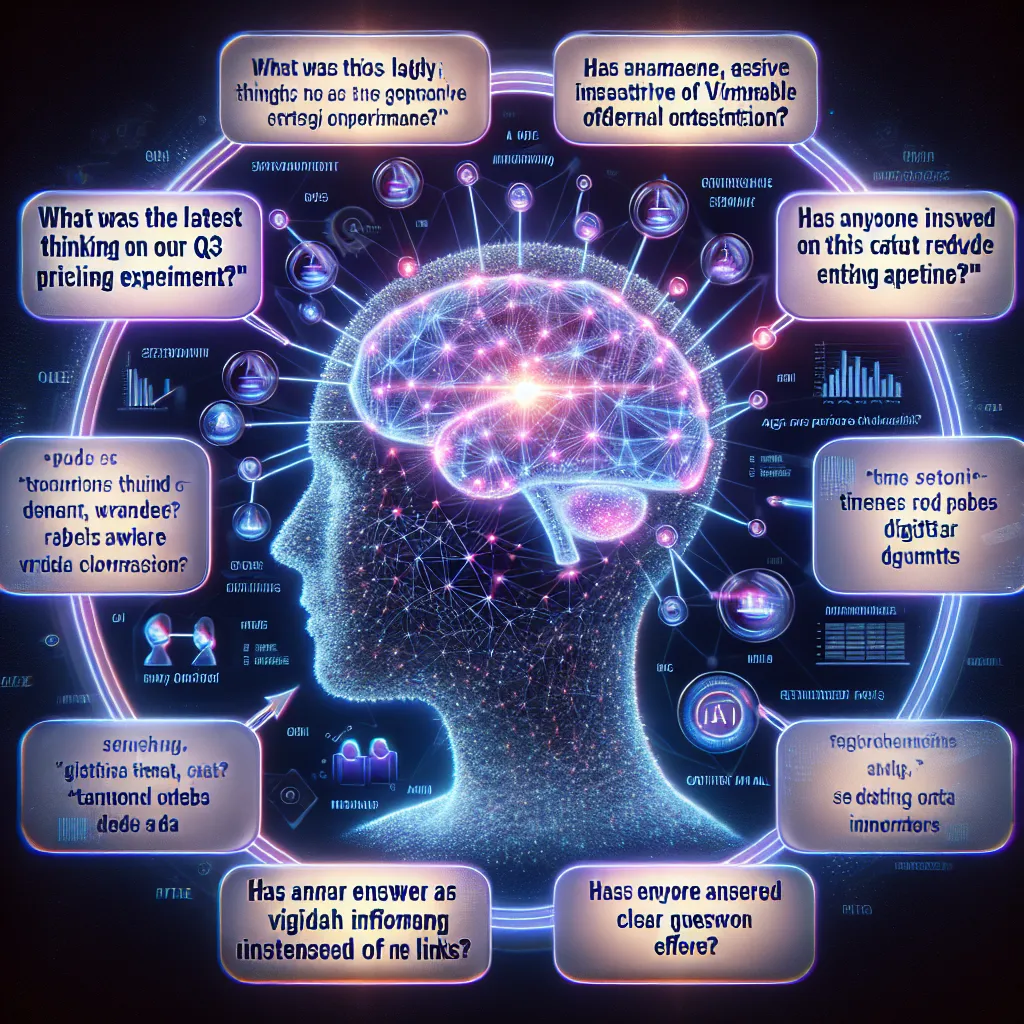
Description
No additional description provided.
The Pitch
In today's fast-paced business environment, companies constantly generate a vast amount of unstructured data. This data is dispersed across various platforms like Slack, Notion, email, and more, resulting in a fragmented knowledge ecosystem where valuable insights often go unnoticed. Traditional search systems are heavily reliant on keywords and lack the understanding needed to effectively retrieve context-rich information. As a result, critical enterprise knowledge is lost, duplicated, or underutilized, leading to inefficiencies and missed opportunities.
Identifying the Problem
The primary issue lies in the way current systems handle internal data. Existing solutions are often brittle and incapable of understanding the context or semantic relationships between pieces of information. This limitation hampers employees’ ability to quickly access relevant knowledge, hindering collaboration, innovation, and decision-making processes.
Proposed Solution
We propose the development of an AI-native search engine uniquely designed to address the complexities of internal company memory. This solution will go beyond simple document indexing and will create a semantic, time-aware graph of an organization's collective knowledge. By leveraging advanced AI technologies, the system will be capable of understanding nuanced questions like “What was the latest thinking on our Q3 pricing experiment?” and providing comprehensive, sourced answers instead of just a list of links.
Product Details
The core innovation in this solution is the transformation of search from a basic lookup operation to one that involves sophisticated reasoning. The system will utilize Large Language Models (LLMs) to remember, comprehend, and summarize information across different formats and time periods. This was previously unachievable due to limitations in context persistence and on-the-fly reasoning with large data sets. However, breakthroughs in retrieval-augmented generation, embedding memory, and AI agents now make it possible.
Key Features - Semantic Understanding: Transforms unstructured data into a coherent knowledge graph that captures the relationships and context between data points. - Context Retention: Maintains continuity and relevance over time, allowing for dynamic and informed responses. - Multiformat Integration: Provides comprehensive search capabilities across various platforms and document types. - Intelligent Summarization: Condenses vast amounts of information into meaningful insights, reducing the cognitive load on employees.
Launching the MVP
Tools and Technologies - Large Language Models: Foundation for natural language understanding and generation. - Knowledge Graphs: Framework to represent and interlink data semantically. - AI Agents: Facilitate dynamic interaction with data to simulate human-like reasoning. - Embedding Memory Networks: Ensure context and historical information are retained and accessible.
Go-To-Market Strategy
Our go-to-market strategy will focus on creating partnerships with technology-forward enterprises looking for innovative solutions to knowledge management. Initial efforts will involve pilot programs with selected companies to refine the product based on real-world feedback. Marketing efforts will emphasize thought leadership in AI and knowledge management, leveraging online content, case studies, and webinars to raise awareness among target audiences.
Business Model
The business model will be subscription-based, offering tiered pricing to cater to the diverse needs of small, medium, and large enterprises. Additional revenue streams could include customizable add-ons for specific industry requirements and professional services for deployment and support.
Conclusion
This AI-native search engine represents a paradigm shift in how companies manage internal knowledge. By transforming search from a simple retrieval process to a sophisticated reasoning system, organizations stand to unlock latent insights trapped within their data. This innovation not only promises to enhance productivity and decision-making but also empowers companies to fully leverage their intellectual assets in pursuit of strategic objectives.