AI-Driven Meeting Documentation and Summarization Tool
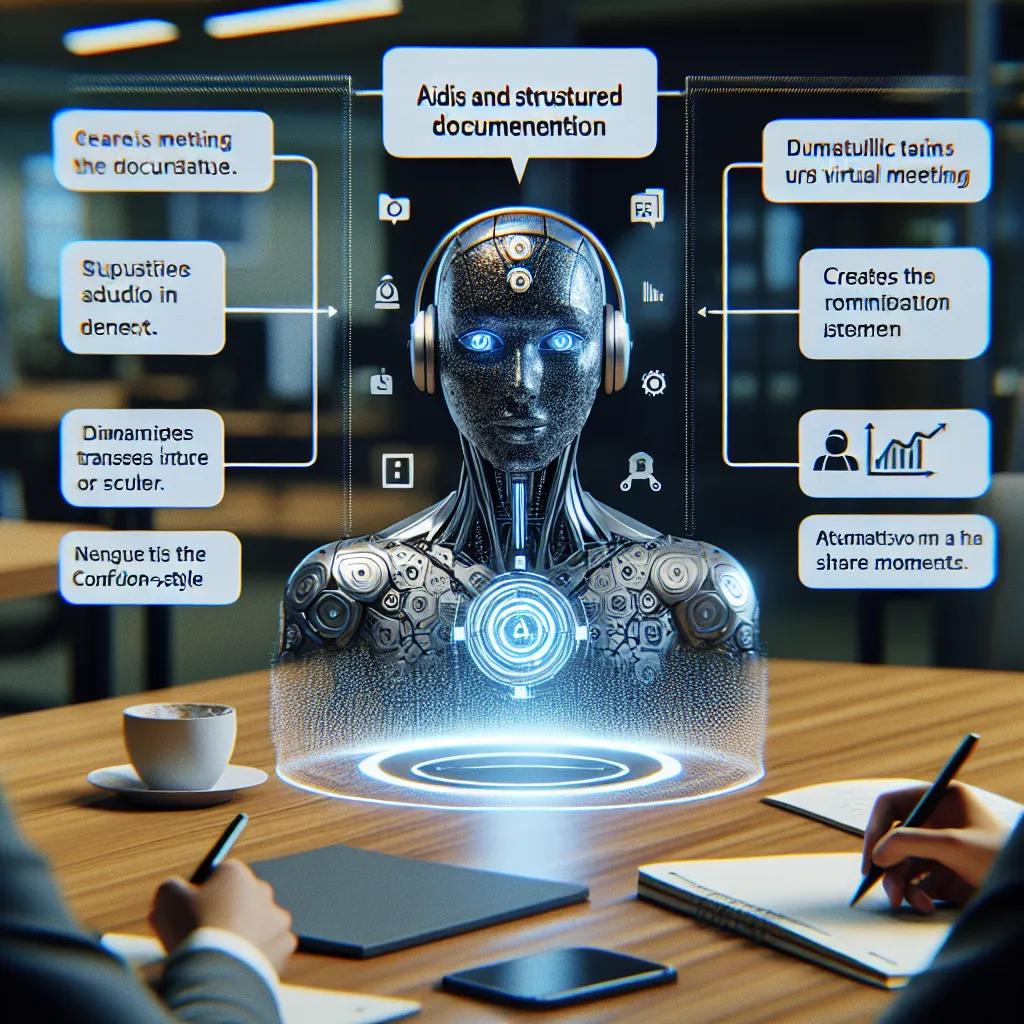
Most teams leave meetings with scattered notes, unclear ownership, and no real documentation. Transcripts help, but they’re passive — they don’t organize, summarize, or explain. Imagine instead an AI that joins the call, listens in on the discussion, and actively creates clean, structured documentation of the process being discussed. It doesn’t just transcribe — it understands. It watches the shared screen, captures key moments as screenshots, and embeds them as visuals in a polished Confluence-style page. The output is LLM-friendly — meaning future AI agents can actually read, learn from, and act on it. No more chasing down “how we did it last time.” The documentation writes itself — accurate, visual, and immediately useful.
Description
No additional description provided.
The Pitch
In today’s fast-paced business world, teams often struggle with the chaos that follows meetings. Typically, meetings produce a flurry of scattered notes, vague task ownership, and, unfortunately, a lack of coherent documentation. Teams resort to transcripts, which, while helpful, serve merely as a passive archive of what was said. They fall short in organizing, summarizing, and explaining the conversations in a way that can easily be referenced or built upon.
**The Problem** The primary challenge is the inefficiency in translating verbal meeting interactions into actionable and organized documentation. This disorganized aftermath can lead to miscommunication, lost information, and an overwhelming burden on team members to recall and reconstruct discussions for future reference. The lack of structured and interactive records hampers productivity and continuity across teams.
**The Solution** Imagine having an AI that acts as an active participant in meetings. This intelligent assistant doesn't just transcribe; it listens, understands, and creates clean, structured documentation of the meeting processes being discussed. Instead of merely storing words, it captures insights, watches the shared screen, identifies key discussion points, and takes screenshots of significant moments to include as visuals in a polished, easily navigable document. This AI-driven output is friendly to large language models, allowing other AI systems to read, learn from, and even act on the information. Essentially, it creates a self-maintained documentation ecosystem where procedures are automatically chronicled in a precise, visual, and usable format.
**Product Details** The proposed product is an AI assistant designed to integrate seamlessly with popular video conferencing tools. Its core functionalities include:
- **Active Listening and Understanding:** Rather than merely converting speech to text, the AI interprets discussion contexts and identifies critical points for inclusion in documentation.
- **Visual Process Capture:** The AI observes the shared screen during the meeting, taking relevant screenshots to supplement the written record, enhancing clarity and comprehension.
- **Structured Documentation Creation:** The assistant produces a polished output similar to a Confluence-style page, organized and easy to navigate, which can be accessed and edited immediately post-meeting.
- **Compatibility with AI Systems:** The output is formatted in a way that future AI-driven systems can parse and utilize, creating a dynamic feedback loop of information sharing and decision-making.
**Tools for Launching the MVP** For the MVP, consider leveraging tools and platforms such as:
- **OpenAI or GPT APIs:** To drive the natural language understanding and generation capabilities. - **Google Cloud or AWS:** For scalable cloud computing power and storage solutions. - **Zoom SDK or Microsoft Teams API:** To integrate the AI seamlessly into existing video conferencing platforms. - **Confluence or Notion APIs:** To produce structured documentation that fits within current collaboration tools.
**GTM Strategy** - **Identify Target Markets:** Focus initially on tech companies and remote teams who heavily rely on digital communication. - **Strategic Partnerships:** Collaborate with video conferencing and project management software providers to reach potential users directly. - **Beta Testing:** Engage early adopters through exclusive beta testing, gathering valuable feedback for iterative improvements. - **Content Marketing:** Utilize insightful content and case studies to demonstrate the efficiency and effectiveness of AI-powered documentation.
**Business Model** Adopt a SaaS subscription model with tiered pricing based on the number of users and advanced features. Offer a freemium version to attract small teams and individual users, encouraging upgrades as their organizational needs grow.
With this solution, businesses can seamlessly transition from chaotic, inefficient meeting follow-ups to well-documented processes that empower teams, improve productivity, and foster continuous learning and growth.
---