AI Distribution Channel Diversification Platform
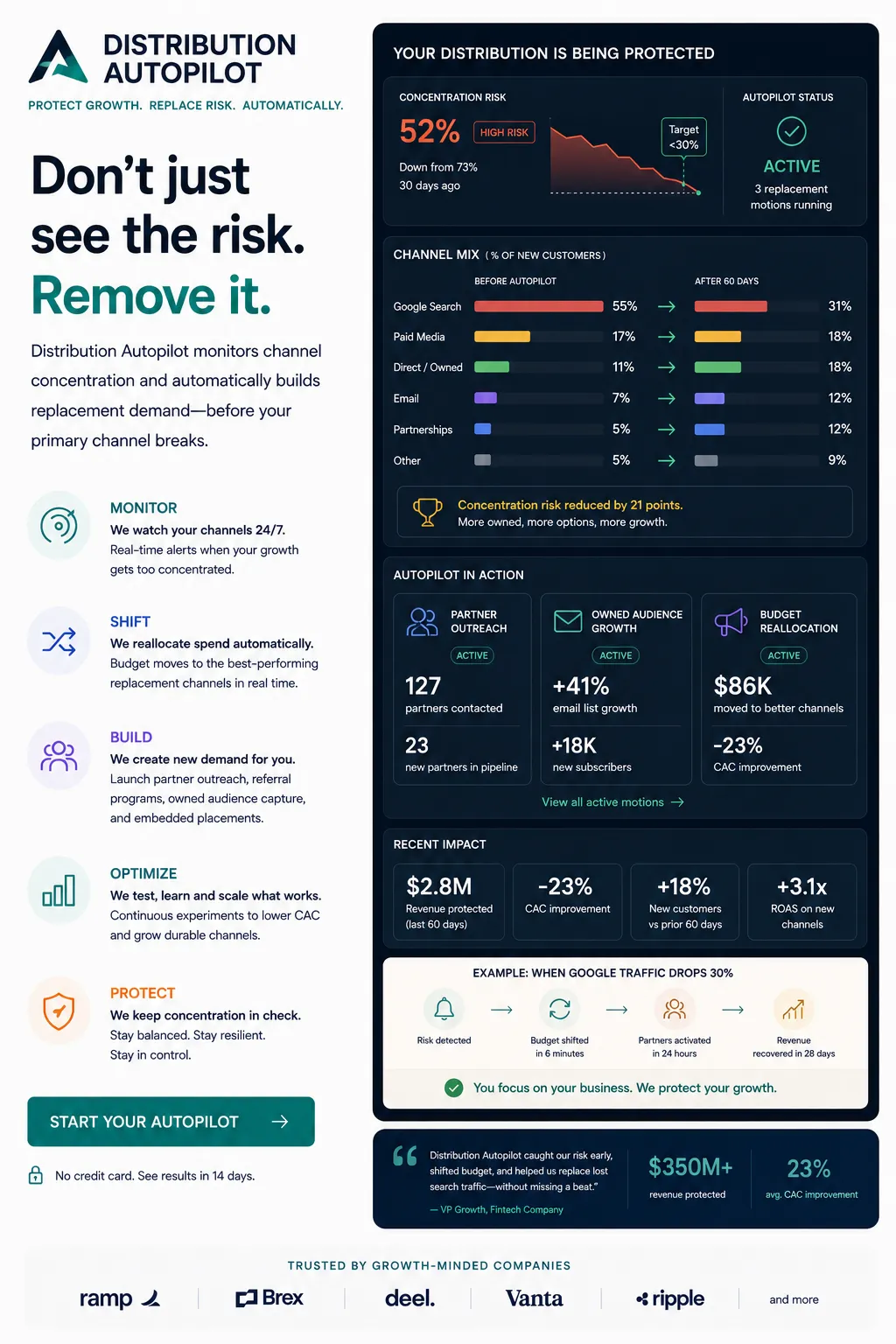
Companies depend on channels they do not control, but building alternatives manually takes years. Distribution Autopilot continuously monitors concentration and then creates replacement demand before the primary channel breaks. It can spin up partner prospecting, launch referral programs, increase owned-audience capture, deploy embedded offers, shift media spend and test new acquisition surfaces against a target CAC. Why now: AI agents can finally execute many of the repetitive tasks required to stand up new channels, not just recommend them. Example: search drives 55% of acquisition and begins deteriorating. The system automatically starts three replacement motions, reallocates 15% of budget, launches a partner-outreach sequence and increases email capture until search concentration falls below a predefined threshold.
Description
No additional description provided.
The Pitch
Distribution risk is usually treated as a marketing problem when it is closer to a balance-sheet liability. Many companies know they are overexposed to Google, Meta, Amazon, TikTok, app stores, or a single partner ecosystem, but the risk remains abstract until the channel changes rules, prices, or visibility. The interesting business is not “better acquisition software”; it is a system that turns channel dependency into something measurable, governed, and continuously reduced.
The hidden truth is that most alternative channels fail not because they are bad, but because companies start building them too late. Partnerships, referrals, owned audiences, embedded distribution, affiliates, community, and secondary media channels all have compounding curves. They are weak in the first month and powerful in the twelfth. A company that waits for its main channel to decay has already lost the time advantage. This creates room for a product that behaves less like a campaign tool and more like an insurance mechanism that is always seeding future demand.
The second important insight is that channel diversification has historically been too labor-intensive to operationalize. It requires prospect lists, outreach, creative variants, landing pages, attribution checks, budget adjustments, partner follow-ups, and constant pruning. That is why teams default back to the channel that already works, even as dependency worsens. If software can now perform much of the boring connective tissue, the economics change: diversification stops being a strategic project and becomes an always-on operating loop.
The buyer psychology is also unusually strong because the pain is felt by both growth teams and executives, but in different languages. Marketers feel rising acquisition costs and diminishing control; leadership feels fragility, forecasting risk, and valuation pressure. A system that can show “55% of demand comes from one unstable source” and then actively reduce that number speaks to a fear companies already have but rarely have a mechanism to address.
The most durable version of this company would become a memory layer for what a company has tried across distribution. Most teams lose that knowledge in spreadsheets, agency decks, and employee turnover. If the system learns which audiences, partners, offers, messages, and surfaces produce resilient demand, it becomes harder to replace over time. The asset is not just automation; it is a proprietary map of how a specific company can create demand when its favorite channel stops cooperating.