AI Distribution Channel Builder for Companies
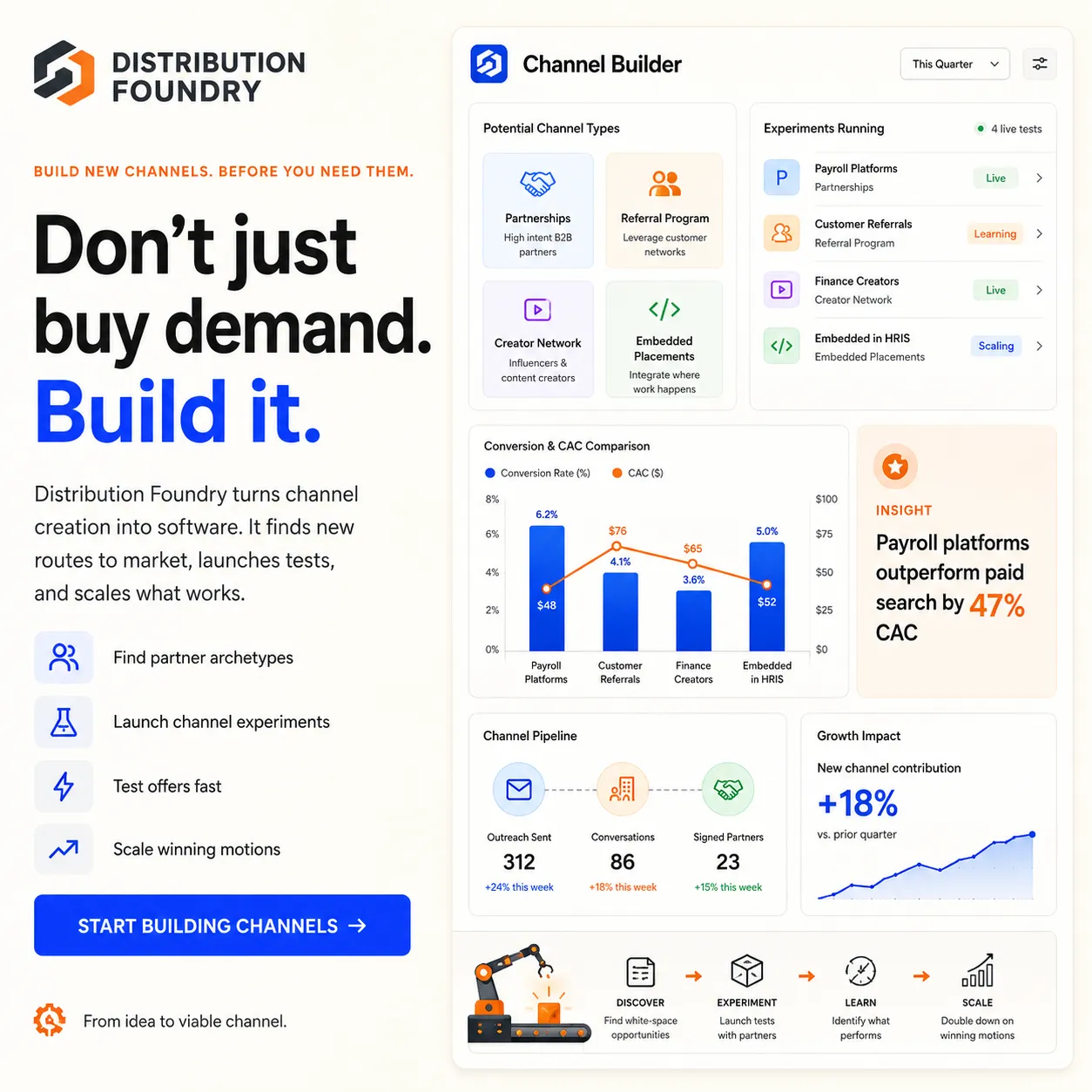
Most companies know how to buy demand but have no repeatable way to create a new distribution channel from scratch. Distribution Foundry would take an ICP, economics, product and current channel mix, then autonomously stand up new distribution motions. It could identify partner archetypes, build target lists, generate offers, launch co-marketing tests, create referral mechanics, produce embedded-placement concepts, recruit affiliates and measure which motion reaches viable economics. Why now: AI can perform enough of the research, prospecting, content generation and experimentation that “build a channel” can start becoming software instead of a six-person team. Example: organic search falls 25%. Instead of recommending partnerships, the system launches four partner archetypes, recruits 80 potential distributors, tests three offers and discovers that payroll platforms can acquire customers at half the replacement CAC.
Description
No additional description provided.
The Pitch
Distribution is one of the last major company functions still treated as craft knowledge. Paid acquisition became legible because platforms made every impression, click, and conversion measurable. Sales became systematized through CRMs and outbound tooling. But new channel creation still lives in the heads of a few operators who know how to sense where a product could travel through someone else’s audience, workflow, or incentive structure. Turning that judgment into repeatable software would be valuable because the scarce resource is not ideas for channels; it is the disciplined testing of enough plausible ones to find the hidden seam.
The deeper shift is that companies are becoming dangerously dependent on channels they do not control. Search, social, marketplaces, app stores, and ad networks all began as growth engines and matured into toll roads. As these channels decay or become more expensive, the winners will be the companies that can continuously discover new paths to customers rather than optimize yesterday’s path a little harder. A system that treats distribution as a living portfolio, not a one-time strategy exercise, would be especially powerful because channel risk is usually invisible until it is already painful.
The business is also interesting because most companies are overstaffed for execution but understaffed for exploration. Teams can write landing pages, send emails, negotiate partnerships, and analyze campaigns, but the coordination cost of trying ten unfamiliar distribution motions is high enough that they usually try one or two half-heartedly. If software can compress the messy middle—finding targets, shaping incentives, creating assets, initiating conversations, and reading early signals—it changes the unit of experimentation. A company no longer has to “choose a channel”; it can run a search process across possible channels.
The most valuable output would not be leads or meetings, but discovery of economic fit between a product and a distribution surface. That is a more durable prize than campaign performance because once a company learns that a certain ecosystem, partner type, or embedded context reliably produces profitable customers, it has found a repeatable advantage others may not see. In that sense, the product would be less like a marketing tool and more like a machine for uncovering overlooked routes through the market.
What makes the idea especially compelling is that the best channels often look weird before they look obvious. They emerge from adjacent workflows, niche trust networks, and non-obvious moments of customer intent. A company that can systematically search those places could make distribution feel less like luck and more like invention.