AI Decision Compliance Platform for Financial Institutions
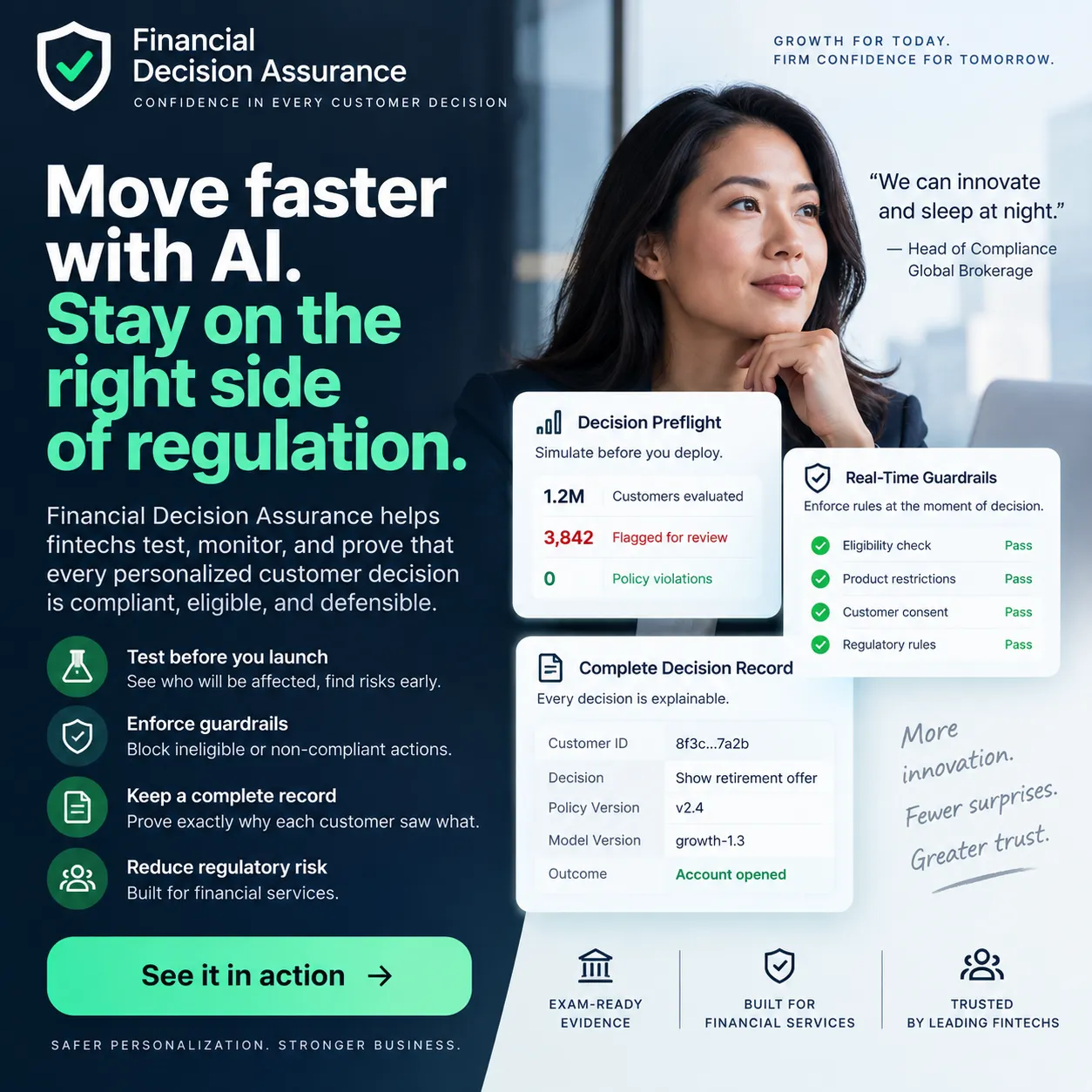
Financial institutions are beginning to use AI and personalization systems to make huge numbers of individualized decisions about which customers see which products, offers, prompts, and financial journeys, but compliance processes were designed around reviewing campaigns and content rather than supervising millions of customer-level machine decisions. The opportunity is an independent decision-assurance layer that can replay proposed decision policies against historical customers before launch, show who would be affected and why, enforce eligibility and compliance rules, and preserve an evidence trail of the customer state, policy, model, decision, and outcome behind each intervention. Why now: AI decisioning is making financial personalization far more granular and dynamic while the institution remains responsible for what those systems do, creating a gap between decision engines and traditional compliance tooling. For example, before a brokerage launches a new AI policy intended to move eligible stock investors toward options, the system could replay the policy across prior customers, identify who would have been targeted, flag ineligible or problematic cases, and show compliance exactly how the decision logic behaves before it reaches a live user.
Description
No additional description provided.
The Pitch
Financial institutions are moving from supervising messages to supervising behavior. In the old world, a bank could approve an email, a banner, or a branch script and feel it had reviewed the customer interaction. In the new world, the important object is not the content but the decision: why this customer, at this moment, received this nudge and not another. That shift quietly breaks a large part of the compliance stack, because the regulated artifact has become dynamic, individualized, and often invisible until after it acts.
The most interesting part is that the buyer does not need to believe AI is dangerous in some abstract way. They only need to recognize that personalization creates a recordkeeping problem. If two customers see different paths through the same financial product, the institution must be able to explain the difference later, under scrutiny, with enough precision to satisfy people who were not present when the system acted. The product becomes valuable because it turns fleeting machine decisions into durable institutional memory.
There is also a natural separation of powers problem inside financial firms. The teams building growth, recommendation, and decisioning systems are usually rewarded for better targeting and more conversion, while compliance is responsible for the consequences of that targeting. An independent assurance layer gives compliance a way to inspect and constrain these systems without asking product teams to stop personalizing. That is a rare wedge: it does not fight the business desire for more intelligent customer treatment, but makes that desire governable.
The strongest businesses in regulated markets often sit at the boundary between innovation and permission. As financial products become more personalized, the permission to deploy them may depend less on whether a policy sounds acceptable in principle and more on whether the institution can prove how it behaves across edge cases. A system that can surface those edge cases before launch becomes part of the machinery of release itself, not a nice-to-have dashboard.
What makes the idea durable is that it addresses a recurring burden, not a one-time audit. Every model change, rule change, product change, eligibility change, and market condition can alter who is touched and why. The more successful personalization becomes, the more decisions there are to assure. In that sense, the business grows with the very complexity it helps contain.