AI Customer Service Margin Management Platform
Companies usually respond to rising service cost after margins have already deteriorated. Margin Autopilot would actively protect a target contribution margin by changing how each customer is served: automate low-risk work, move expensive interactions to self-service, change SLA, batch work, substitute vendors, trigger repricing or require an upgrade when service intensity crosses a threshold. Why now: AI agents can increasingly execute the operational changes required to reduce service cost rather than simply report it. Example: a membership customer begins using concierge service at four times the expected rate; the system moves routine requests to automation, reserves humans for complex cases and triggers a higher service tier before that customer becomes structurally unprofitable.
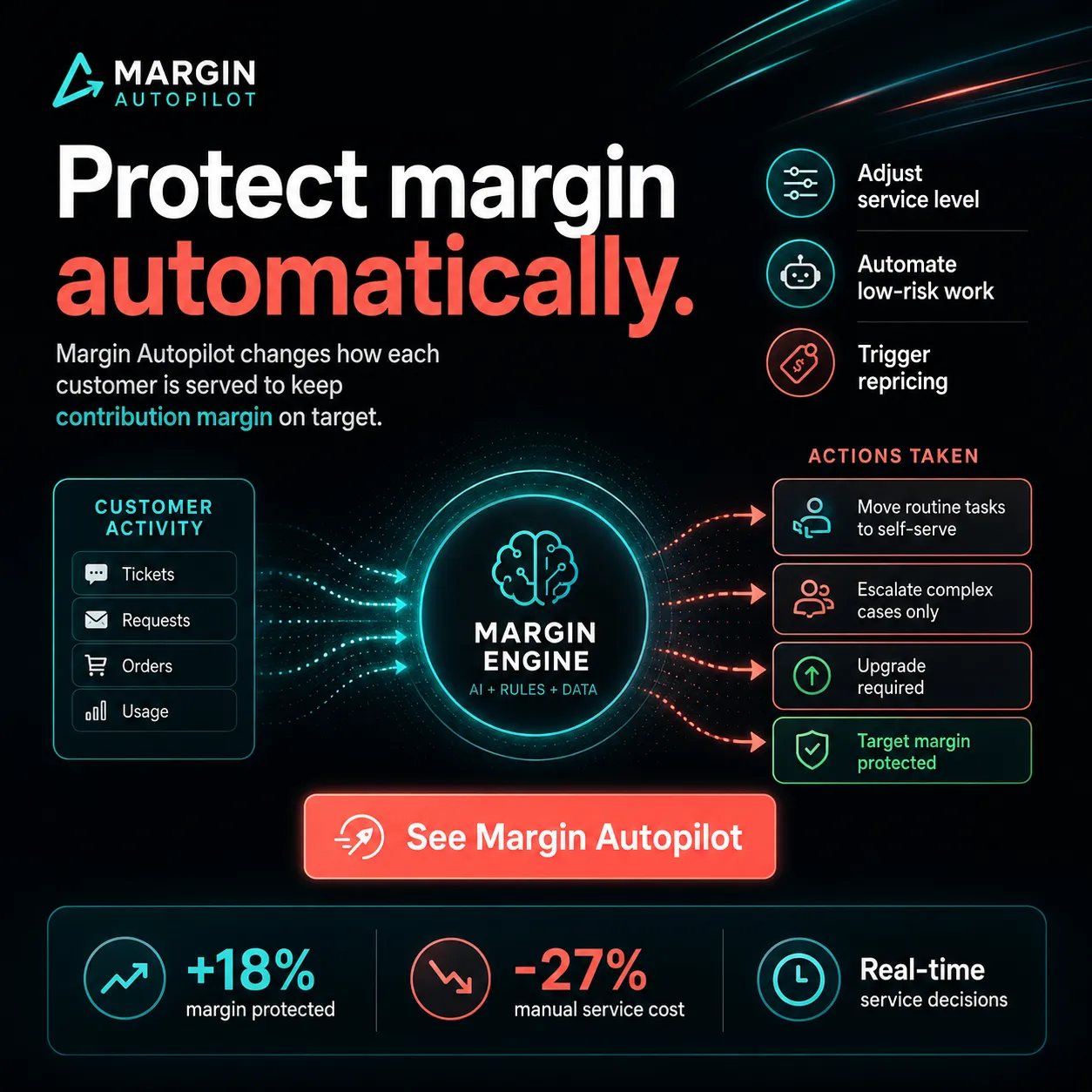
Description
No additional description provided.
The Pitch
The core appeal is that service cost is usually treated as an accounting fact, when it is actually a product behavior. Every support ticket, exception, escalation, custom request, rush job, and human handoff is a tiny renegotiation of the original deal. Most companies price the customer once, then silently reprice themselves downward every time they deliver more service than planned. A business that makes those service choices explicit would expose one of the least understood forms of margin leakage: customers do not just buy differently, they consume differently.
This would be especially compelling in companies where average margin hides extreme variance. Two customers can pay the same amount and look identical in a billing system, while one is effortless and the other quietly absorbs the profit of the entire cohort. The important insight is not simply that some customers are unprofitable; it is that many become unprofitable gradually, through operational habits that no single team owns. Sales wants retention, support wants resolution, operations wants speed, finance wants margin, and the customer receives whichever compromise is least visible. The company that coordinates those tradeoffs in real time becomes a kind of margin governor for the business.
The non-obvious prize is that margin protection can become part of the service experience rather than a back-office correction. Today, companies often respond to expensive customers with blunt moves: surprise price increases, degraded support, or account reviews after resentment has already accumulated. A more adaptive system could preserve the best parts of the relationship by changing the fulfillment path before the economics break. That makes the business less about cost-cutting and more about keeping promises at the right altitude: humans where judgment matters, automation where repetition dominates, premium service where premium usage is real.
This also changes how companies think about customer value. Revenue has been instrumented obsessively, while cost-to-serve is still strangely episodic and anecdotal. If a company can see service intensity as it emerges, it can distinguish a customer who is growing into a better tier from one who is exploiting a mismatch in the model. That distinction is commercially powerful because it replaces moral language—“demanding,” “abusive,” “strategic”—with economic clarity.
The business would matter because many modern companies are becoming service businesses even when they sell software, memberships, logistics, benefits, healthcare, or financial products. As AI makes labor easier to deploy, the temptation will be to over-serve everyone. The winners will not be the companies that automate the most, but the ones that know exactly where service creates loyalty and where it merely donates margin.