AI Customer Acquisition Channel Planner
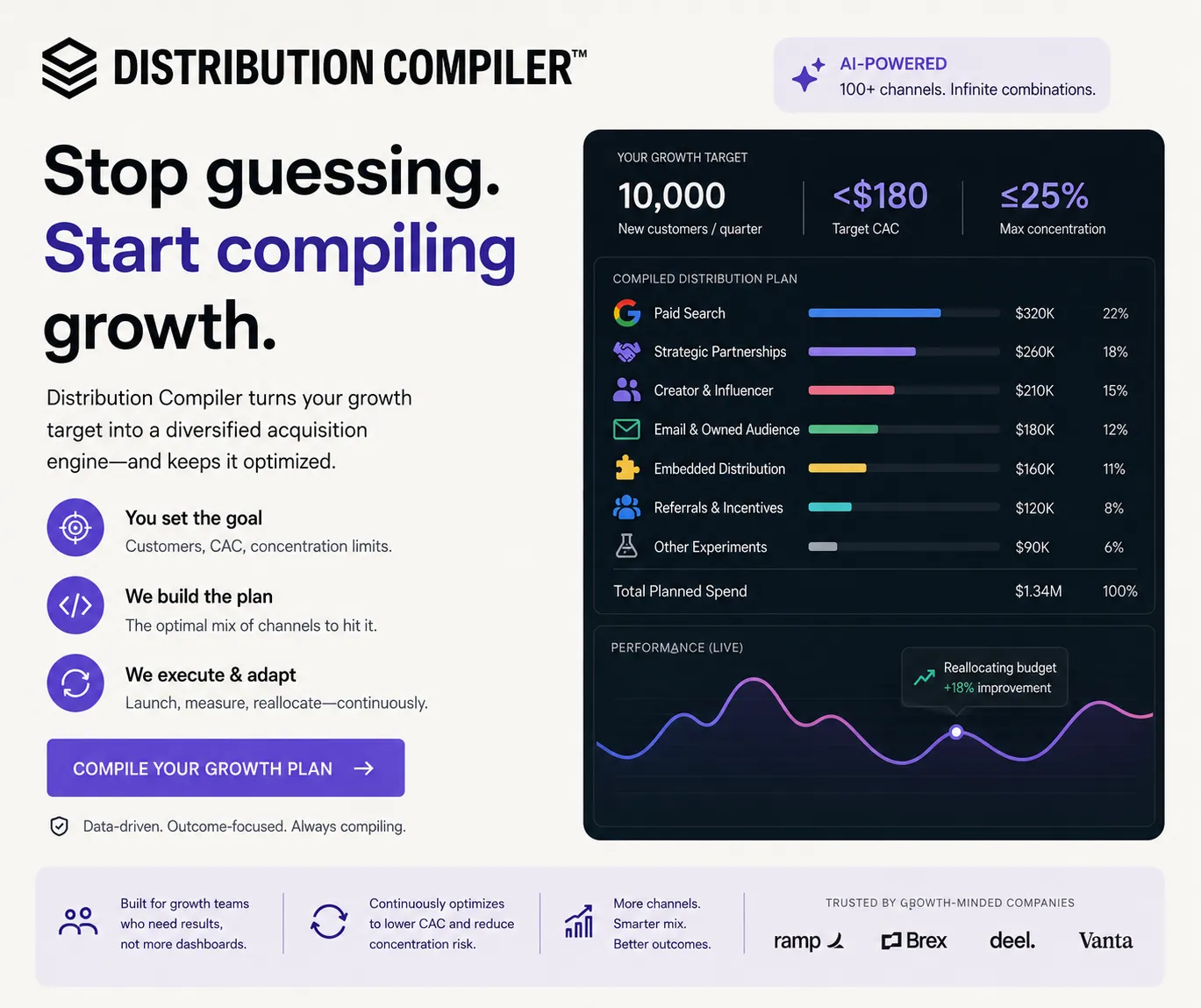
Companies know how many customers they need and what CAC they can afford, but they still build distribution channel by channel through manual planning and experimentation. Distribution Compiler turns a growth target into a live acquisition architecture, deciding what mix of paid, partnerships, referrals, creators, embedded distribution and owned audience should exist, then continuously reallocating effort as performance changes. Why now: AI can finally coordinate the research, outreach, testing and optimization required to stand up multiple channels at once. Example: a company asks for 10,000 new customers per quarter at under $180 CAC with no channel above 25%, and the system builds and manages the distribution mix required to hit it.
Description
No additional description provided.
The Pitch
Distribution is still treated as craft work even when the goal is mathematical. Most businesses do not really want “Google ads” or “creator partnerships” or “referral programs”; they want a certain number of customers at an acceptable cost, with enough resilience that one platform change does not ruin the quarter. The strange inefficiency is that teams translate this simple desired outcome into a dozen disconnected channel bets, each managed with its own tools, vendors, dashboards, and folklore. A distribution compiler would invert that relationship: channels become interchangeable inputs to an acquisition system, not identities teams organize around.
The deeper opportunity is that most companies are under-diversified in distribution not because they lack imagination, but because coordination costs make diversification feel irresponsible. Running five acquisition channels at once usually means five kinds of expertise, five feedback loops, and five ways for accountability to blur. If software can make multi-channel execution feel as legible as managing one channel, it changes what a “normal” growth motion looks like. The default stops being over-reliance on whichever channel the founding team happened to understand first.
This is especially interesting because channel performance is increasingly perishable. A tactic that works for six months gets copied, priced up, throttled by platforms, or weakened by audience fatigue. The durable asset is not the channel itself, but the machinery for discovering, testing, and reallocating across channels faster than competitors. In that world, the business resembles a market maker for attention: constantly sensing where acquisition is mispriced and moving budget, effort, and creative supply toward the temporary inefficiencies.
It also addresses a quiet organizational problem: growth teams often know something is broken before they can prove what should replace it. They are trapped between attribution data that is too narrow and strategic planning that is too vague. A system that can express distribution as a portfolio gives management a more useful language: concentration risk, marginal CAC, channel dependency, payback variance, and capacity constraints. That may sound less glamorous than a new acquisition hack, but it is how mature companies actually make distribution decisions when the stakes get high.
The most compelling version would not be valuable because it automates marketing tasks. It would be valuable because it turns customer acquisition from a collection of channel opinions into an adaptive operating system. Businesses spend enormous sums trying to buy growth; the rarer capability is knowing where growth should come from next.