AI Competitor Website Change Alerts
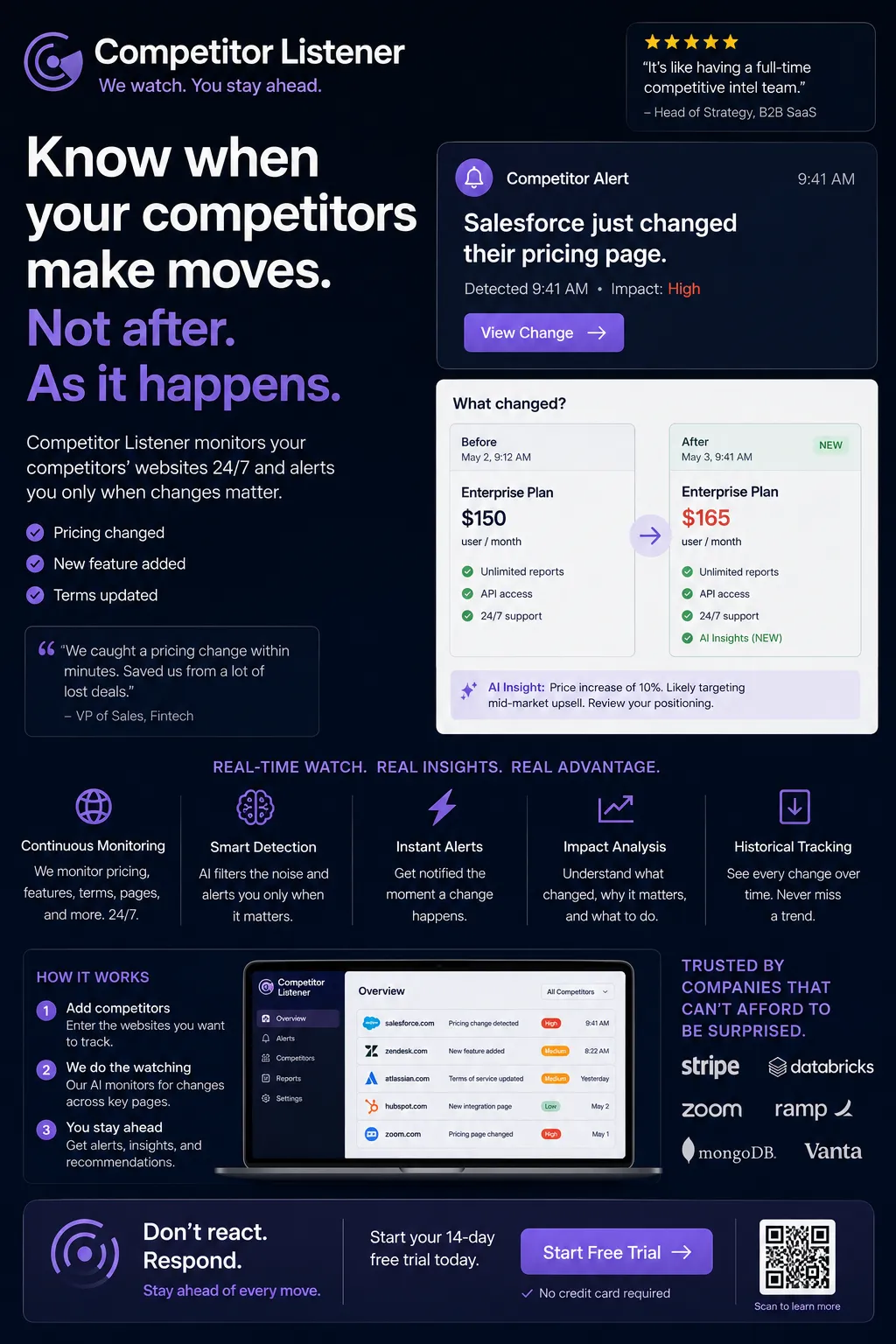
You probably don't need another competitive intelligence dashboard. You need someone to tap you on the shoulder when a competitor actually does something. Give Competitor Listener a list of companies and it watches their websites continuously. Pricing changed. New feature added. Enterprise page rewritten. Free trial disappeared. Terms changed. New integration launched. Instead of sending you every change, AI explains what changed, why it might matter, and only alerts you when something is worth knowing. Google Alerts, except for the parts of a competitor's business you actually care about.
Description
No additional description provided.
The Pitch
Most competitive intelligence fails because it treats information as the product, when the real product is interruption. A competitor changing a headline is not inherently useful; a competitor quietly replacing “contact sales” with “start free trial” may be. The valuable unit is not a webpage diff, but a judgment that something has crossed the threshold from noise into consequence. A business built around that judgment would be compelling because it sells back attention to people whose jobs require them to notice the market but punish them for watching it all day.
The internet has made companies more transparent than they intend to be. Strategy now leaks through pricing pages, hiring pages, changelogs, documentation, terms of service, integration directories, and small copy edits written by product marketers under deadline. Individually these fragments look trivial. In sequence, they become a shadow earnings call: who a company is pursuing, what they are abandoning, where margins are tightening, which customer objections they keep trying to answer. The opportunity is in turning the public web into a living behavioral record of companies, not a pile of pages.
The timing is interesting because AI changes the cost of interpretation, not just collection. Previous monitoring tools could tell you that something changed; they could not reliably say whether the change was a repositioning, a test, a legal cleanup, a packaging shift, or a sign of competitive pressure. Humans still need to make the final call, but software can now do the tedious first read: compare old and new language, infer the likely commercial meaning, and suppress changes that are technically new but strategically empty. That makes the service feel less like another feed and more like a sharp analyst who never sleeps.
The strongest version of this business would become part of how teams build institutional memory. Most companies only understand competitors through anecdotes that decay: a sales call from last quarter, a screenshot in Slack, a rumor from a customer. A continuous listener creates a timestamped narrative of how rivals evolve. Over time, the archive may become more valuable than the alerts, because it lets a team see not just what a competitor says today, but how often they reverse themselves, where they copy the market, and which moves precede commercial aggression.
The defensibility is subtle: the hard part is not scraping pages, but learning what each customer considers meaningful. One company cares when enterprise language changes; another cares when developer docs shift; another cares when security claims appear. The product gets better as it learns the user’s anxieties. That is why the business can be narrow and still important: it does not need to know everything about every competitor, only the few changes that would make the right person stop what they are doing.