AI Communication Coach for Workplace Teams
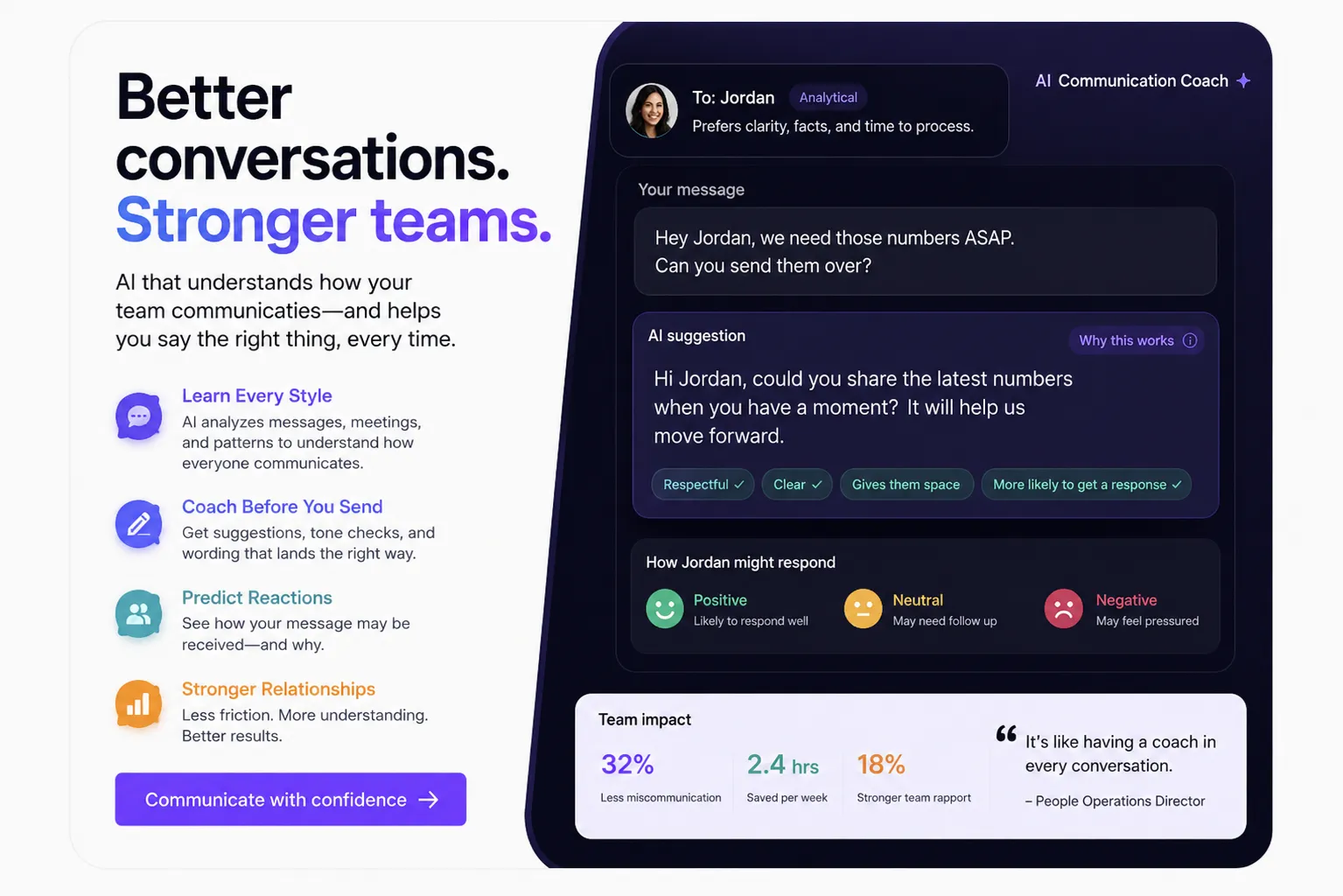
Most workplace conflict isn't caused by bad intentions—it's caused by people communicating differently. Employees waste enormous amounts of time misunderstanding coworkers, managers, and clients because they don't know how each person prefers to receive feedback or make decisions. Imagine an AI that learns everyone's communication style from emails, Slack messages, meetings, and personality assessments, then coaches every conversation before you hit send. It suggests wording, predicts reactions, explains why someone may respond defensively, and helps teams communicate more effectively without changing who they are. As AI gains persistent context across workplace communication, interpersonal coaching can become real-time rather than something reserved for executive coaches
Description
No additional description provided.
The Pitch
A business like this would be compelling because communication problems are one of the few workplace costs that are both everywhere and mostly invisible. A bad meeting, a defensive Slack thread, or a poorly framed piece of feedback rarely appears as a line item, but it quietly compounds into slower decisions, avoidable turnover, and entire teams working around each other instead of with each other. The interesting opportunity is not to make people “better communicators” in the abstract, but to reduce the translation tax paid every time two capable people misread each other.
The deeper insight is that every company already contains a dense, living map of how its people think, react, decide, and collaborate; it is just trapped in the exhaust of daily work. Emails, chat, documents, call transcripts, and calendar patterns reveal far more about interpersonal dynamics than annual engagement surveys or one-off personality tests. If that map can be made useful at the moment a message is written or a hard conversation is prepared, the company gains something closer to emotional infrastructure: not therapy, not HR policy, but a layer of practical interpretation between humans.
This also works because the value increases with context in a way generic writing tools cannot match. A normal assistant can make a message clearer; a workplace-native coach can know that “quick feedback” from one manager feels abrupt to one employee, that another colleague equates directness with respect, or that a client becomes difficult when options are framed too broadly. The product becomes less about polishing language and more about preserving intent across different interpersonal operating systems.
The most powerful wedge is that it serves both the individual and the organization without making either feel like the product is only for the other. Employees get fewer unpleasant surprises and less social guesswork. Managers get a way to handle difficult conversations before damage is done. Companies get better collaboration without forcing everyone through another training module that is forgotten by Thursday. The best version would feel less like surveillance and more like a private interpreter for the social complexity of work.
If this existed, it could become important because modern work has made communication faster while making mutual understanding harder. Remote teams, cross-functional work, and text-heavy collaboration have removed many of the cues people once used to repair misunderstandings in real time. A tool that restores some of that lost context could become as normal as spellcheck: not a replacement for judgment, but a quiet warning system for the moments when words are about to do something different from what the sender intends.