AI Co-Pilot Enhances Human Judgment and Skills
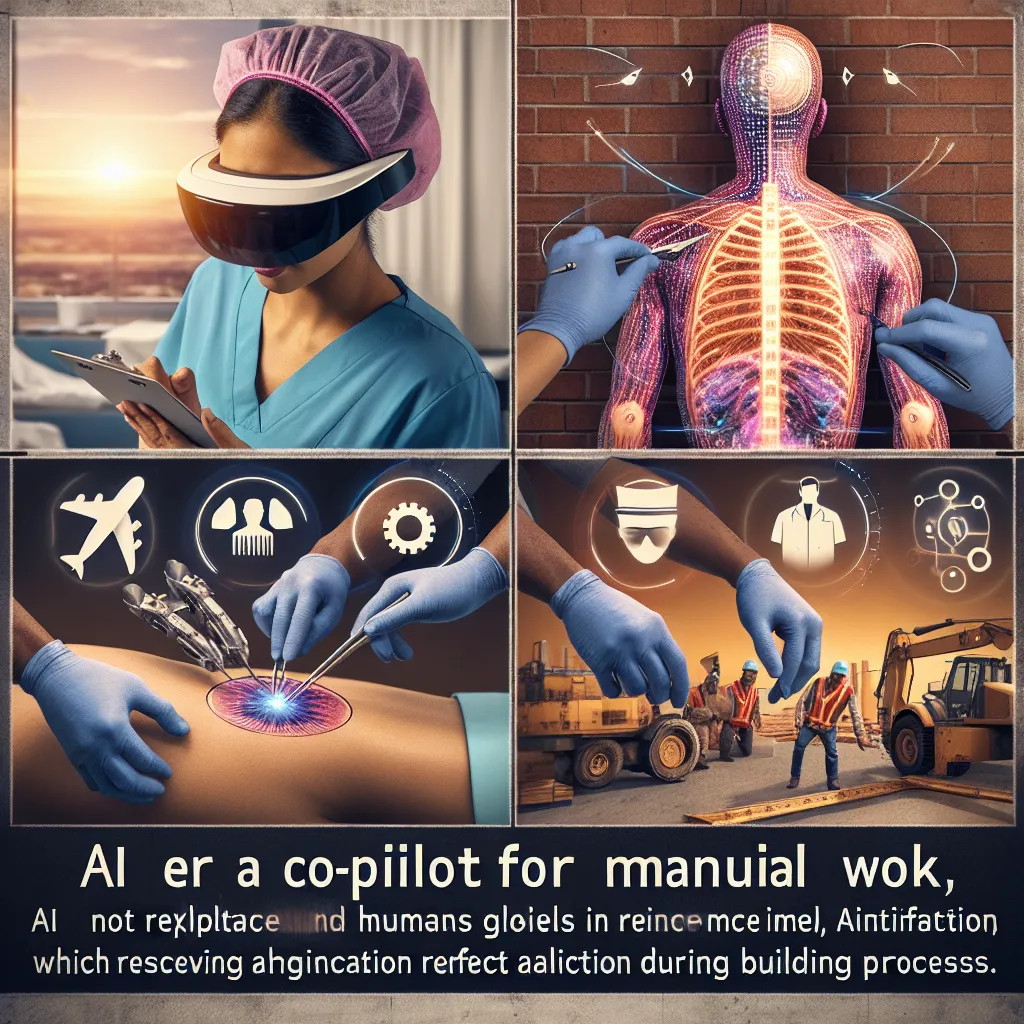
AI is excellent at full autonomy but struggles in hybrid collaboration — especially where human judgment is still key. A Co-Pilot for Manual Work would integrate LLMs and computer vision into industries like healthcare or construction, guiding workers in real time, correcting errors, suggesting optimizations, and keeping humans in the loop without taking over entirely. Why now? The next wave of AI adoption isn’t just replacing humans — it’s augmenting them where judgment, dexterity, and improvisation matter. Imagine a nurse with AR glasses receiving real-time AI-guided suggestions during complex wound care or a construction worker getting visual AI overlays ensuring perfect alignment during builds, without being replaced by robots.
Description
No additional description provided.
The Pitch
In today's rapidly evolving technological landscape, artificial intelligence (AI) has made significant strides in achieving full autonomy. However, one of the critical challenges remains its capability to collaborate effectively in hybrid environments where human judgment plays a crucial role. This need becomes particularly evident in fields like healthcare and construction, where nuanced decision-making, dexterity, and improvisation are paramount. The concept of a Co-Pilot for Manual Work proposes a solution to this challenge by integrating Large Language Models (LLMs) and computer vision to assist and enhance human performance in real-time, without displacing the invaluable human element.
Backstory
The increasing complexity of tasks in industries such as healthcare and construction demands both enhanced precision and efficiency. Despite the rise of autonomous systems, there are still scenarios where human expertise cannot be fully replaced due to the need for judgment and adaptability. For example, in healthcare settings, nurses perform intricate procedures that require careful consideration and adaptability to patient-specific conditions. Similarly, construction workers often face unique on-site challenges that demand improvisation and fine motor skills.
Problem
Current AI solutions either aim for full automation, risking the complete removal of the human element, or fail to adequately integrate with manual tasks that require human intuition and adaptability. This gap between advanced AI capabilities and the need for human oversight and involvement poses a significant challenge in industries that depend on skilled manual labor. Without a system that adequately supports the human workforce, we risk errors, inefficiencies, and a lack of innovation in critical sectors.
Solution
To bridge this gap, the development of a Co-Pilot for Manual Work is proposed. This co-pilot system would leverage LLMs and computer vision technologies to provide real-time guidance, error correction, and optimization suggestions. The system aims to keep humans in the loop and enhance their capabilities without taking over entirely. By doing so, it ensures that tasks are performed with greater accuracy, efficiency, and safety. For instance, nurses equipped with augmented reality (AR) glasses could receive real-time AI-guided suggestions during complex wound care procedures. Similarly, construction workers could benefit from visual AI overlays, ensuring precise alignment and adherence to plans in real-time.
Product Details
The Co-Pilot for Manual Work will consist of several key components:
1. Augmented Reality Hardware: AR glasses or wearable devices will deliver real-time visual cues and instructions to the user, ensuring seamless integration with the environment.
2. AI-Driven Software: Integrating LLMs for contextual understanding and computer vision for environment interaction. These technologies will collaborate to provide situationally aware guidance, corrective feedback, and optimization recommendations.
3. User Interface: An intuitive interface design will provide users with easy access to AI advice without overwhelming them or distracting from their primary tasks.
4. Feedback Loop: Continuous learning from user interactions to refine and improve AI models, ensuring evolving accuracy and relevance.
Tools for MVP Launch
1. Develop a basic prototype using off-the-shelf AR hardware and open-source AI libraries for rapid testing and iteration. 2. Gather a small focus group from target industries for initial feedback and data collection. 3. Use agile development practices to refine features and usability based on early user interactions.
Go-To-Market Strategy
1. Identify key industry partners in healthcare and construction for pilot programs. 2. Leverage case studies and testimonials from pilot programs to build credibility and authority. 3. Participate in industry conferences and events to showcase technology capabilities and benefits. 4. Develop strategic partnerships with AR hardware providers to streamline integration.
Business Model
1. Subscription-Based Service: Offer a tiered subscription model that provides access to continuous updates, customer support, and feature enhancements. 2. Custom Solutions: Provide compliance and customization services for enterprises requiring tailored implementations. 3. Consulting: Offer consulting services to help organizations optimize workflows and maximize the co-pilot’s potential.
Conclusion
The Co-Pilot for Manual Work addresses a pressing need across industries that demand both expert human judgment and advanced AI support. By creating a symbiotic relationship between technology and human expertise, industries can improve efficiency, reduce errors, and maintain high standards of work. As AI continues to advance, fostering environments where human and machine collaboration can thrive will be key to unlocking future innovations.