AI-Certified Job Transition Coach Platform
As automation and AI rapidly displace roles like clerks, tellers, and administrative assistants, millions of workers are being left without a clear path forward. Today’s reskilling programs are generic and rarely account for individual skillsets or local job markets. A novel platform could act as an “AI-Certified Job Transition Coach,” providing hyper-personalized reskilling pathways based on a worker’s background, psychometric profile, and demand in their geography. The system would simulate job market changes and recommend tangible next steps—courses, internships, or apprenticeships—verified by employers. Backed by the trend of AI-enhanced workforce planning and the projected displacement of 92 million jobs, this service could be piloted with government agencies or Fortune 500 companies seeking to mitigate layoffs.
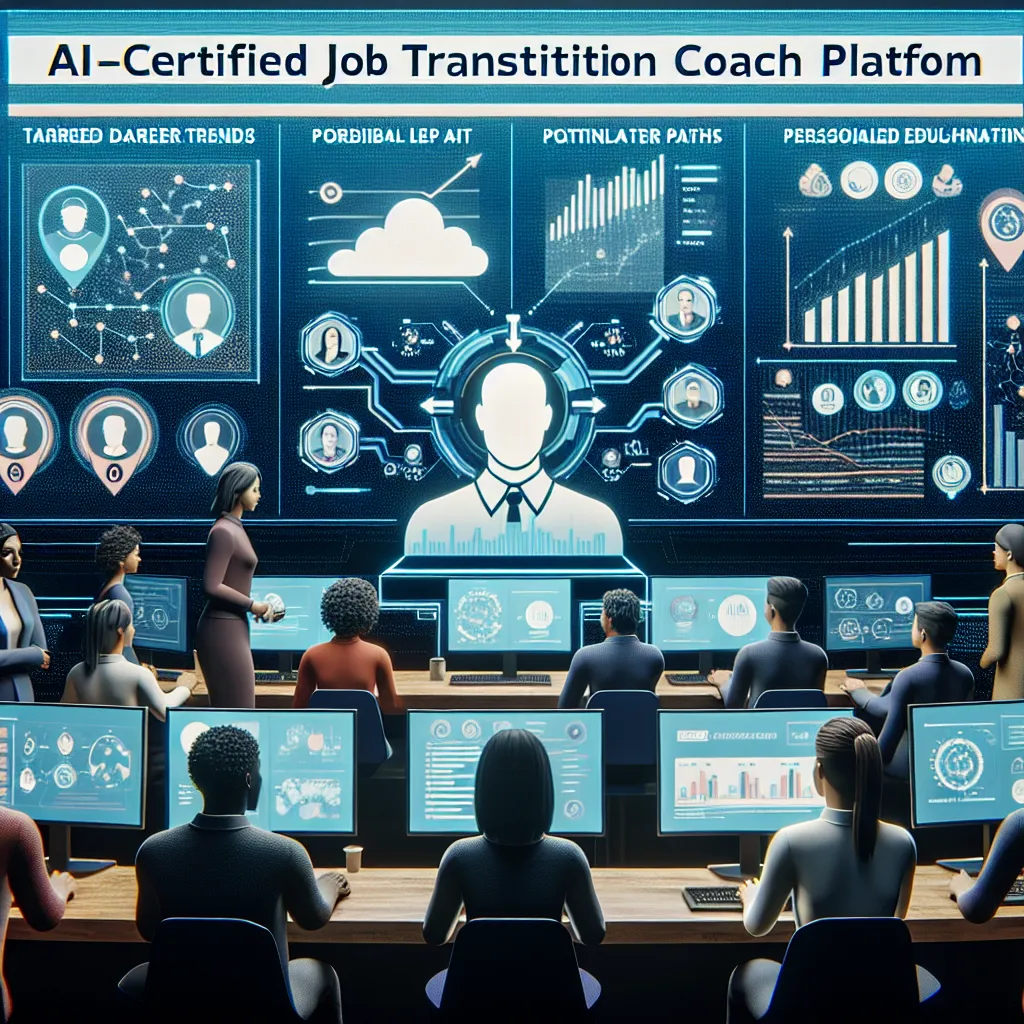
Description
No additional description provided.
The Pitch
In an era defined by rapid technological advancement, particularly in the realms of automation and artificial intelligence, the workforce landscape is undergoing a seismic shift. Roles traditionally held by clerks, tellers, and administrative assistants are increasingly being supplanted by algorithms and machines. This transformation is leaving millions of workers in need of new career directions, but current reskilling programs often fall short. They tend to be too generic, lacking customization based on individual skills or the nuances of local job markets.
The solution is to develop an innovative platform that serves as an AI-Certified Job Transition Coach. This platform would provide hyper-personalized reskilling pathways tailored to an individual’s unique background, psychometric profile, and the specific demand in their geographical area. The heart of the system would be a sophisticated engine capable of simulating job market changes and recommending concrete next steps. These steps would include courses, internships, or apprenticeships, all verified and endorsed by potential employers.
The concept for this platform aligns with the growing trend towards AI-enhanced workforce planning. As projections indicate the potential displacement of up to 92 million jobs, the need for such adaptive tools is pressing. This platform could initially be piloted in collaboration with government agencies or large corporations, particularly those in the Fortune 500 bracket, seeking strategies to mitigate the impact of layoffs.
For those interested in building this platform, the approach involves several key components:
1. **Backstory:** The impetus for this platform arises from the accelerating displacement of traditional roles by technology. Workers are confronted with an uncertain future where their current skills may no longer be relevant. Meanwhile, existing programs typically offer one-size-fits-all solutions that inadequately prepare individuals for new opportunities.
2. **Problem:** The core issue is that standard reskilling programs do not account for the individual worker's existing skills, personal attributes, or the specific job market dynamics of their location. Consequently, workers face barriers in transitioning smoothly to new roles.
3. **Solution:** The proposed platform acts as a sophisticated career transition tool. By using AI to analyze a worker’s profile in depth, it generates personalized reskilling paths. The system’s AI models are trained to understand market trends and future job availability, ensuring suggestions are practical and timely.
4. **Product Details:** The platform would consist of several modules: - Data Collection: Captures users' work history, skills, interests, and geographical data. - Analysis Engine: Uses this data to create psychometric profiles and predict career trajectories. - Simulation and Recommendation: Provides a simulation of market changes and tangible next steps. - Verification: Involves potential employers to verify and endorse the skills and pathways suggested.
5. **Tools and Technologies:** Leveraging cloud-based infrastructure for scalability, the platform would integrate machine learning algorithms for data analysis and prediction. Front-end development tools would ensure a user-friendly interface, while a secure database would protect user information.
6. **GTM Strategy:** A targeted go-to-market strategy would involve partnering with government labor departments and large corporations experiencing technological disruptions. Marketing efforts would highlight the platform’s ability to prevent layoffs by offering alternative career pathways.
7. **Business Model:** The platform could adopt a subscription model for institutions and enterprises, with tiered pricing based on the number of users. Additional revenue streams might include partnerships with educational institutions offering verified courses.
By providing a tailored, data-driven approach to career transitions, this platform could become an essential tool in navigating the future workforce landscape. Through strategic partnerships and a focus on real-world applications, it addresses an urgent need in today’s labor market.