AI Career Simulation Platform
Most people choose careers from job descriptions, YouTube videos, or advice from people whose experiences are years out of date. Then they spend four years and tens of thousands of dollars discovering they hate the reality. Imagine an AI that lets you live a career before committing. It simulates your first year as a venture capitalist, product manager, surgeon, or startup founder, showing the projects you'll work on, the meetings you'll sit through, the skills you'll need, and even introducing you to people already doing the job. Instead of guessing what a career feels like, you experience it before investing years of your life. That's a product that needs to exist.
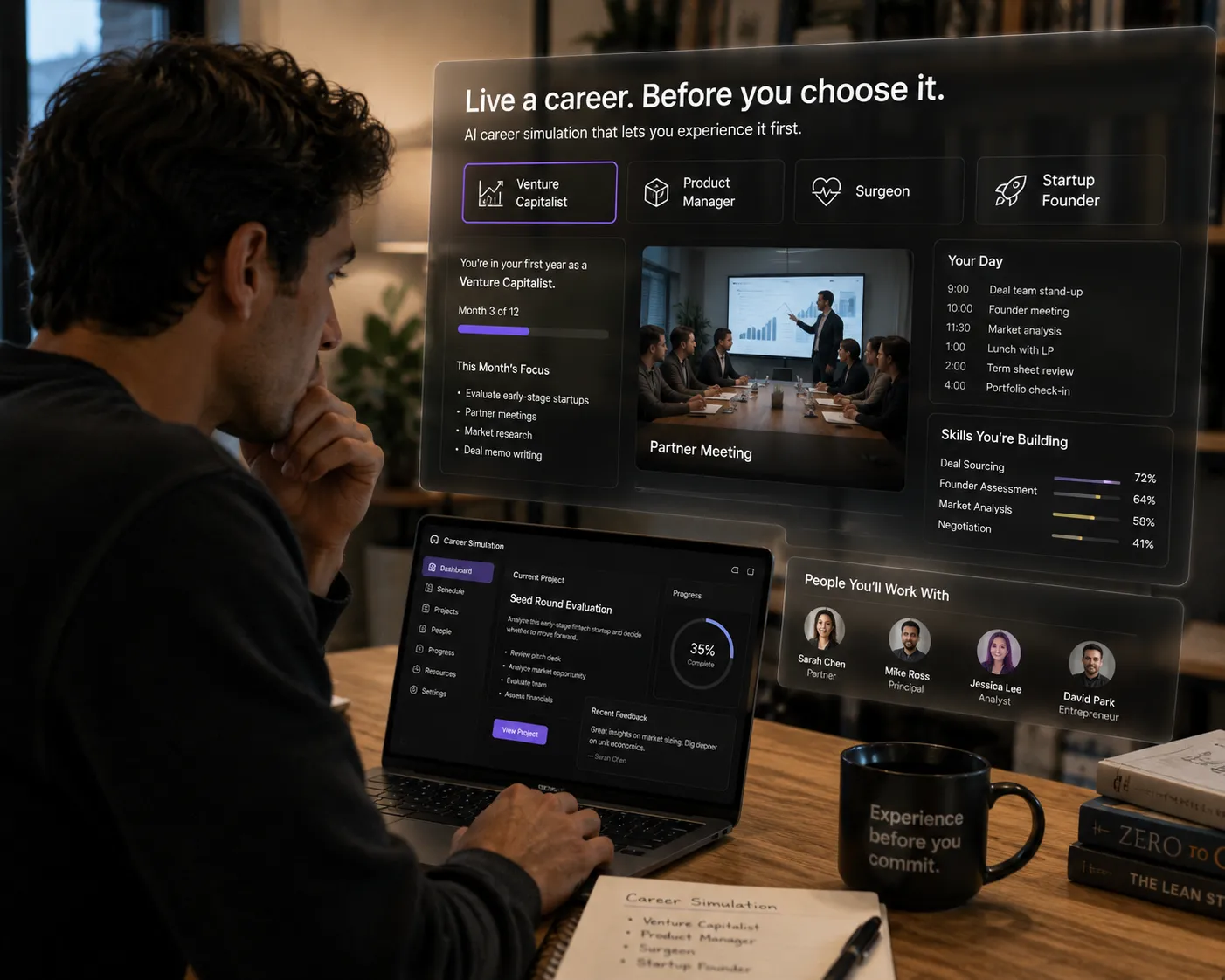
Description
No additional description provided.
The Pitch
Careers are one of the largest purchases people make without a trial period. College, graduate school, unpaid internships, relocation, and early-career opportunity cost are all bets placed on very low-resolution information. The strange part is not that people make bad career choices; it is that society has normalized making them from marketing materials. A product that turns career choice from abstract aspiration into lived rehearsal would sit at the point where personal identity, education spending, and labor-market allocation all collide.
The most valuable insight is that people do not only need information about careers; they need disillusionment at the right time. Many prestigious paths are attractive because outsiders see the status and not the texture: the inbox, the repetitive analysis, the emotional labor, the boredom, the politics, the ambiguity. A realistic simulation can make disappointment useful instead of expensive. If someone discovers after three hours that they hate the day-to-day of investment banking or clinical medicine, that is not a failed conversion; it is the product delivering its highest form of value.
It also changes career discovery from a content problem into an experience problem. The internet already has endless interviews, salary reports, “day in the life” videos, and Reddit threads, yet people still misjudge fit because passive consumption lets them preserve fantasies. Asking someone to write the memo, triage the patient, debug the product launch, handle the client call, or make the tradeoff under time pressure reveals preferences they could not have articulated beforehand. The defensible asset is not simply career information, but a growing map of how different kinds of people react to different kinds of work.
The business becomes more interesting as work itself changes faster than credentials. Traditional guidance systems are anchored to stable professions; modern careers are increasingly bundles of tasks, tools, workflows, and cultures that mutate every few years. A simulation layer could stay closer to the frontier than universities or career offices because it can be updated from practitioners’ actual work patterns. In that sense, it would not just help people choose a career; it would become a living interface between the labor market’s reality and the stories people tell themselves about it.
The emotional pull is unusually strong because the customer is not merely buying advice. They are buying a safer encounter with a possible self. That is rare: a practical product with existential stakes.