AI Brand Name Testing Platform
Launching a new brand is one of the few major business decisions that's still driven largely by intuition. Founders debate names for weeks without knowing how customers will actually react until after launch. Imagine an AI that predicts how a brand name will perform before it's ever released, scoring memorability, pronunciation, emotional associations, trust, distinctiveness, and even how quickly people will recognize and recall it across different markets and languages. Instead of relying on focus groups or personal preference, companies could test hundreds of names in minutes and understand why one is likely to outperform another. As AI becomes better at modeling human perception, branding can become a measurable science instead of educated guesswork.
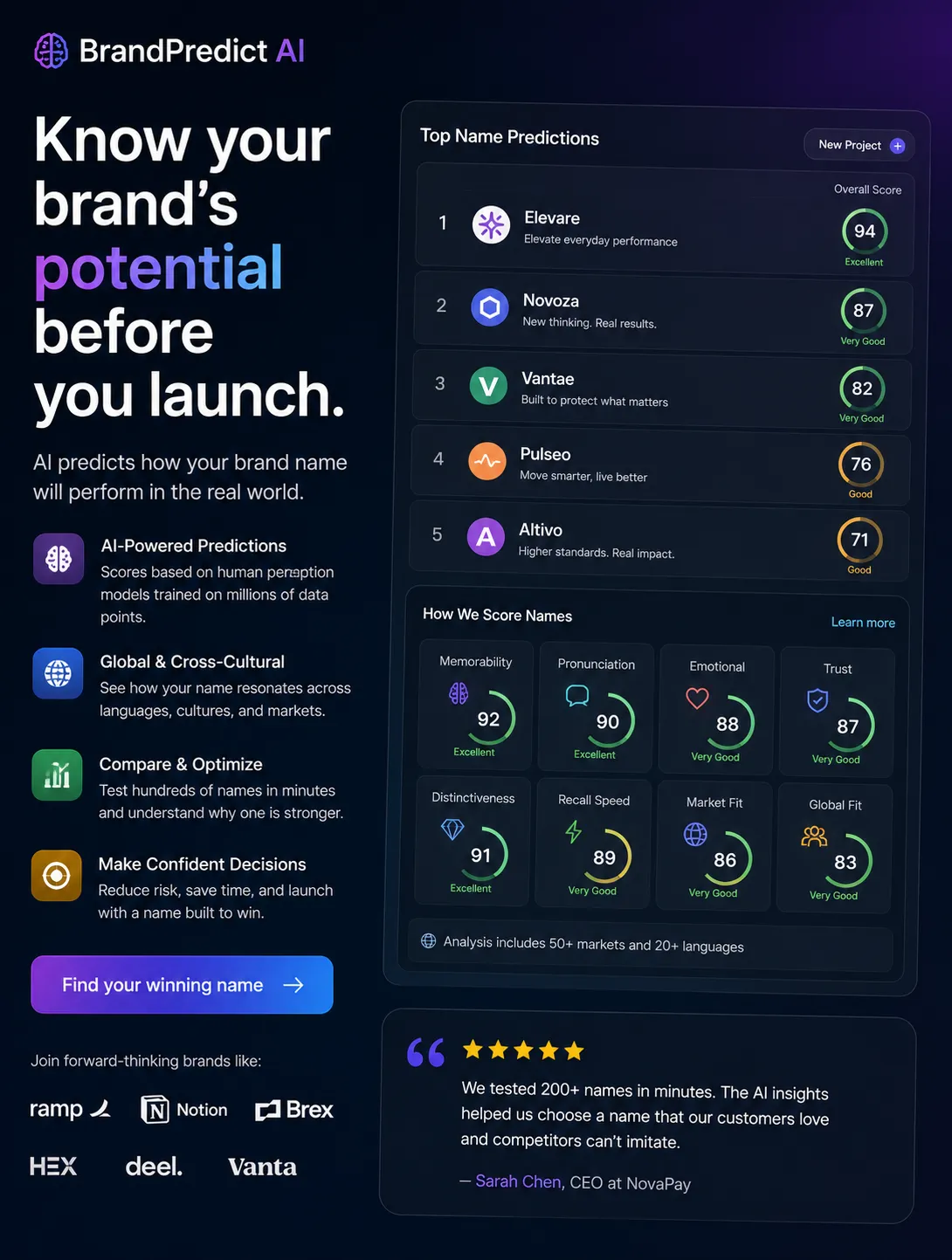
Description
No additional description provided.
The Pitch
A business like this would be compelling because brand names are strange assets: they are cheap to create, expensive to change, and impossible to fully evaluate by looking at them. A weak name does not fail loudly on day one; it quietly taxes every ad, every sales call, every search result, and every word-of-mouth moment that follows. That makes the decision unusually asymmetric. Companies will tolerate paying for better judgment before launch because the alternative is living for years with a choice that compounds against them.
The deeper opportunity is that naming is not really a creative problem; it is a prediction problem disguised as a creative one. People often think they are choosing a name because it “sounds right,” but what they are really estimating is how strangers will process it under conditions of low attention. Will they remember it after hearing it once? Will they spell it correctly? Will it feel premium, playful, clinical, cheap, local, foreign, trustworthy, or awkward before anyone explains the product? If software can model even part of that reaction, it turns a vague boardroom argument into something closer to pre-market signal.
The most interesting wedge is that names are becoming more global and more fragile at the same time. A word that works in one language may sound clumsy, generic, offensive, or unsearchable in another; a name that feels distinctive to insiders may collapse into a sea of similar AI-era brands. As more companies are born online and sell across borders from the beginning, linguistic edge cases stop being rare. The value is not just finding a good name, but avoiding the hidden liabilities that only appear once the brand is already public.
This also works because branding agencies and founders are not necessarily replaced by measurement; they are made sharper by it. The best creative people do not want a machine to name the company for them. They want to stop wasting political capital defending subjective taste. A system that explains why one option is more recallable, more ownable, or more trusted gives creative teams better ammunition and gives decision-makers a way to move past personal preference.
The company that wins this category would not merely be a naming tool. It would become a kind of pre-launch perception layer for commercial language. Names, taglines, product tiers, feature labels, and campaign phrases all share the same hidden question: what will this do in a human mind before the human has context? That question is asked constantly, but today it is rarely answered well.