AI Audience Networking Recommendation Tool
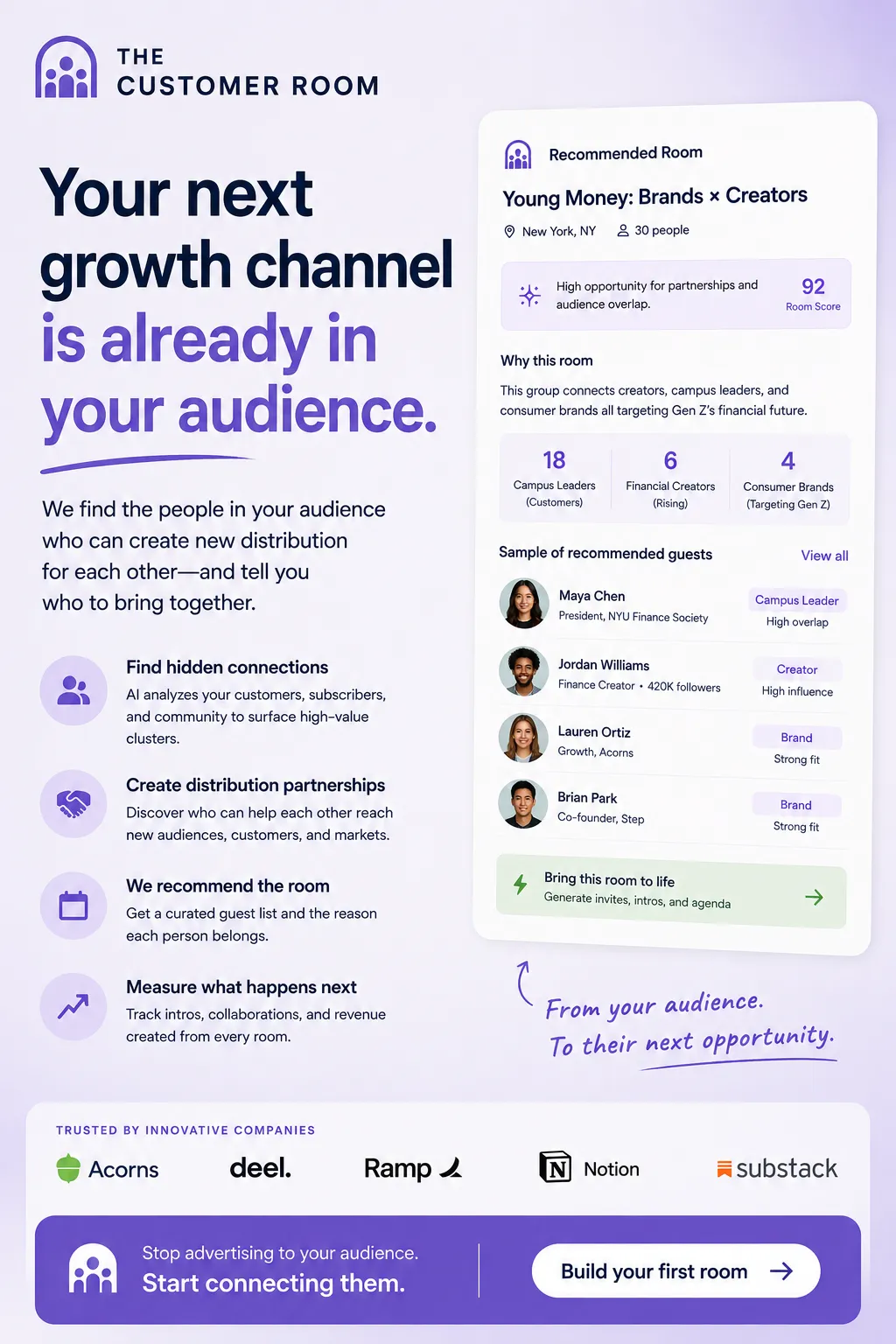
Companies spend millions building customer lists, newsletters, communities, and event audiences, but rarely ask which of those people could become distribution for each other. The Customer Room would analyze a company’s owned audience to identify high-value clusters and recommend exactly who the company should bring together — and why. A fintech might discover 20 customers who run college organizations, eight emerging financial creators, and five brands trying to reach young consumers, then get a recommendation for a 30-person dinner built around partnerships between them. AI can finally understand thousands of audience relationships at once, while rising acquisition costs make owned audiences increasingly valuable beyond simply marketing back to them. The next growth channel may already be sitting in your CRM. The Customer Room tells you who should meet.
Description
No additional description provided.
The Pitch
A company’s audience is usually treated as a list of people to message, not as a map of latent relationships. That is a strangely wasteful mental model. Many businesses already own something more valuable than attention: they own context about thousands of people who share adjacent interests, markets, ambitions, or customers. The commercial opportunity comes from turning that dormant context into intentional introductions.
The powerful insight is that distribution is no longer only top-down. A brand does not merely broadcast to its audience; its audience contains nodes that can broadcast, partner, hire, buy, sponsor, refer, and convene. The most valuable customer may not be the one with the highest lifetime value, but the one who connects ten other valuable people who should have met anyway. Most companies cannot see that because their systems are built to rank individuals, not relationships.
This becomes especially compelling because trust is moving into smaller rooms. People are less persuaded by generic marketing and more persuaded by credible peers in specific contexts: the operator group, the alumni circle, the niche creator community, the private dinner. A business that can reliably assemble the right room gives companies a way to manufacture the conditions where trust forms, without pretending to control the conversation. That is a subtle but important shift: the company becomes useful not by saying more, but by introducing better.
There is also a data advantage hiding in plain sight. CRM records, newsletter engagement, event attendance, job titles, social profiles, purchase history, and community behavior are individually mundane, but together they can reveal commercial patterns no single participant can see. The business works if it can translate that mess into a simple judgment: these people have asymmetric reason to know each other. That judgment is valuable because bad convening is forgettable, while good convening creates stories, deals, loyalty, and status around the host.
The most interesting version of this company would not be another marketing analytics tool. It would be a relationship intelligence layer for companies with audiences large enough to contain undiscovered markets inside them. Over time, the host that consistently makes valuable introductions earns a privileged position: not just as a seller, but as the place where opportunity in a category quietly gathers.