AI Assistant for Personal Financial Recovery
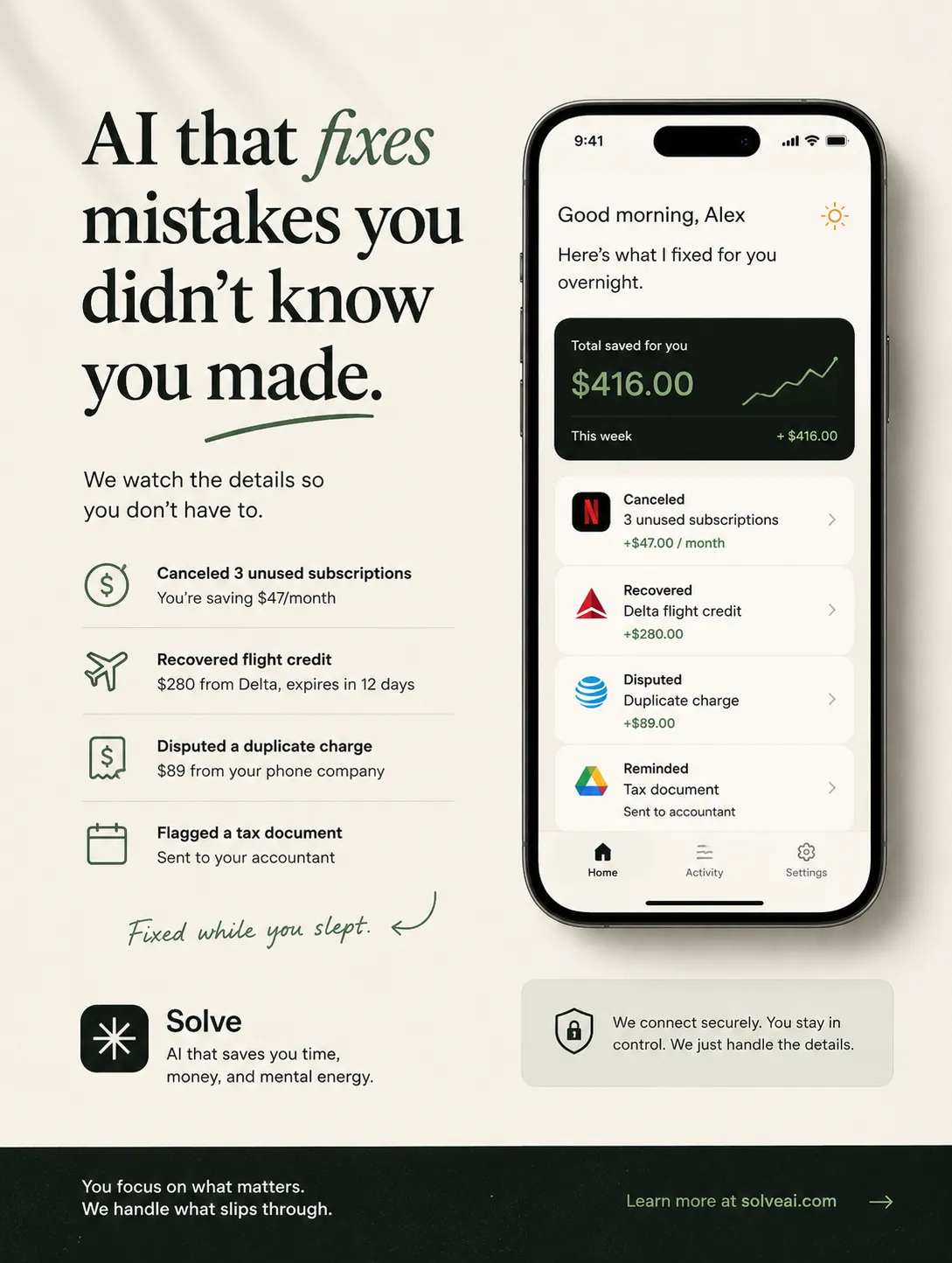
Most AI products ask users to change how they work. The better opportunity is helping people recover from the things they never realized they missed. Imagine opening your phone on Friday morning to a notification that says: “Good news. I found and canceled three subscriptions you haven’t used in six months, recovered a $280 airline credit that was about to expire, disputed a duplicate charge from your phone company, and reminded your accountant about a missing tax document before the filing deadline.” You never asked it to do any of those things. It simply watched for costly mistakes and fixed them. AI models are finally capable of continuously monitoring your digital life and taking action instead of waiting for instructions. Consumers may never pay for another chatbot, but they’ll gladly pay for software that quietly saves them time and money every single week.
Description
No additional description provided.
The Pitch
Modern life creates thousands of tiny financial obligations, but almost none of them are worth managing one by one. A person will not spend Saturday searching for unused subscriptions, expired credits, duplicate charges, reimbursement deadlines, insurance forms, trial renewals, bank fees, benefit elections, or tax documents. Yet together these unattended edges can easily be worth hundreds or thousands of dollars a year. The business works because it turns a pile of chores too small to justify human attention into one continuous job that software can perform economically.
The most interesting part is that the product would not need to manufacture demand. The money is already leaking. That makes the value unusually concrete: recovered dollars, avoided fees, captured credits, prevented lapses. Many consumer apps sell improvement, organization, or peace of mind, which require belief before use. This would sell hindsight made useful. The proof is not a dashboard or a streak; it is the moment someone realizes a problem was solved before they knew it existed.
It also benefits from an unusually durable behavioral truth: people are willing to grant access when the payoff is custodial rather than expressive. They may not want an AI companion reading their life to generate summaries or advice, but they may tolerate deep access if the system behaves like a financial immune system. The permission feels different when the software’s role is to catch mistakes, enforce entitlements, and prevent waste. Trust is earned not by sounding intelligent, but by being boringly correct in moments where the user would otherwise lose money.
The business becomes more powerful as institutions make consumer obligations more fragmented. Every company prefers breakage: unused gift cards, forgotten credits, unclaimed benefits, confusing billing, missed cancellation windows, opaque reimbursements. The individual is structurally disadvantaged because each vendor controls one small maze. A persistent agent that sees across accounts, inboxes, calendars, statements, and documents creates the missing counterweight. It gives consumers the kind of administrative memory that large companies already have.
The enduring company here would not be “AI that helps you manage life.” It would be a new layer of consumer protection, built around the idea that your future self deserves an advocate. The category is compelling because success is measurable, recurring, and emotionally resonant: every recovered dollar feels like evidence that someone competent is finally paying attention.