AI Apprenticeship Network for Professional Judgment
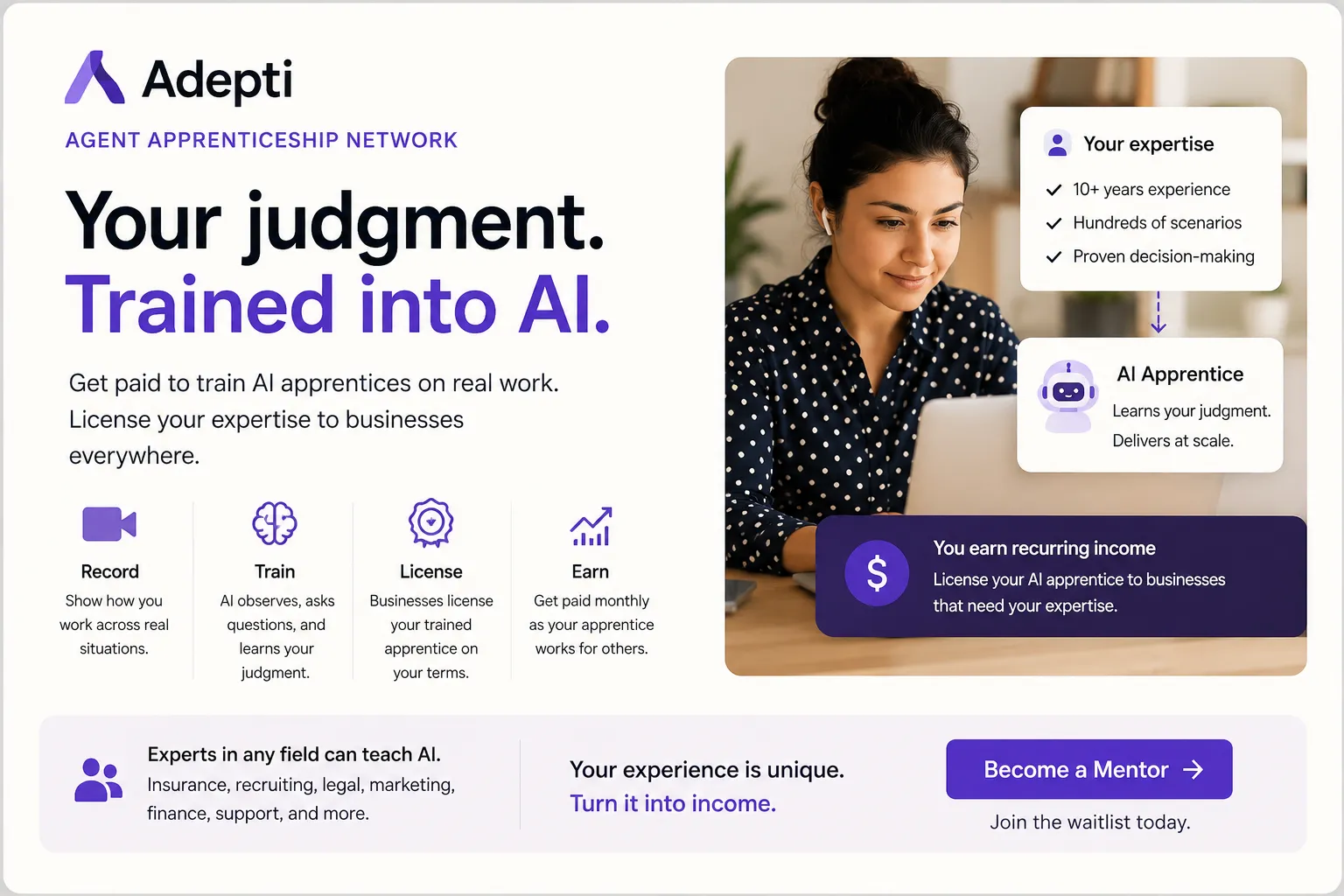
AI agents can learn the steps of a job by watching a screen recording, but they still struggle with the judgment behind the work: when to stop, when to escalate, what looks suspicious, and which exceptions matter. An Agent Apprenticeship Network would pay experienced workers to train AI apprentices across dozens of real scenarios, creating reusable judgment models they could license to businesses. A top insurance adjuster, recruiter, paralegal, or media buyer could earn recurring income from an AI trained on years of their decision-making without becoming a software founder.
Description
No additional description provided.
The Pitch
The valuable part of many white-collar jobs is not the visible workflow. It is the private boundary map inside an expert’s head: which discrepancy is harmless, which customer deserves a second look, which candidate gap is explainable, which claim has the texture of fraud. Companies often discover these boundaries only after hiring, supervising, and correcting people for months. A business that turns expert judgment into reusable training assets would be selling the part of work that is hardest to document and most expensive to learn through mistakes.
The timing is interesting because AI has made execution cheap before it has made taste, caution, and discretion cheap. That creates a strange inversion: the bottleneck moves from doing the task to knowing whether the task was done wisely. In many regulated or high-stakes workflows, a mediocre human with good judgment is still more useful than a fast agent with no sense of consequence. The company that captures judgment as a transferable layer could sit between raw automation and actual trust.
The supply side is unusually compelling because many of the best domain experts are trapped in jobs where their knowledge compounds for their employer but not for themselves. A strong adjuster or recruiter may have seen thousands of edge cases, yet has no product through which that pattern recognition can be monetized. Giving those workers a way to earn from their judgment creates a new class of “expert creator,” but one based on decisions rather than content. The best teachers would not necessarily be famous; they would be the people whose instincts are quietly correct at an unusually high rate.
The defensibility would come from accumulating examples where experts disagree, hesitate, revise, and explain tradeoffs. Clean demonstrations are easy to copy; messy judgment under uncertainty is not. Over time, the network would not just contain recordings of how work gets done, but a living atlas of exceptions: the rare cases, the ambiguous cases, the cases where policy says one thing and experience says slow down. That corpus would become more valuable as AI agents spread, because every deployed agent increases demand for better guardrails.
The business is compelling because it treats human expertise not as something to replace, but as an asset class that can be separated from a single employee’s time. If automation eats routine work, the remaining scarce commodity is judgment with provenance. A market that can source, verify, and license that judgment would make AI more useful while giving experienced workers ownership over the part of their labor that was never properly paid for.