AI Answer Revenue Clearinghouse for Publishers
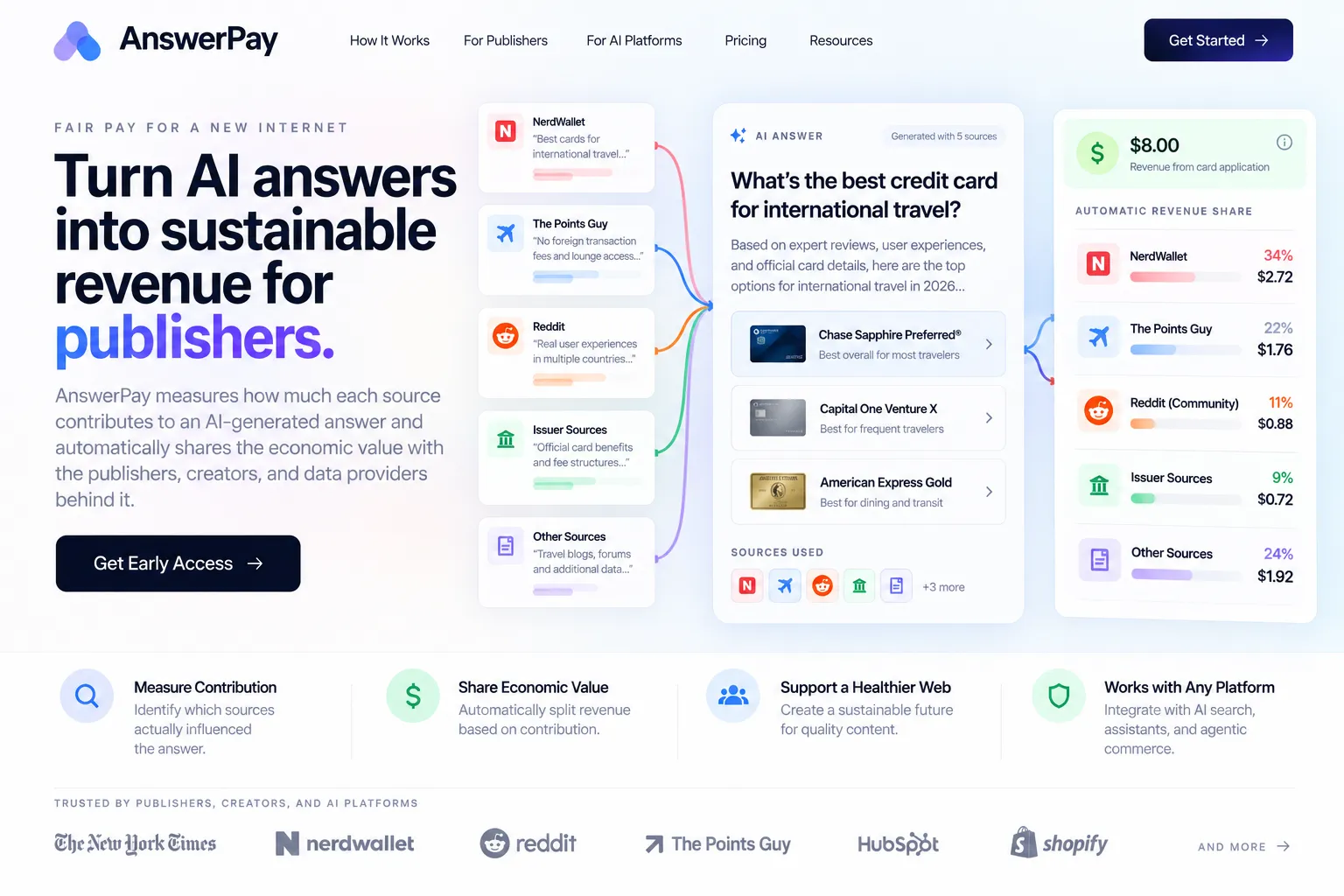
AI answers are increasingly replacing the clicks that once paid publishers, but today content creators are either compensated for access to their pages or not compensated at all. Build a neutral clearinghouse that measures how much each source actually contributed to an AI-generated answer, assigns a share of the economic value created by that answer, and automatically pays the publishers, creators, and data providers behind it. This matters now because AI search is capturing more of the user journey while commerce, affiliate revenue, and paid actions increasingly happen inside the answer itself. Imagine an AI recommending the best credit card, earning $8 from the resulting application, and automatically splitting part of that revenue across the publishers whose reporting, reviews, and data materially shaped the recommendation.
Description
No additional description provided.
The Pitch
This turns attribution from a moral argument into a market mechanism. Publishers currently argue that AI systems owe them because their work was used in training or retrieval, while AI companies argue that value comes from synthesis, ranking, and user experience. A clearinghouse reframes the fight around contribution to a specific commercial outcome. That is a much more durable unit of measurement than page views, links, or vague claims of “content value.”
The timing is powerful because the internet’s old bargain is breaking in a very specific way. Publishers were not only paid by attention; they were paid by the messy sequence of attention becoming intent, intent becoming comparison, and comparison becoming a transaction. AI collapses that sequence into a single answer. If the transaction now happens inside the answer, then the economically important question is no longer “who got the click?” but “whose information changed the decision?” A company that can answer that question becomes infrastructure for a post-click web.
This also works because the highest-value answers are the ones most dependent on trustworthy outside material. In areas like finance, health, travel, law, enterprise software, and consumer reviews, the answer is valuable precisely because someone did expensive work before the user asked: testing products, collecting data, interviewing sources, maintaining databases, building expertise, or earning trust with a niche audience. Generic content may have little claim on the economics, but scarce, decision-shaping information can. The clearinghouse would make that scarcity legible.
Neutrality is not a nice-to-have; it is the product. AI platforms do not want to negotiate thousands of bilateral content deals, and publishers do not want the platforms that displaced their traffic to be the sole judges of what their work is worth. The business becomes more useful as an independent layer that both sides can distrust less than they distrust each other. Its real asset is not just measurement software, but legitimacy: a shared accounting system for a web where answers, not pages, are the main surface.
The deeper opportunity is that compensation could improve the information supply itself. If creators know that original reporting, clean datasets, and high-signal analysis can earn downstream revenue wherever they influence decisions, the incentive shifts away from producing search-shaped filler and toward producing material machines actually need to answer well. That would make the clearinghouse more than a tollbooth. It would be a way to fund the kinds of knowledge that an answer engine cannot cheaply invent but quietly depends on.