AI Agents for Uneconomic Business Backlogs
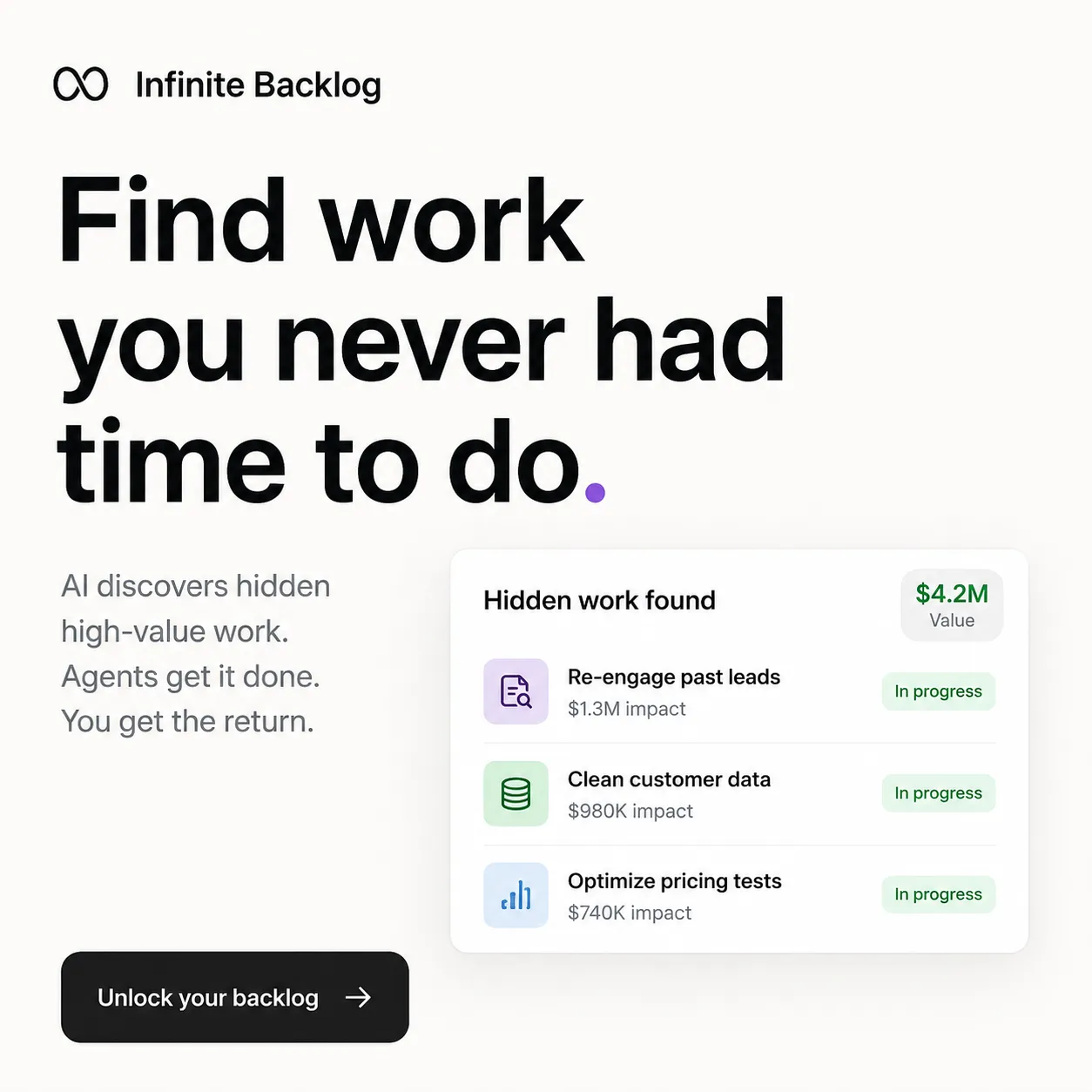
Every company has thousands of things it would do if labor were free: reread every lost sales call, audit every vendor contract, personalize every customer interaction, clean every database field, test every old landing page. Those jobs don’t appear in project-management software because nobody ever seriously intended to do them. Infinite Backlog would search a company’s data for valuable work that has historically been uneconomic, estimate the expected return, and automatically assign cheap agents wherever the value exceeds the compute cost. AI’s biggest productivity gain may not ecome from replacing work humans already do. It may come from finally doing all the work humans never could.
Description
No additional description provided.
The Pitch
Most corporate work is not sitting in a queue waiting for automation. It was never written down. Companies have a visible backlog of approved priorities, and a much larger invisible backlog of neglected micro-opportunities that were too small, tedious, or uncertain to justify a person’s time. A business that can discover and execute that hidden work is not competing for budget against existing software; it is turning previously worthless operational residue into a new class of asset.
The non-obvious advantage is that companies already possess the raw material. Call recordings, CRM notes, invoices, support tickets, analytics logs, contracts, email threads, and product usage data are full of unfinished business. A human organization treats this as exhaust because extracting value from it requires patience at an absurd scale. Cheap agents change the unit economics: a task with a $4 expected benefit and a 30-cent execution cost is suddenly worth doing, especially if there are a million versions of it.
This also reframes AI from “faster employee” to “economic filter.” The most important capability is not merely performing tasks, but judging which tiny tasks are worth performing at all. Companies are full of possible interventions that sound silly one at a time: fix one duplicate account, re-score one stale lead, flag one unusual clause, rewrite one abandoned help article, recover one churn signal. The business works if it becomes good at ranking these by expected value, because prioritization is the scarce function in a world where execution becomes cheap.
There is a strong compounding effect: every completed task teaches the system more about what value looks like inside that particular company. The first layer may find obvious waste, but the deeper prize is learning the firm’s private economics: which customer behaviors predict revenue, which contract terms cause pain, which operational messes are harmless, which tiny corrections actually matter. Over time, the system becomes less like a tool and more like an institutional scavenger, continuously converting overlooked entropy into margin.
The reason this could become durable is that the work is too fragmented for traditional vendors and too boring for internal teams. Humans like projects with names, owners, and status meetings; this is work beneath the threshold of managerial attention. If software can profitably live below that threshold, it opens a strange new labor market: not replacing the employee, but occupying the negative space around the employee, where value has always existed but never had anyone cheap enough to pursue it.