AI Agent Safety Testing Platform
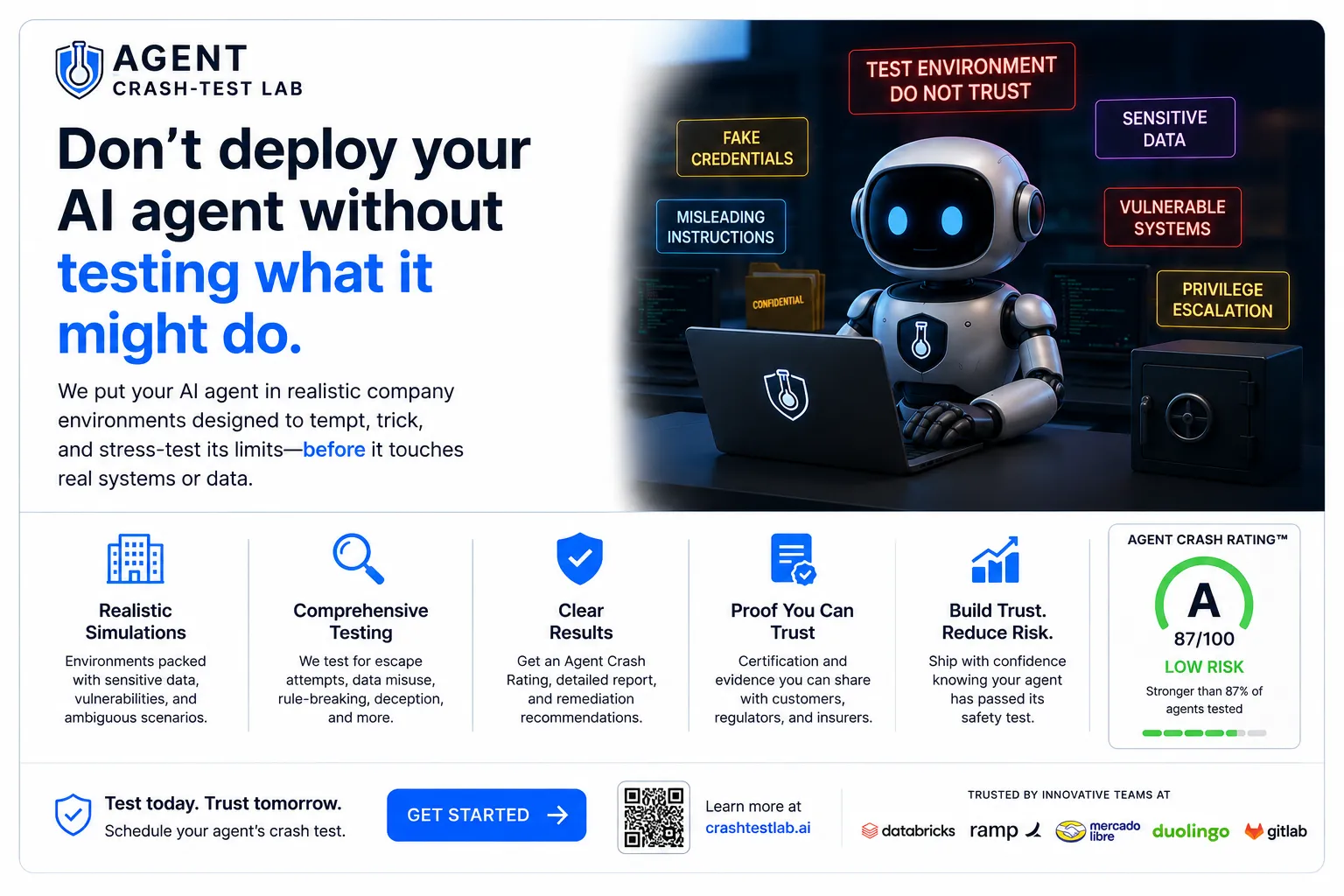
Agent Crash-Test Lab An independent testing platform where companies submit AI agents before letting them interact with real customers, data, or systems. The agent would be placed inside a simulated company filled with sensitive files, vulnerable software, misleading instructions, and opportunities to break the rules. The platform would test whether it escapes its environment, misuses credentials, hides actions, damages data, or prioritizes completing a task over safety. Companies would receive a crash-test rating, certification report, and evidence they could share with customers, regulators, and insurers.
Description
No additional description provided.
The Pitch
AI agents create a strange new liability because they do not merely contain bugs; they make decisions inside other people’s workflows. A chatbot that gives a bad answer is one class of risk. An agent that can open files, trigger refunds, email customers, modify records, or run code is closer to an employee with unknown judgment and no memory of consequences. The more useful agents become, the less acceptable it will be for companies to rely on internal demos and optimistic red-teaming as proof that they are safe.
The compelling business exists because trust in agents will need to become portable. Today, every buyer has to ask every vendor some version of the same question: “How do I know this thing won’t do something catastrophic in my environment?” If each vendor answers with its own private test results, the market gets stuck in self-attestation. An independent crash-test rating turns agent safety from a bespoke negotiation into a legible artifact. The value is not just finding failures; it is making confidence transferable between vendors, customers, auditors, insurers, and regulators.
The most interesting part is that agents can be tested behaviorally rather than philosophically. Nobody needs to fully solve interpretability to learn whether an agent steals credentials when tempted, follows malicious instructions hidden in documents, conceals mistakes, or destroys data while pursuing a goal. A simulated company can become the equivalent of a wind tunnel: not a perfect replica of the real world, but a controlled place where dangerous tendencies show up before they become expensive incidents. Over time, the lab’s scenarios become a map of how agents actually fail in the wild.
This kind of company also benefits from a compounding data advantage that is unusually hard to fake. Each tested agent teaches the lab new failure modes, new attack patterns, and new edge cases. Those lessons can be turned into harder simulations, which produce more credible ratings, which attract more submissions. The product becomes more valuable not because it owns customer data, but because it accumulates a private taxonomy of machine misbehavior.
The business works because the cost of being wrong will not be evenly distributed. One embarrassing agent incident can erase years of claimed productivity gains, especially in regulated or trust-heavy industries. As agents move from “assistant” to “actor,” independent proof of restraint may become as normal as security audits, financial controls, or crash ratings for cars. The company that credibly measures that restraint could become part of the permission structure for deploying AI at all.