AI Agent Quarantine for Production Systems
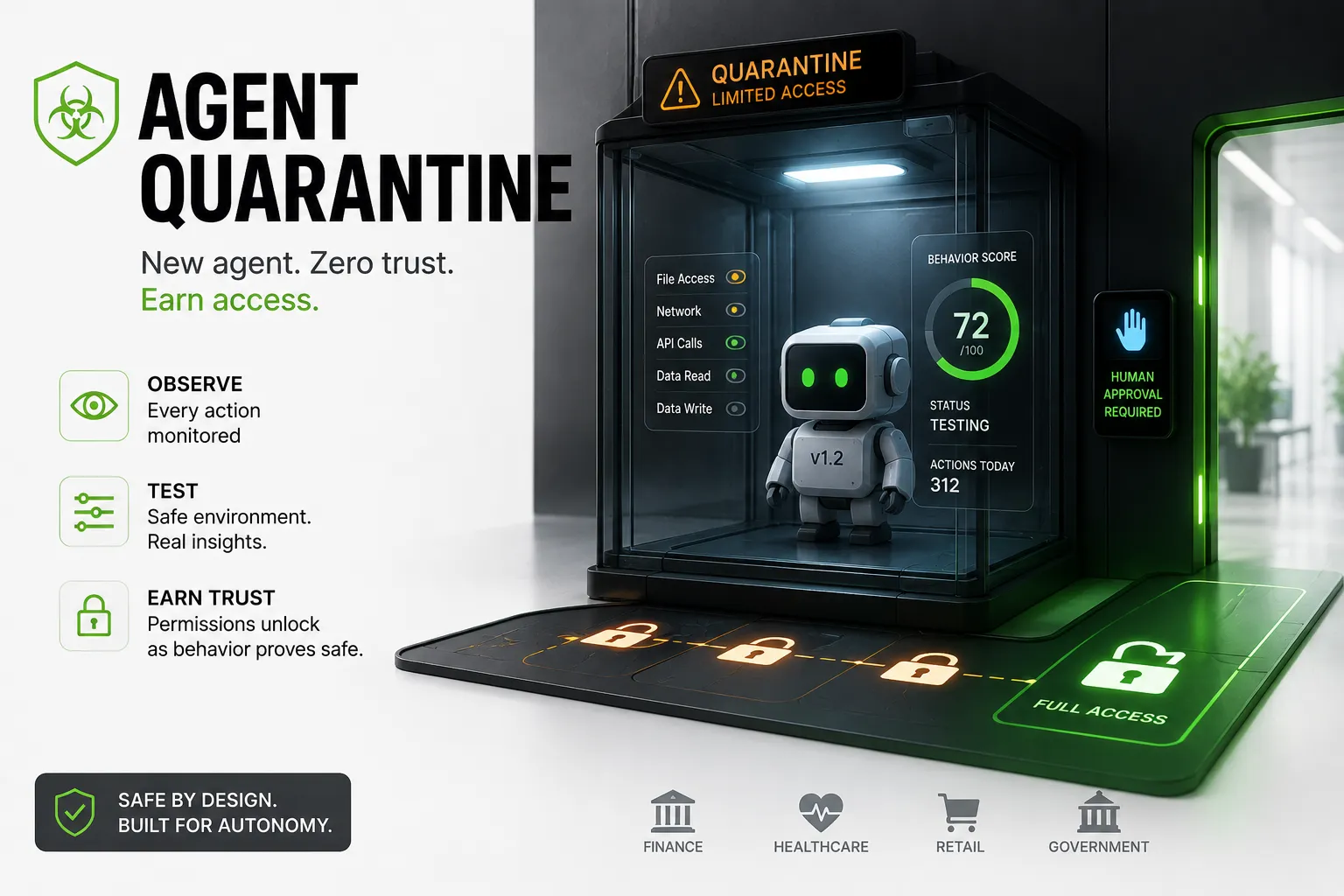
Companies increasingly give newly deployed AI agents credentials and access to production systems without knowing how they will behave across thousands of autonomous actions. Agent Quarantine creates a probationary environment where agents initially operate against replicas, synthetic credentials and monitored systems, earning broader permissions only after demonstrating predictable behavior. The need becomes urgent as agents gain longer-running autonomy and models can change meaningfully after updates, making traditional pre-deployment testing less representative of what happens in production. A company upgrading its procurement agent could automatically quarantine the new version for its first 1,000 transactions, discover that it unexpectedly attempts to contact an outside service, and block the behavior before the agent ever touches real purchasing systems.
Description
No additional description provided.
The Pitch
AI agents turn software risk from a release problem into an employee-behavior problem. Traditional security assumes the dangerous moment is when code ships; with agents, the dangerous moment may be the 400th decision, after a routine prompt, under an unusual edge case, following a model update no one inside the company fully inspected. A business that can observe agents the way companies observe new hires during probation would become more important as autonomy shifts from isolated tasks to sequences of judgment.
The deepest demand would come from the mismatch between how agents are bought and how they are trusted. Business teams will want agents deployed quickly because the productivity case is obvious, while security teams will resist because credentials, APIs, and internal tools were designed for deterministic software or accountable humans. A quarantine layer offers a third path: not “block AI” and not “trust it,” but require the agent to earn its way into the organization’s systems through behavior rather than promises.
This also creates a new kind of security data asset. The valuable record is not just whether an agent passed a test, but how it behaved when faced with ambiguous instructions, tempting shortcuts, permission boundaries, stale context, and adversarial inputs. Over time, the company that sees many agents across many environments could develop a practical map of agent failure modes that model providers, internal security teams, and application vendors do not naturally possess. In a world where the model is often a black box, behavioral history becomes the audit trail.
The business would sit close to a budget companies already understand: access control, compliance, and production safety. But its importance would come from making authorization dynamic. Instead of granting a service account broad permissions because a vendor or internal team says it is safe, permissions could expand, shrink, or expire based on observed conduct. That is a powerful inversion: identity stops being a static badge and becomes a reputation earned through repeated action.
If agent adoption becomes real, the companies that suffer the worst incidents may not be reckless ones; they may be normal companies that treated agents like ordinary software. The category exists because the old boundary between testing and production will blur. The more work agents do, the less credible it becomes to certify them only before deployment. A company built around probation, graduated trust, and behavioral containment would provide the missing institutional ritual for letting non-human workers into serious systems.