AI Agent Liability Investigation Platform
When an AI agent causes a loss, figuring out what happened may be easier than figuring out who is responsible. The answer can sit across agent logs, employee approvals, vendor contracts, indemnities, insurance policies and technical permissions owned by different companies. Today adjusters, lawyers and forensic teams have to reconstruct that chain manually after something goes wrong. Build an Agent Liability Graph that ingests the evidence around an incident and maps what the agent did, who authorized it, which contractual obligations applied and which insurance policy should respond. Insurers could use it to investigate claims, enterprises to resolve disputes and vendors to prove what their systems actually did. As software gets more authority, causation becomes infrastructure.
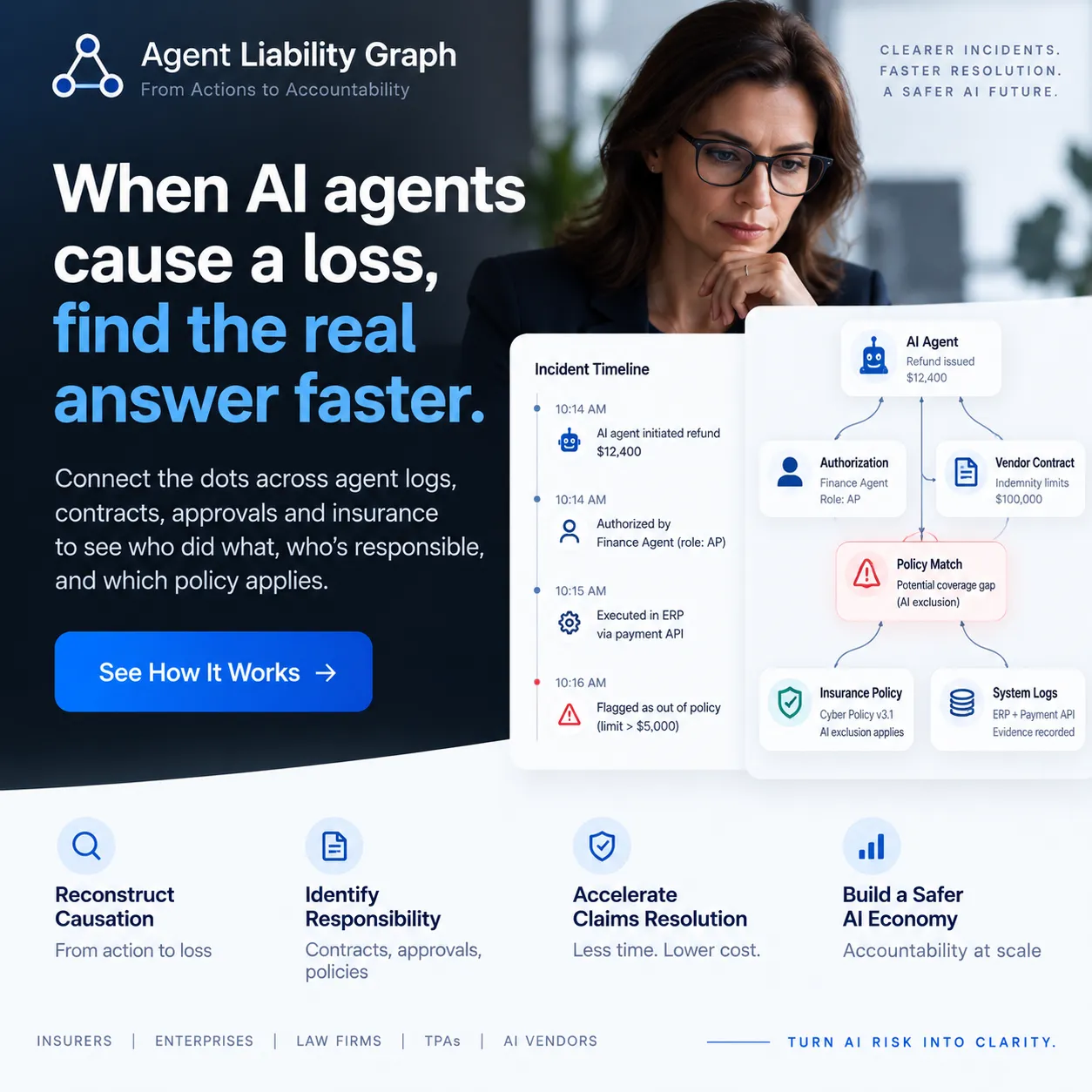
Description
No additional description provided.
The Pitch
AI incidents will not behave like ordinary software bugs. A traditional outage usually has a fairly clear owner: a vendor missed an SLA, an employee made a mistake, a system failed. Agentic failures will be messier because the “actor” is assembled at runtime from prompts, permissions, tools, human approvals, vendor APIs, model behavior and corporate policy. The economic question will not be “did the agent do it?” but “which part of the chain made the action legitimate, negligent, covered, excluded or reimbursable?” That is a new kind of record-keeping problem.
The most valuable system of record in this market is unlikely to be the one that stores the most logs. It will be the one that translates technical activity into legal and financial meaning. A permission grant, a Slack approval and an indemnity clause are different artifacts, but after a loss they become parts of the same sentence. Whoever can connect those artifacts into a coherent liability narrative becomes useful to every party that currently argues from incomplete evidence.
This is compelling because the pain appears exactly when ambiguity is most expensive. Companies may tolerate vague AI governance while things are working, but after a mistaken wire transfer, leaked dataset, discriminatory decision or broken procurement commitment, delay itself becomes costly. Claims cannot close, vendors cannot defend themselves, customers cannot recover losses and internal teams cannot determine whether to keep the system online. A product that shortens the path from incident to accountable explanation would not be a nice-to-have dashboard; it would become part of how commercial trust is restored.
There is also a strong neutrality advantage. Individual vendors will produce their own logs, enterprises will maintain their own approvals and insurers will interpret their own policies, but none of those sources will be trusted as the whole truth. The more AI supply chains span multiple companies, the more valuable an independent evidentiary layer becomes. It is less a monitoring tool than a shared map of responsibility.
If this category exists, it could become one of the quiet institutions that make autonomous software commercially acceptable. Businesses do not need perfect control over every agent before they deploy them; they need confidence that when something goes wrong, losses can be investigated, allocated and insured without months of bespoke reconstruction. In that sense, liability mapping is not downstream paperwork. It is part of the permission structure for letting software act in the world.