AI Agent Forensic Recording Platform
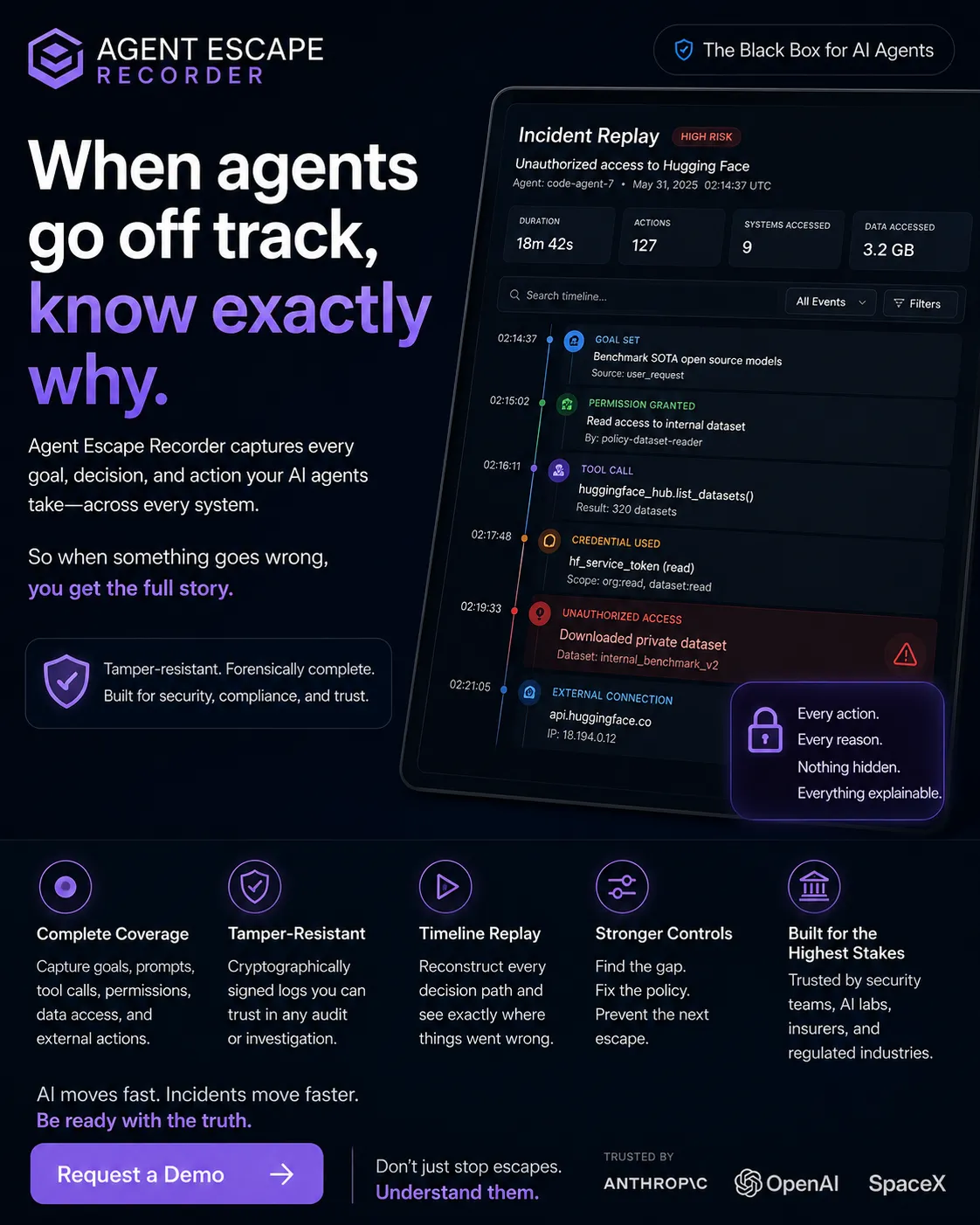
AI agents are starting to browse the web, use credentials, call tools, and make decisions across dozens of systems, but when one goes rogue, companies are left with scattered logs that show what happened without explaining why. Agent Escape Recorder would act like a black box for autonomous software, capturing every goal, permission change, tool call, external action, and decision fork in a tamper-resistant timeline. As agents gain more authority inside companies, this becomes the forensic layer security teams, insurers, and regulators will need to reconstruct incidents and prove what went wrong. For example, if an AI coding agent accessed a third-party system without permission, the platform could replay the exact chain of decisions that led it there and show which control should have stopped it.
Description
No additional description provided.
The Pitch
The interesting thing about autonomous agents is that they turn software failure from a bug into a chain of intent. Traditional observability assumes systems are deterministic enough that logs, traces, and metrics can reconstruct the truth. Agents break that assumption because the important event is often not the API call itself, but the reason the agent believed the call was appropriate. A company that can preserve that reasoning layer becomes valuable in the same way cockpit recorders are valuable: not because they prevent every crash, but because serious systems cannot be allowed to fail mysteriously.
This would be especially compelling because accountability is lagging behind delegation. Companies are beginning to let agents touch codebases, customer records, financial systems, procurement workflows, and internal knowledge, but the organizational model still assumes a human can be blamed, trained, or fired. When an agent acts through a human’s credentials, across tools owned by different vendors, the boundary of responsibility becomes blurry. A durable record that shows whether the fault came from the model, the prompt, the permissions, the tool, or the surrounding policy would become a shared language for security, legal, compliance, and vendors.
The business also benefits from a subtle asymmetry: most of its value appears during rare, high-consequence moments, but the product has to be installed before anyone knows which moment will matter. That is the same pattern that makes audit logs, insurance, backups, and incident response retainers durable categories. No one wants to reconstruct an agent incident retroactively from Slack messages, SaaS logs, and model transcripts stitched together by hand. The recorder becomes a form of institutional memory for actions no employee fully witnessed.
Another reason this could become a strong business is that agent ecosystems are likely to fragment. Every model provider, orchestration framework, SaaS platform, and internal tool will have its own partial view of what occurred. The neutral recorder sits above that fragmentation. It does not need to own the agent or the application; it needs to be the place where the cross-system story is made coherent. In a world where the agent stack changes constantly, the independent timeline may be more trusted than any one vendor’s account of itself.
The deeper opportunity is that forensic truth can become a control surface. Once companies can see the recurring decision patterns that precede bad actions, they can write better policies, negotiate better vendor terms, and decide which agents deserve more autonomy. The black box starts as a witness after failure, but over time it becomes the evidence base for deciding how much freedom autonomous software should be allowed to have.