AI Agent for Replacing Expensive SaaS Renewals
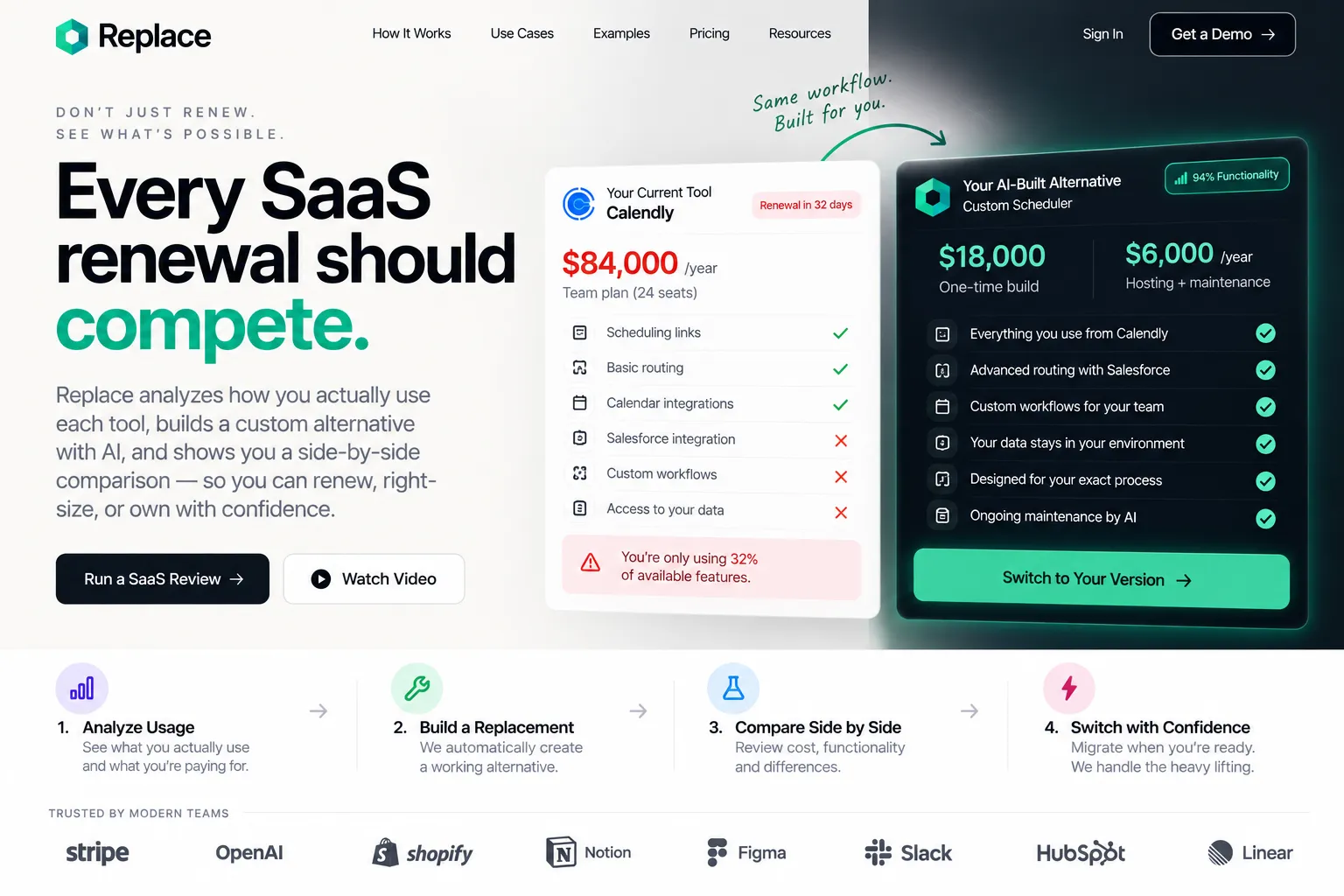
Companies keep renewing expensive software because replacing it has historically meant months of engineering, migration work, and risk, even when they only use a fraction of what they pay for. Build an agent that watches how a company actually uses each SaaS product, identifies when custom software would be cheaper, then automatically builds a working replacement in shadow mode before the renewal decision. This becomes possible now because AI can generate and maintain narrow internal tools fast enough that buying software is no longer always the obvious default. Imagine a company approaching an $84,000 Calendly renewal and receiving a fully functioning custom scheduler that reproduces 94% of what the team uses, adds its proprietary Salesforce routing logic, and costs less than $25,000 to build and run.
Description
No additional description provided.
The Pitch
The interesting shift is that software renewals are becoming less like procurement decisions and more like make-versus-buy decisions with live evidence. Historically, the “buy” side always won because the alternative was theoretical: someone might estimate that an internal replacement would be cheaper, but nobody wanted to fund a speculative rebuild. A system that produces a functioning substitute before the renewal date changes the psychology completely. The company is no longer comparing an invoice against a slide deck; it is comparing an invoice against a usable thing.
The most valuable target is not software that is strategically important, but software that has quietly become infrastructure for a small number of repetitive workflows. Many SaaS products sell broad capability, but companies often settle into surprisingly narrow usage patterns: three approval flows, two calendar rules, one reporting view, a handful of integrations. That gap between what is purchased and what is actually used is where the business lives. The waste is not simply unused seats or shelfware; it is the premium paid for generality when the customer only needs specificity.
This also turns vendor lock-in against itself. The more a SaaS product embeds itself into daily operations, the more data exists about what the replacement must do. Logs, permissions, API calls, workflows, and user behavior become a specification written by the company’s own usage rather than by a product manager’s assumptions. The incumbent’s stickiness creates the map for unbundling it.
The business would be compelling because it attacks spending at the precise moment when companies are most willing to act: just before renewal, when the cost is visible, the pain is fresh, and the alternative can be tested without immediately disrupting anyone. Cost-cutting tools often fail because they ask managers to give something up. This asks a different question: if your team can keep the workflow and remove the rent, why renew the whole package?
Over time, the company would build an unusual asset: a memory of which SaaS products are most commonly overbought, which features are actually used, and which internal replacements survive contact with real employees. That knowledge compounds. It would reveal that the software market is less a collection of indispensable platforms than a stack of rented habits, many of which are now cheap enough to recreate.