AI Agent for Removing Obsolete Code Dependencies
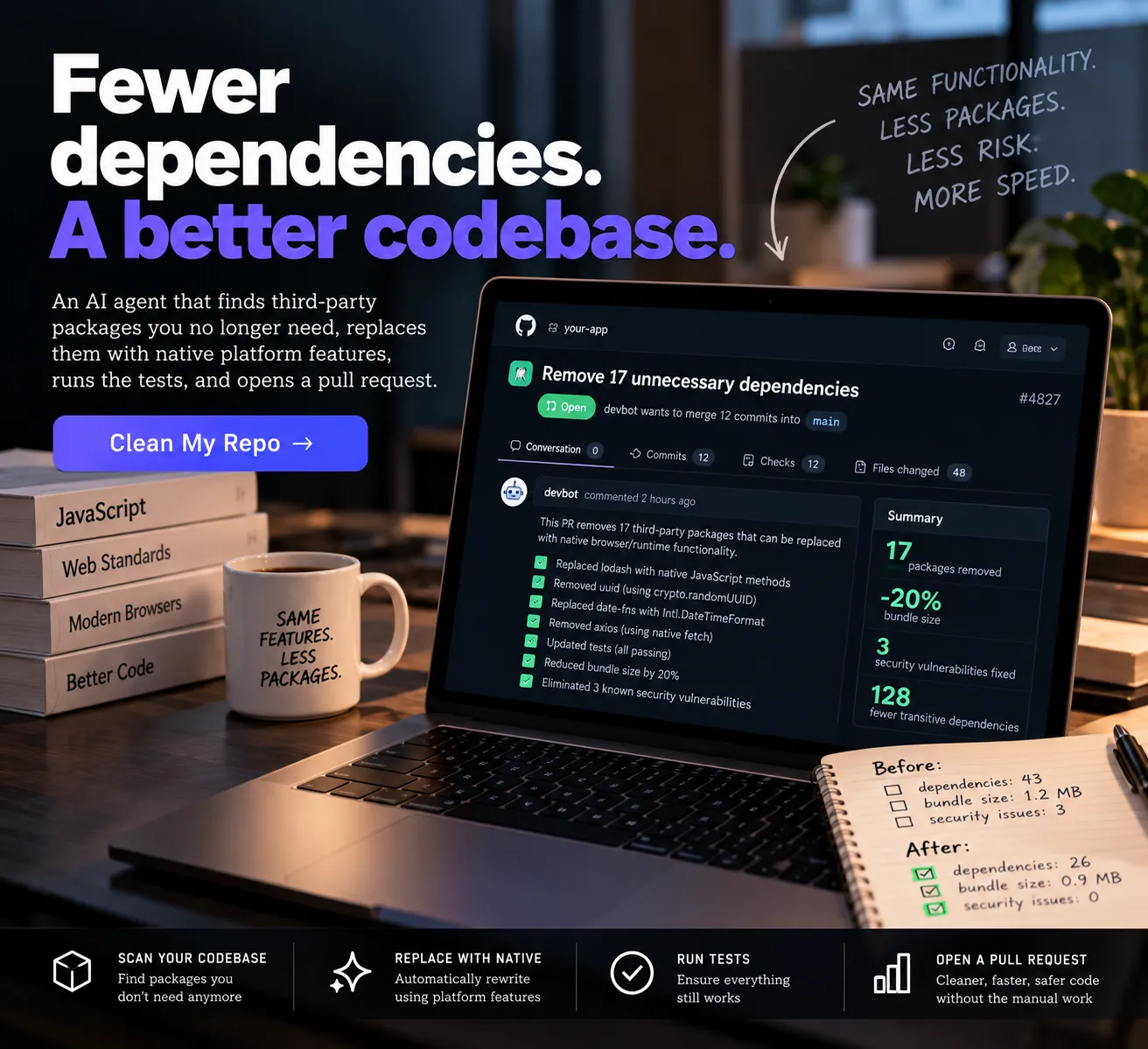
Software teams constantly add libraries, frameworks, and packages to solve problems that browsers and programming languages eventually learn to handle themselves, but almost nobody goes back and removes the old dependencies. Build an agent that continuously scans a codebase for third-party packages the underlying platform can now replace, rewrites the code using native functionality, runs the tests, measures the improvement, and opens a pull request. This matters now because browsers and runtimes are absorbing more capabilities every year while AI coding agents can finally understand how a dependency is actually being used rather than simply checking whether it is installed. Imagine opening GitHub Monday morning and finding a pull request that removes 17 npm packages, cuts your bundle size by 20%, eliminates three security vulnerabilities, and passes every test without an engineer touching the migration. M
Description
No additional description provided.
The Pitch
A strange asymmetry has appeared in software maintenance: teams are willing to spend hours debating whether to add a dependency, but almost never spend equivalent time asking whether that dependency has become obsolete. The result is that software accretes historical decisions long after their original rationale has disappeared. A company that reverses this entropy would be valuable because it turns code modernization from an occasional heroic cleanup into a continuous background process.
The compelling part is that the buyer already feels the pain, but usually misdiagnoses it. Bloated dependency trees show up as security alerts, slow builds, large bundles, license reviews, flaky upgrades, and developer confusion. Each symptom is treated separately, even though many share the same root cause: the codebase is carrying borrowed abstractions that the platform has since absorbed. Removing a package is therefore unusually high-leverage; it can improve performance, reduce attack surface, simplify onboarding, and lower maintenance burden with one change.
This is also a rare case where automation can produce work engineers actively want to review. Most generated code adds surface area, which creates suspicion. Dependency-removal changes move in the opposite direction: fewer files, fewer transitive risks, fewer concepts to understand. A pull request that deletes more than it adds begins with a credibility advantage. The emotional appeal is not “AI wrote code for you,” but “AI made your codebase smaller without asking for a rewrite.”
The business would also benefit from a built-in source of recurring demand. Platforms do not stand still. JavaScript runtimes, browsers, Python, Java, .NET, mobile SDKs, databases, and cloud providers continuously absorb patterns that once required external packages. Every platform release potentially creates a new class of removable dependency. That makes the product less like a one-time migration tool and more like a living interpreter between yesterday’s workarounds and today’s native capabilities.
The deepest insight is that dependencies are not just technical choices; they are frozen snapshots of what the platform could not do at the time. As platforms mature, those snapshots become debt. A company that can safely recognize and retire them would occupy a valuable niche: not helping teams build more software, but helping them stop carrying software they no longer need.