AI Agent for Automated Support Exception Resolution
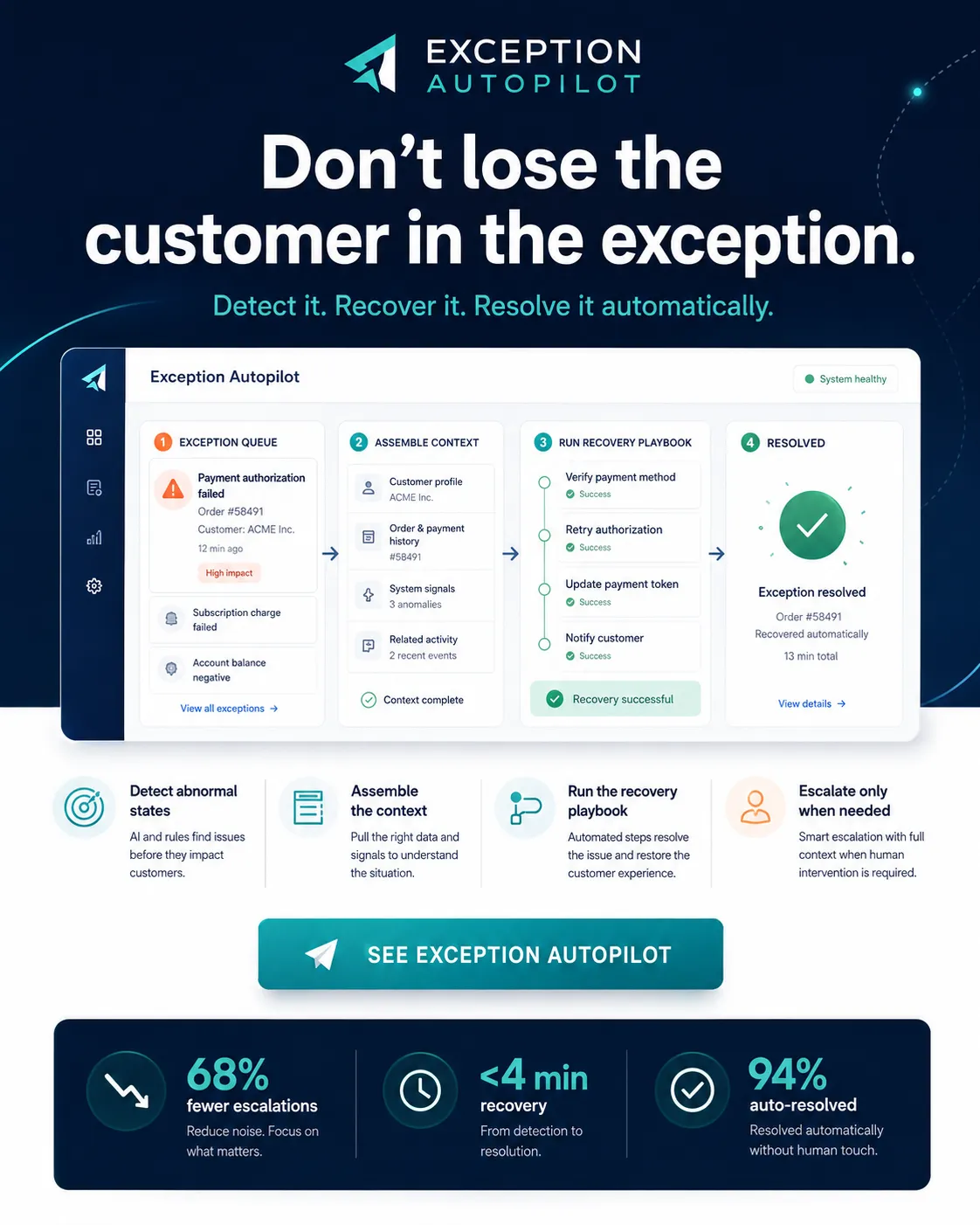
Most software handles the standard workflow well and dumps everything unusual into support queues, where context is lost and resolution time explodes. Exception Autopilot detects when a transaction leaves the happy path, assembles the relevant customer history and system state, chooses the correct recovery playbook, takes permitted actions across systems, and escalates only when judgment is actually required. Why now: AI agents can finally navigate multiple systems and execute multi-step recovery workflows instead of merely suggesting what a support rep should do. Example: a payment fails after an account change. Rather than opening a ticket, the system identifies the failure mode, verifies account state, retries the correct rail, communicates with the customer and closes the exception before it becomes churn.
Description
No additional description provided.
The Pitch
The economic damage from software is no longer concentrated in what it cannot automate, but in what it only half-automates. Companies have spent years digitizing the normal path, which makes the abnormal path more expensive by comparison. A failed payment, stuck order, mismatched record, or policy edge case is rarely a single error; it is a small fracture across several systems. The cost is not just the support ticket, but the accumulated drag of context reconstruction, customer anxiety, manual coordination, and delayed cash movement.
This business would sit in a neglected layer between workflow software and customer support. Existing systems are optimized to enforce rules inside their own boundaries, while support teams are organized around human attention after something has already gone wrong. Exceptions live in the seams: billing talks to CRM, fulfillment talks to inventory, risk talks to payments, and no one system owns the recovery. A company that becomes excellent at recognizing and repairing these seams could become more valuable than yet another system of record, because it would govern the moments when systems of record fail to agree.
The interesting wedge is that exceptions are repetitive without being simple. They look bespoke to a frontline employee because every case arrives with different customer context, timestamps, account states, and partial actions already taken. But underneath, many exceptions follow recoverable patterns. That makes them a strong fit for software that can reason over context while still operating inside bounded permissions. The product does not need to replace human judgment; it needs to prevent human judgment from being wasted on cases where the real work is lookup, verification, sequencing, and communication.
If it worked, the company would also create a rare feedback loop: every exception teaches the business where its underlying systems are brittle. Support tools usually preserve a record of pain; this would create a map of operational failure modes. Over time, the system would know not only how to fix recurring issues, but which upstream processes generate the most expensive exceptions. That turns support from a reactive cost center into a kind of diagnostic layer for the whole company.
The reason this could become durable is that exception handling is deeply contextual. The more recoveries the system performs inside a specific business, the more it learns the company’s policies, customer promises, operational shortcuts, and hidden dependencies. Those details are usually trapped in experienced employees’ heads. Capturing them as executable recovery knowledge would make the software unusually hard to displace, because it would embody how the business actually works when the script breaks.