AI Agent Evaluation Readiness Software
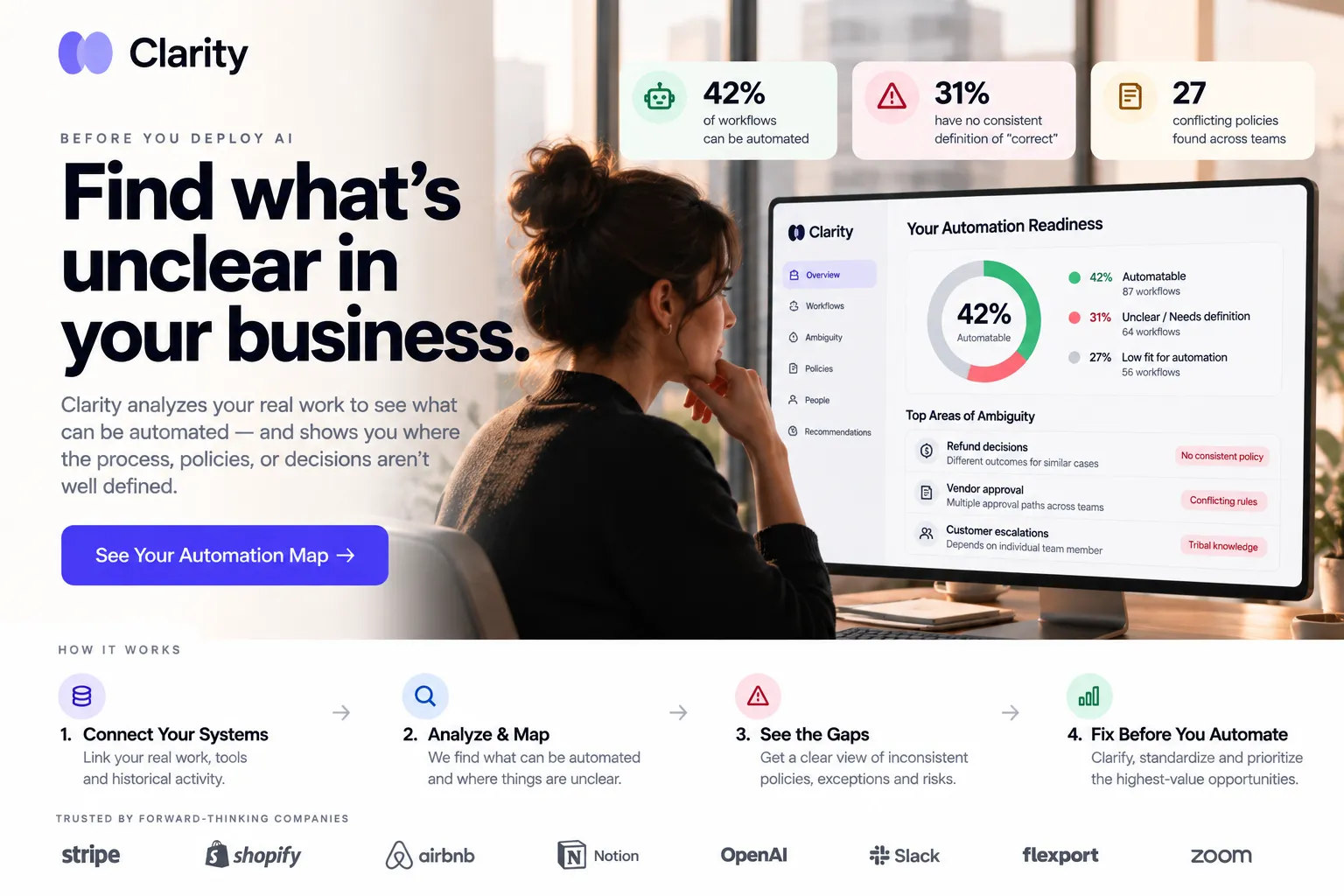
Companies are racing to deploy AI agents, but many discover the real problem isn’t that the agent is bad—it’s that nobody inside the company can consistently explain what the correct answer or workflow actually is. Build software that tries to turn a company’s historical work into an eval suite and, when it can’t determine the right outcome, maps the ambiguity instead. It flags conflicting policies, undocumented exceptions, employee disagreement, unclear ownership, and workflows that depend on tribal knowledge before automation begins. This matters now because every enterprise adopting agents needs evals, and building those evals will expose how much of the business has never been formally specified. Imagine discovering that 31% of your refund workflow has no consistent definition of “correct,” with different teams making different decisions for the same case.
Description
No additional description provided.
The Pitch
It is revealing that many companies have been operating with a false sense of procedural clarity. Before AI, ambiguity was absorbed by people: a support lead remembered the exception, a finance manager knew which rule to ignore, a senior ops employee could interpret the policy in context. Automation removes that human padding. The moment a company asks software to perform the work, it discovers that the work was never fully defined.
That makes this product valuable because it sits at the boundary between automation and organizational truth. Most enterprise software assumes the business knows its own rules and simply needs a system to encode them. In reality, the act of building evals becomes a diagnostic instrument. The company learns not only whether an AI agent is ready, but where its own operating model is incoherent. That is a rare category: software whose first output is not productivity, but self-knowledge.
The timing is especially powerful because AI agents create a forcing function that previous process-improvement tools lacked. Companies could tolerate messy knowledge bases, contradictory policies, and undocumented exceptions as long as humans were the runtime. But agents need examples, expected outputs, edge cases, and decision boundaries. Every failed eval is a small confrontation with institutional vagueness. This turns a vague managerial problem into a concrete artifact: here are the cases where nobody agrees what “right” means.
The business also has unusual staying power because ambiguity is not a one-time cleanup problem. Policies change, teams reorganize, products evolve, regulations shift, and exceptions accumulate again. The eval suite becomes a living map of operational intent, while the ambiguity layer shows where the company is drifting away from its own stated rules. In that sense, it becomes a system of record for how work is supposed to happen, not merely how it did happen.
The deepest insight is that AI readiness and organizational maturity are becoming the same question. A company that cannot specify good outcomes cannot safely automate them. The winners in enterprise AI may not be the firms with the most agents, but the ones that can continuously define, test, and reconcile what good work means. A business that helps them do that would become more important as automation spreads, because every new agent would expose another place where the company has been relying on memory instead of structure.