AI Agent Dependency Risk Mapping Platform
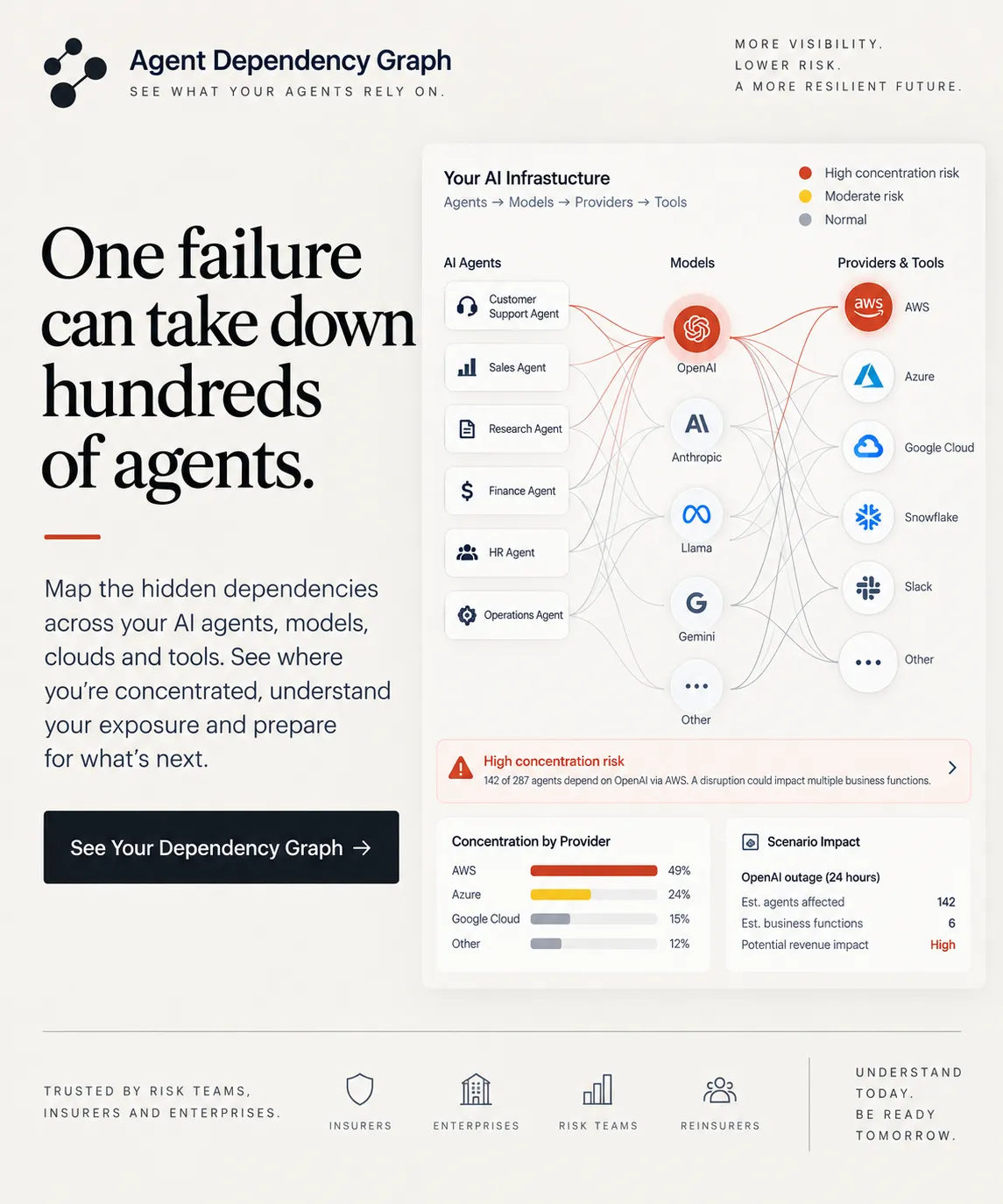
Enterprises may deploy hundreds of AI agents that look independent but quietly rely on the same foundation models, cloud providers, frameworks and tools. That creates a new kind of concentration risk: one upstream failure can hit many companies at once. Insurers and enterprises can see each deployment individually, but rarely see the dependency graph underneath the whole portfolio. Build an Agent Dependency Graph that maps which agents depend on which models, clouds, connectors and tool providers, then shows where exposure is concentrated. Risk teams could use it to understand single points of failure, insurers to price correlated exposure and reinsurers to stress-test systemic events. As agents spread, the hidden question may become less “is this agent safe?” and more “what happens if everything depends on the same few systems?”
Description
No additional description provided.
The Pitch
AI agents turn software supply chains into something closer to financial derivatives: the visible product is not the real exposure. Two companies may appear to run unrelated workflows in unrelated industries, while both ultimately depend on the same model endpoint, vector database, identity provider, orchestration framework, or browser automation tool. The risk is not merely that one agent fails, but that many supposedly diversified bets are secretly the same bet wearing different labels.
The most valuable asset in this business would not be a dashboard; it would be a living map of common-mode failure. Enterprises already document vendors for procurement and compliance, but those records were built for contracts, not contagion. An agent can inherit dependencies dynamically through APIs, plugins, retrieval sources, model fallbacks, and third-party tools that change faster than normal vendor reviews. The company that can observe and normalize those dependencies becomes a kind of credit bureau for AI infrastructure risk: useful not because it knows one firm deeply, but because it sees patterns no single firm can see alone.
Insurers make the opportunity especially interesting because they are forced to care about correlation before most customers do. A business can survive misunderstanding the risk of one customer; an insurer can be destroyed by misunderstanding that many customers share the same upstream trigger. Cyber insurance has already shown how hard it is to price events that do not respect company boundaries. AI agents intensify that problem because failure may come from model behavior, tool execution, policy changes, degraded inference, cloud outages, or compromised connectors, and the losses may manifest as operational interruption rather than cleanly defined breaches.
There is also a timing asymmetry. In calm periods, agent dependency feels like an architecture detail. After a major shared failure, it will feel obvious that every board, insurer, and regulator should have asked for exposure maps. Businesses that become obvious only after a shock are often valuable before the shock, because the early work is mostly about building the language, taxonomy, and baseline data that everyone later needs in a hurry.
The deeper thesis is that autonomy makes dependency more important, not less. As enterprises delegate more work to agents, they are not eliminating operational fragility; they are relocating it into layers they understand less well. A company that reveals those layers would become part of the trust infrastructure for an agentic economy, measuring not whether AI is impressive, but whether its failure modes are unknowingly synchronized.