AI Agent Decision Experiment Lab
The startup idea involves creating a platform that conducts controlled experiments to analyze how AI shopping agents make purchasing decisions, helping brands understand which factors influence those decisions to enhance their competitiveness in an increasingly AI-driven market.
Description
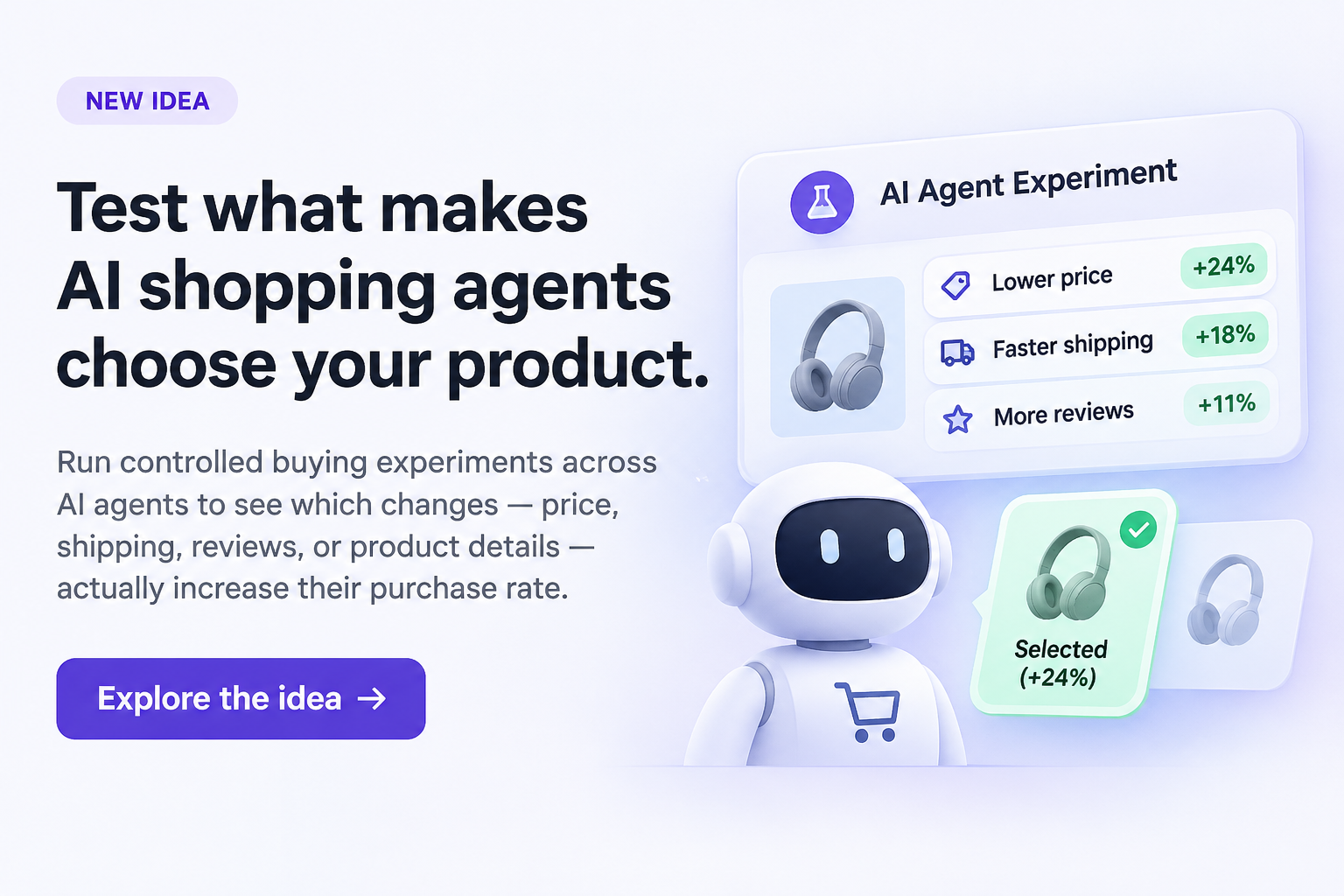
As AI shopping agents increasingly make purchasing decisions on behalf of consumers and businesses, brands face a new challenge: understanding what actually makes an AI choose their product over a competitor's. Traditional marketing analytics can track clicks and conversions, but they can't reliably explain how autonomous agents evaluate competing options. Imagine a platform that runs controlled purchasing experiments across different AI agents to discover which factors influence their decisions. A retailer could test whether lowering prices, offering faster shipping, improving product descriptions, or extending return policies makes AI agents more likely to recommend or purchase its products. The platform would simulate thousands of realistic buying scenarios, measure how each change affects agent selection, and recommend the improvements most likely to increase sales. As more purchasing decisions shift from humans to AI agents, businesses will need new ways to understand and compete for these automated customers. That's a product that needs to exist.
The Pitch
The emergence of AI purchasing agents is redefining the landscape of consumer behavior, creating a rift between traditional marketing strategies and the modern demands of automated decision-making. Businesses are blindsided by this shift; traditional analytics simply cannot capture the nuanced dynamics of how these AI systems evaluate products. This gap creates a desire for a new kind of insight that goes beyond surface-level metrics, making an AI Agent Decision Experiment Lab not just relevant but essential.
By facilitating controlled experimentation among AI agents, this platform can illuminate the criteria that drive their choices in real-time. In a world where milliseconds count and algorithms can pivot the balance of competition, understanding the decision-making engine of AI is crucial. If brands can simulate various buying scenarios and pin down the elements that sway AI systems, they can tailor their offerings with precision that aligns with this automated shopping paradigm. This strategic intelligence shifts the focus from merely competing for human attention to engaging intelligently with algorithms themselves, creating a new frontier in marketing.
Moreover, as AI agents take on more purchasing authority, enhanced adaptability will be vital for retailers looking to maintain relevance. The rapid iteration of these digital agents demands that brands remain one step ahead. Through continuous experimentation, brands can refine their offerings and marketing strategies, leading to more optimized business models that resonate with the needs of AI decision-makers. The capacity for immediate feedback based on real-world simulations gives businesses a competitive advantage, enabling them to pivot faster than rivals who remain anchored in outdated approaches.
This new avenue breaks away from the constraints of traditional customer insights, positioning businesses to engage proactive strategies that resonate in the ever-evolving retail landscape. Embracing a platform that helps brands decode AI preferences not only future-proofs their strategies but also reimagines the interplay between human creativity and artificial intelligence. Ultimately, as we navigate the complexities of a digital-first marketplace, the ability to understand, influence, and compete with AI agents becomes not just a competitive edge—it becomes synonymous with survival.