AI Agent Deal Risk Passport
AI-agent deals are starting to create a strange procurement problem. The contract says who accepts liability, the security review says what the agent can access, and the insurance certificate says what might be covered, but nobody combines the three. A company can sign a deal without realizing that an important failure scenario falls between them. Build an AI Deal Risk Passport that takes the MSA, insurance terms and agent permissions and maps the real risk allocation before the contract is signed. For each major failure case, it shows who is responsible, what coverage applies and where the exposure is still uncovered. Instead of asking legal, security and insurance to reconcile the same deal separately, give everyone one shared view of what happens if the agent gets it wrong.
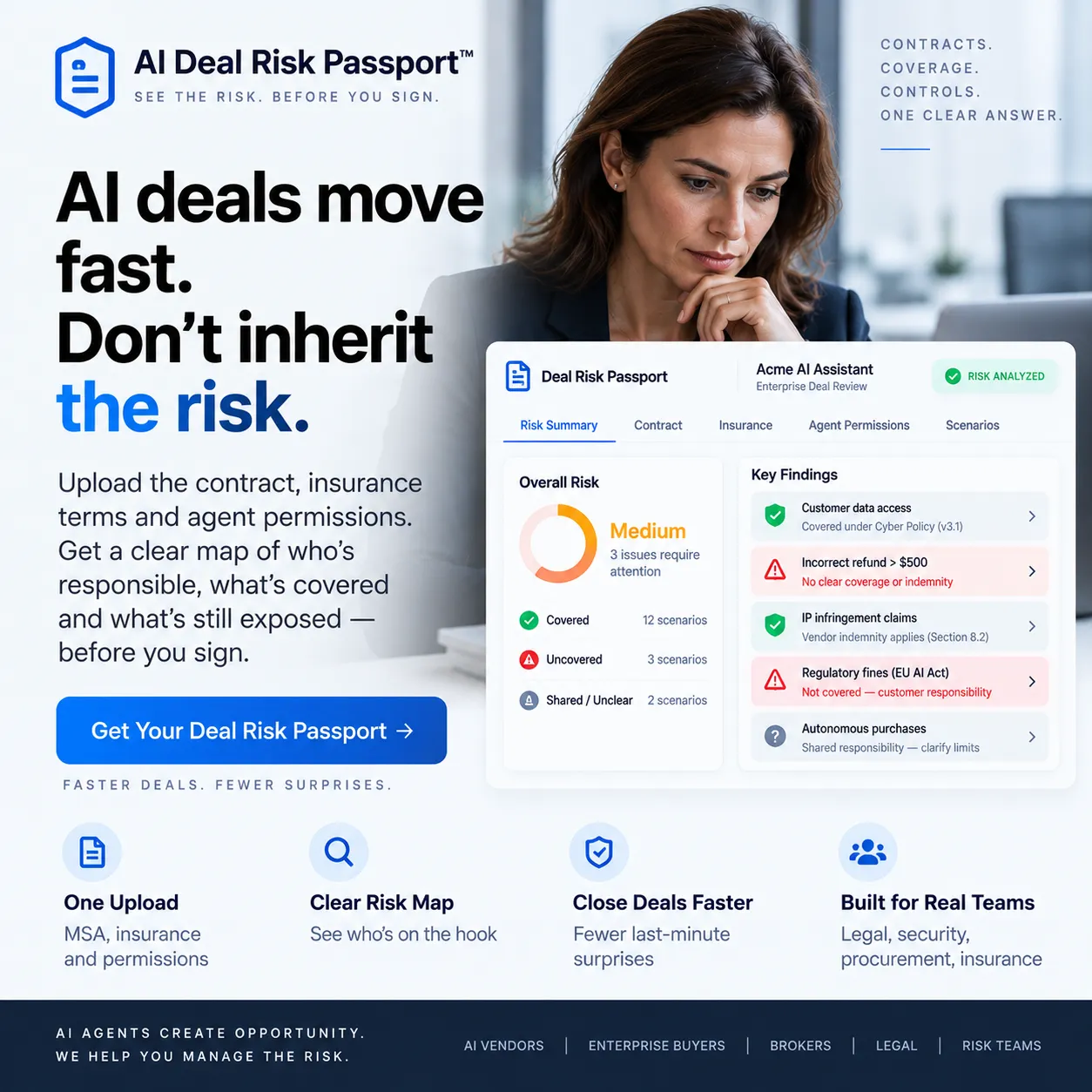
Description
No additional description provided.
The Pitch
AI-agent procurement turns abstract risk into operational risk. Traditional software mostly failed by being unavailable, leaking data, or breaching a warranty. Agents fail by taking actions: approving refunds, changing records, contacting customers, moving money, escalating the wrong case, or exposing information through a tool they were allowed to use. That makes the real question less “is this vendor safe?” and more “when this agent acts inside our business, whose balance sheet is actually standing behind each kind of mistake?”
The unusual opening is that the relevant facts already exist, but they live in documents owned by different teams that rarely reason from the same scenario. Legal reads indemnities, security reads permissions, insurance reads exclusions, and the business owner reads promised outcomes. Each group can approve the deal correctly within its own frame while the company as a whole misunderstands the exposure. A shared risk passport would be valuable not because it adds another review step, but because it reveals the gaps created by separately reasonable approvals.
The timing matters because agent permissions are becoming as important as contract language. In ordinary SaaS, access rights were a security concern; in agentic systems, access rights are also a liability map. The same vendor obligation means something different if the agent can only draft a recommendation versus if it can execute a transaction in production. This creates a new class of deal artifact: not a legal summary, not a security questionnaire, and not an insurance schedule, but a scenario-by-scenario account of what happens when delegated judgment produces damage.
The business could also become a system of record for trust between companies. Once buyers start asking vendors to clarify uncovered failure cases, vendors have an incentive to maintain cleaner permissions, tighter insurance alignment, and more explicit liability positions. Over time, the passport becomes a common language for agent risk in the same way SOC 2 became a common language for controls: imperfect, but useful because everyone knows how to read it.
The deeper insight is that AI agents make risk allocation dynamic. A contract signed six months ago may describe a product that no longer exists in practice if the agent has gained new tools, broader autonomy, or a different workflow role. A company that continuously connects legal obligations to actual agent capabilities would sit at a valuable control point: the place where buyers can see not just what they bought, but what they are now exposed to.