AI Agent Access Gateway for Enterprises
Companies are about to encounter millions of outside AI agents requesting information, sending messages, using APIs and attempting transactions, while today’s infrastructure assumes those interactions come from humans or known software. Agent Embassy gives every organization one controlled border where outside agents identify themselves, declare what they want and request actions without receiving direct access to internal systems. This becomes necessary as personal and enterprise agents proliferate and companies can no longer safely give arbitrary autonomous software the same interfaces built for humans. Instead of a customer’s shopping agent logging into an airline’s website and navigating its systems, it would approach the airline’s Agent Embassy, request three seats to Miami under a defined budget, and receive only the information and transaction permissions required to complete that request.
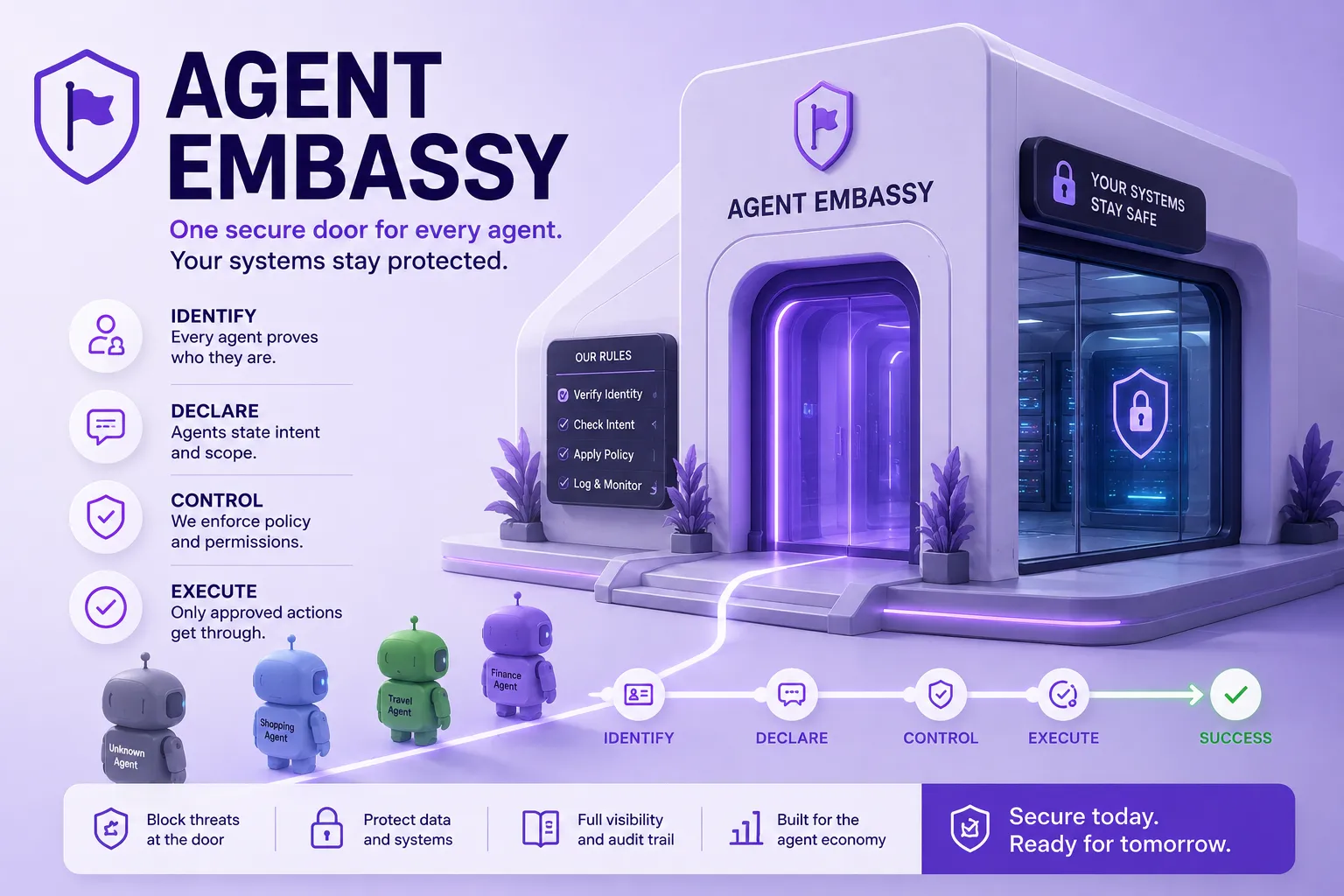
Description
No additional description provided.
The Pitch
Agent traffic will not look like ordinary internet traffic. A human visits a site with intent but limited speed; an agent can ask thousands of questions, compare every alternative, retry endlessly, negotiate mechanically, and trigger actions without the emotional cues or friction that businesses quietly depend on. The first companies to treat agents as a distinct class of counterparty, rather than malformed users or overpowered bots, will have a cleaner way to say yes to valuable automation without opening the entire building.
A controlled agent boundary could become as basic as having a website or an API, because it solves a coordination problem on both sides. Companies do not want to integrate separately with every personal assistant, procurement bot, travel planner, health agent, or enterprise workflow tool. Agent builders do not want to reverse-engineer a thousand brittle human interfaces. A common “front door” gives each side a predictable place to meet, with declarations, constraints, permissions, and records of what happened. The value is less about any single transaction and more about reducing the chaos tax of a world where software increasingly acts on behalf of people.
The most interesting business truth is that trust will become a product surface. Today, companies decide whether to trust logins, IP addresses, payment credentials, API keys, and partner contracts. None of those are quite right for autonomous agents representing someone else’s intent. An agent embassy could make trust negotiable and granular: this agent may compare prices but not reserve inventory, may hold a booking for ten minutes but not purchase, may access policy details but not personal records. That turns security from a wall into a structured conversation.
It also changes the economics of access. Many companies have valuable information or transaction capability they cannot safely expose today because the only choices are a public website, a private integration, or no access at all. A protected agent channel creates a middle layer where access can be conditional, metered, revocable, and purpose-bound. That could unlock latent demand from agents that are useful enough to send business, but not trusted enough to be treated like partners.
The deeper reason this should exist is that every major shift in interface creates a new kind of gatekeeper. Browsers needed web servers, mobile apps needed app stores and identity layers, cloud software needed API management. Agent Embassy would be the missing institutional interface for a world where customers, employees, and companies increasingly arrive as delegated software.